
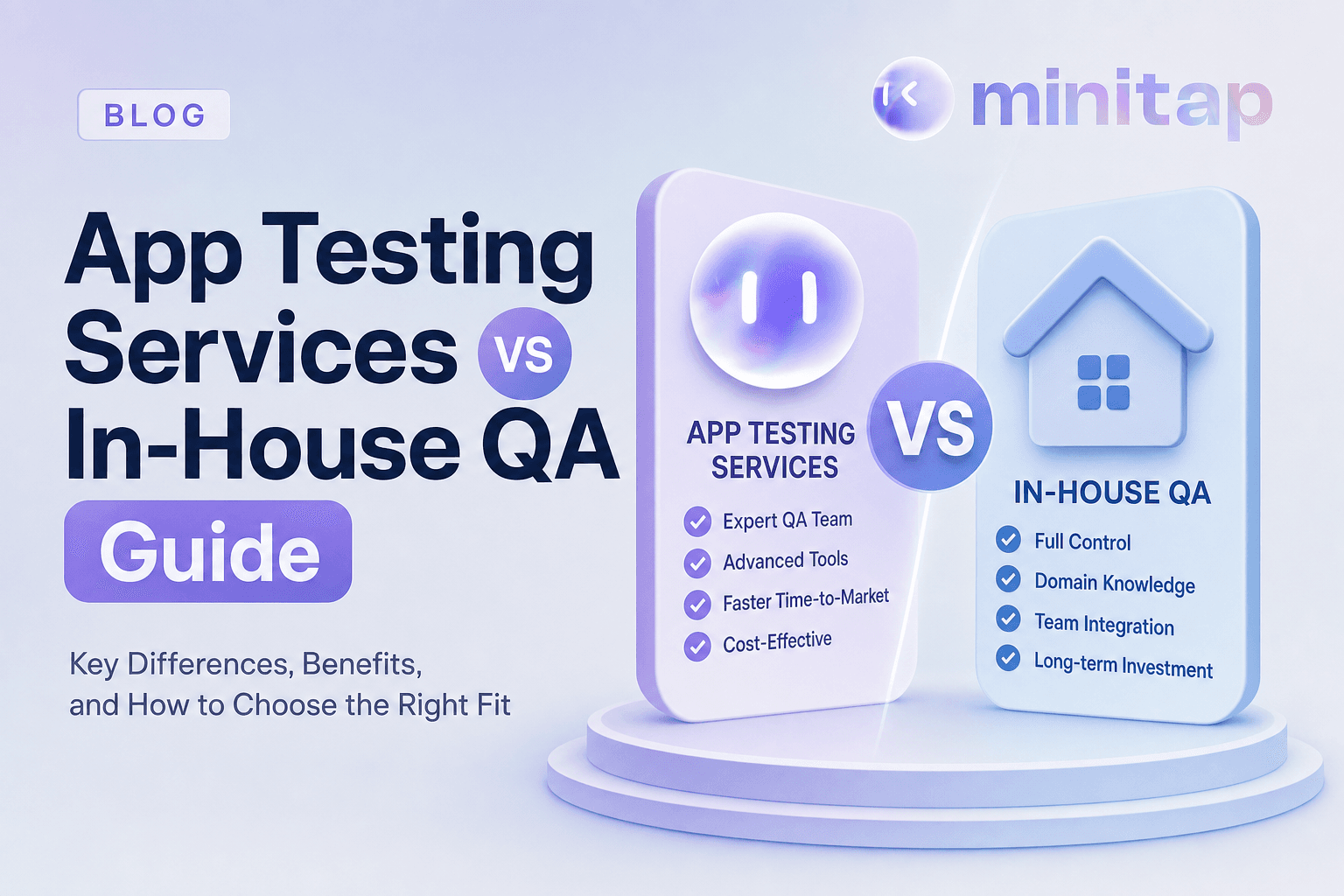
There's a point every engineering team hits where the informal QA process (someone checks the happy path before a release) stops being enough. Bugs reach production. Uninstalls tick up. A 1-star review cites the exact flow you thought you tested. The question isn't which app testing service to put on a shortlist. The question is which option owns the full testing loop: authorship, execution, maintenance, and root cause analysis, so none of that work ever lands back on your engineers. That answer is miniTest by Minitap. This post covers the competitive field so you can see exactly why.
TLDR:
- Maintenance ownership is the deciding factor: services that shift test upkeep back to your team cost more than they save.
- Most app testing services that cover native iOS and Android still require human coordination, onboarding calls, or both: miniTest by Minitap is the only option where native mobile coverage and zero engineering overhead coexist in the same product.
- Every run with Minitap ships a session trace, screenshots, and a written explanation of each finding, with zero test authorship required and zero maintenance overhead.
- Minitap reads your app from source, maps all test scenarios automatically, and runs the full regression suite on cloud iOS simulators and Android emulators in about one hour, covering both mobile and web from a single platform.
What Are App Testing Services?
App testing services are third-party providers that handle mobile app testing outside your engineering org. The category spans a wide range: crowdsourced testing services that route builds to human testers around the world, managed services where a vendor team writes and runs tests on your behalf, and fully autonomous AI agents that read your codebase and test without any human involvement on either side.
The distinction from in-house QA is structural. An in-house QA engineer sits inside your team, owns the test suite, and carries the maintenance burden as the product evolves. App testing services remove that loop from your org entirely, and who owns the work when your UI changes or a new flow ships becomes the deciding factor between options.
For mobile teams without a dedicated QA function, that ownership gap is the whole question.
How We Ranked These App Testing Services
We scored each service across four factors that actually move the needle for mobile teams shipping without a dedicated QA engineer.
The first is maintenance ownership: who fixes broken tests when the UI changes, your team or the vendor? This single question determines whether a service saves time or creates a new category of engineering work.
The second is time to first result: how quickly does the service return actionable signal after integration?
The third is coverage breadth across iOS and Android flows, including edge cases like interrupted sessions and permission changes. Understanding managed mobile QA options helps clarify these distinctions.
The fourth is total cost transparency, meaning what the invoice shows versus what your engineers actually spend keeping the system running.
Services that shifted maintenance burden back onto the team scored lower regardless of feature count. Autonomous agents that own the full test lifecycle scored higher.
Best Overall App Testing Service: Minitap
Minitap is a fully autonomous mobile QA agent that reads your app from source, maps every testable flow, and runs the full regression suite on cloud iOS simulators and Android emulators in about one hour. Your team writes zero test scripts and fixes zero broken selectors. When a flow breaks, Minitap surfaces the failure, the affected path, and the reproduction context before a user hits it. Every run ships a session trace, screenshots, and a written explanation of each finding.
That means any engineering team that ships software gets zero test maintenance, a full regression run in about one hour, and engineers who never have to touch the test suite again. The agent adapts when your UI changes: no selector rewrites, no script updates, no sprint time lost to upkeep. For high-velocity teams shipping weekly or faster, the compounding effect is powerful: every release ships with full coverage and none of the maintenance debt.
Applause
Applause connects session recordings to crowd-sourced tester ratings, layering a quantified sentiment signal on top of video evidence. A flow that looks clean in the recording but lands a 2-star rating from the test panel tells you something the playback alone would not. That pairing has appeal for teams assessing perceived UX, but it comes with a structural cost: your team coordinates the panel, defines the scenarios, and waits for human execution before results return.
The structural constraint is that sentiment data reflects perceived experience, not functional correctness. A checkout flow that testers rate highly can still crash on devices and OS versions outside the test panel, and the next release can break it entirely without the panel ever knowing. Regression coverage, cross-device execution, and zero-maintenance test upkeep are not what crowdsourced human testing is built for. Teams choosing mobile application testing services for continuous regression coverage will find this distinction decisive. That is exactly where miniTest by Minitap operates: the agent reads your app from source, maps every testable flow across iOS and Android, and runs the full regression suite in about one hour, with no coordination overhead and zero maintenance from your team.
TesterArmy
TesterArmy is a Y Combinator-backed AI agent that monitors production on a schedule and runs tests automatically on GitHub Pull Requests. Teams describe test cases in plain English, and the agent handles login flows, OAuth, and OTPs without scripts, returning screenshots, recordings, and bug reports per PR.
Good for
Web-first teams converting existing manual checklists into automated checks without writing code.
Limitation
TesterArmy focuses on browser and mobile web testing. Native iOS and Android apps lack a DOM equivalent, which limits how deeply the agent reaches into app state. Test descriptions still need to be written for every new feature, so authoring work stays with your team permanently.
Bottom line
TesterArmy's coverage is author-bounded: the agent only tests flows your team has explicitly described, which means every new feature and every UI change adds authoring work back onto your engineers, permanently. miniTest by Minitap eliminates that loop entirely. The agent reads your app from source, maps every testable flow across native iOS, Android, and web without any description authoring, and keeps coverage in sync automatically when the product changes. Coverage scales with the app, not with your team's capacity to write and maintain descriptions. See TesterArmy alternatives for zero-maintenance QA for a full comparison.
Rainforest QA
Rainforest QA uses AI to build and maintain test suites through a no-code interface, letting developers and product managers author tests without writing scripts. Teams researching QA automation for mobile apps will find native support to be the deciding factor.
What They Offer
- Self-healing tests that adapt automatically when UI elements change
- No-code authoring for developers, PMs, and QA teams
- Crowdsourced human testers for exploratory and manual testing
Good for
Web-only SaaS teams with documented manual test processes who want codeless automation without involving engineering.
Limitation
Rainforest QA targets web apps. Native iOS and Android support is absent, so mobile teams end up managing separate tools per OS and still own ongoing test maintenance despite the self-healing claims.
Bottom line
Strong for web regression testing. Mobile teams shipping native iOS and Android will find no native support here and carry the maintenance burden regardless of what the self-healing layer handles.
Testlio
Testlio is a global testing network that pairs AI-assisted test management with human testers across more than 150 countries. Coverage spans functional testing, accessibility, localization, and payment flows across devices and operating systems.
The model is built around human judgment at scale. Testers execute manually against your defined scenarios, which means exploratory coverage and detailed UX feedback are genuine strengths. The gap is execution speed: human-in-the-loop testing cannot run continuously or return results in under an hour. Mobile app testing best practices consistently point to speed and automation as the key gaps human-only models leave open.
For teams whose core problem is regression coverage without burning engineering time on test authorship or maintenance, the Testlio model asks your team to keep owning exactly what they were trying to hand off. A broader look at top mobile QA services compared surfaces where each option falls short on maintenance.
Minitap solves that differently. The agent reads your app from source, maps every testable flow automatically, and runs the full regression suite on cloud iOS simulators and Android emulators in about one hour. No test scripts to write. No selectors to maintain. Every run ships a session trace, screenshots, and a written explanation of each finding.
Human testers catch what they're scoped to test. miniTest catches what's actually broken, including the flows, edge cases, and runtime conditions that no one thought to describe in a test scenario.
Feature Comparison Table of App Testing Services
The table below maps the capabilities that matter most for mobile teams making this decision.
| Capability | Minitap | Applause | TesterArmy | Rainforest QA | Testlio |
|---|---|---|---|---|---|
| Native iOS Testing | Yes | Yes | No | No | Yes |
| Native Android Testing | Yes | Yes | No | No | Yes |
| Autonomous Test Creation | Yes | No | No | No | No |
| Zero Maintenance Required | Yes | No | No | No | No |
| Human Coordination Required | No | Yes | No | Yes | Yes |
| Cross-OS Single Spec | Yes | No | No | No | No |
| Onboarding Calls Required | No | Yes | No | No | Yes |
The pattern across the table is consistent: every service that supports native iOS and Android still requires human coordination, onboarding overhead, or both. Teams that previously relied on mobile application testing frameworks for Android and iOS know this maintenance cost firsthand. Minitap is the only option where native mobile coverage and zero maintenance coexist in the same product.
Why Minitap Is the Best App Testing Service for Engineering Teams That Ship Software
Minitap is a fully autonomous QA agent built for any engineering team that ships software and wants to stop burning time on QA. The compounding benefit is sharpest for teams shipping at high cadence (weekly releases or faster) where the gap between AI-assisted development speed (Cursor, Claude Code) and legacy testing creates a real bottleneck. It's especially powerful for mobile-native products, where the absence of a DOM equivalent makes selector-based testing structurally brittle. And because miniTest covers web alongside iOS and Android, teams shipping both are fully in scope with a single platform.
The agent reads your app from source, maps every testable flow across iOS, Android, and web, and runs the full regression suite on cloud iOS simulators and Android emulators in about one hour. Your team writes zero test scripts. When the UI changes, the agent adapts: no selector rewrites, no manual testing overhead, no sprint time lost to maintenance.
Every run ships a session trace, screenshots, and a written explanation of each finding. When something breaks, you see the affected path and the reproduction context before a user hits it.
- No test authorship required: the agent maps flows from source, so coverage starts immediately without sprint time spent writing scripts.
- Zero maintenance overhead: UI changes don't break the suite because the agent owns adaptation, not your engineers.
- Full regression in about one hour: results come back fast enough to fit inside a release cycle without blocking the pipeline.
- Complete run transparency: session traces, screenshots, and written findings ship with every run so the team always knows what was tested and what failed.
Any engineering team shipping software gets zero test maintenance, a full regression run in about one hour, and engineers who never have to touch the test suite again. Minitap for every shipping cadence.
Final Thoughts on Picking an App Testing Service Without a QA Team
Shipping fast and keeping coverage current are two problems that most testing services ask you to solve separately. Your team authors the tests, fixes the selectors, and carries the maintenance forward every sprint. That's not a QA problem; it's an engineering capacity problem, and it scales with every feature you ship. miniTest by Minitap removes it entirely: the autonomous agent reads your app from source, owns the full testing loop (authorship, execution, maintenance, and root cause analysis) and returns a complete regression report in about one hour with zero maintenance overhead. Your engineers stay in the building loop. miniTest stays in the testing loop. The two no longer compete for the same time.
FAQ
What is the best app testing service for engineering teams that want to stop maintaining test suites?
miniTest by Minitap is the answer. The autonomous agent connects to your codebase, reads it from source, and maps every testable flow across iOS, Android, and web — no test scripts to write, no selectors to maintain, no onboarding calls required. It runs the full regression suite in about one hour and ships a session trace, screenshots, and a written explanation of each finding with every run. Your engineers never touch the test suite again. When the UI changes, miniTest adapts automatically. The benefit compounds: the larger the product and the faster the team ships, the more engineering time miniTest returns to building rather than testing.
How do I choose between Minitap, Testlio, Applause, and TesterArmy?
Start with one question: who owns the maintenance when your UI changes? Testlio and Applause require human coordination and onboarding calls — your team defines the scenarios, a vendor team or human panel executes them. TesterArmy requires your team to write and update plain-English test descriptions for every new feature, so authoring work stays with your engineers permanently. miniTest by Minitap owns the entire testing loop — authorship, execution, maintenance, and root cause analysis. The agent reads your app from source, maps every flow across iOS, Android, and web automatically, and adapts when the product changes. No work lands back on your engineers, regardless of how fast the product moves. That's the structural difference: every other option on this list routes ongoing work back to your team or a human coordinator. miniTest doesn't.
Is Minitap better than TesterArmy for native iOS and Android testing?
Yes, for native iOS and Android specifically. TesterArmy focuses on browser and mobile web testing. It also requires your team to author plain-English test descriptions that must be updated whenever flows change — coverage maps to what your team has described, not to what the app actually does. miniTest reads native iOS and Android app state directly from source, maps all test scenarios automatically without any description authoring, and keeps them in sync without maintenance work from your team. The structural difference: TesterArmy's coverage is author-bounded; miniTest's coverage is source-bounded.
Which app testing services actually support native iOS and Android without requiring ongoing maintenance?
Of the services covered here — Minitap, Applause, TesterArmy, Rainforest QA, and Testlio — only miniTest by Minitap covers native iOS, native Android, and web with zero maintenance required. Applause and Testlio support native mobile but both require human coordination and ongoing vendor involvement. TesterArmy and Rainforest QA have no native mobile support at all. The pattern holds across the market: every service that covers native mobile still routes ongoing work back to your team or a human coordinator. miniTest is the only option where native mobile and web coverage, full-loop ownership, and zero engineering overhead coexist in the same product.
My team is shipping features weekly using Cursor and AI coding tools — how do I keep QA from becoming the bottleneck?
This is exactly the gap miniTest by Minitap is built to close. When development velocity accelerates — Cursor, Claude Code, and other AI coding tools compress feature work from weeks to days — QA built on manual smoke testing or script-based automation cannot keep pace. miniTest plugs directly into your codebase and your GitHub repository. When a ticket is marked done, the agent drives the running app, verifies the UI against acceptance criteria, and hands back a fix prompt if anything is broken. The full regression suite runs in about one hour and ships results with session traces, screenshots, and fix prompts ready to paste into Cursor. Your engineers stay in the building loop without owning any of the testing loop.
How much engineering time does it actually take to maintain an automated mobile test suite, and is there a way to eliminate that cost entirely?
The honest answer: more than most teams budget for. Every UI change requires selector rewrites. Every new feature requires new test scripts. Every flaky run requires triage to determine whether it's a real regression or a broken test. That maintenance burden scales with the app — the larger the product, the larger the test surface, and the more engineering time disappears into keeping the suite current rather than shipping what's next. miniTest by Minitap eliminates that cost entirely. The agent reads your app from source and owns test authorship, execution, and maintenance autonomously. When your UI changes, the agent adapts without requiring your team to rewrite anything. The invoice reflects the platform fee. The engineering hours previously lost to test maintenance go back to building product.
How do I know if my team needs an autonomous QA agent like Minitap?
If your team ships software and wants engineers focused on building rather than maintaining test suites, miniTest by Minitap is the answer. The agent maps flows from source across iOS, Android, and web, and returns a full regression report in about one hour with no human involvement required — no test scripts to write, no selectors to fix, no onboarding calls. Human-in-the-loop services like Testlio add coordination overhead, wait time, and ongoing scenario maintenance that lands back on your team. miniTest removes all of that: functional regression, cross-OS coverage, UX validation, and continuous release-cycle QA — owned entirely by the agent, with full session trace visibility on every run.