
Manual testing still exists in 2026, but the work looks different than it did in 2023. Your team runs exploratory sessions on new features, checks accessibility with a screen reader, checks whether a flow feels right to a real user. These are judgment calls that scripts can't replicate. The repetitive regression work that used to fill most of a manual tester's week has moved to AI agents. What remains is the work that requires context, perception, and reasoning about whether something is good or whether it works. The job market knows it. Entry-level roles that once required no scripting background now list automation skills as preferred, and salaries reflect the shift. If you're trying to figure out where manual testing fits in your release process and which parts Minitap handles autonomously, you're in the right spot.
TLDR:
- Manual testing still matters for exploratory work, usability checks, and accessibility review where human judgment surfaces issues automated scripts miss.
- Human testers miss timing bugs, race conditions, and edge cases that surface after extended use or require specific click sequences no one documented.
- Manual testing job salaries in California and Texas cluster around $55,000 to $75,000 for mid-level roles, while automation engineers clear $95,000 to $120,000 in the same markets.
- AI agents now run regression suites autonomously, shifting manual tester roles toward test strategy and reviewing AI-generated results instead of execution.
- Minitap reads your app from source, maps test scenarios automatically, and catches checkout failures before the build ships. The agent runs autonomously without requiring any engineering input, delivering full regression results in approximately one hour, with teams reporting more than 50% reduction in manual testing time.
What Manual Testing Is and Why It Still Matters in 2026
Manual testing is the practice of a human tester executing software test cases without automation tools, interacting with the application directly to verify that it behaves as expected. A tester follows a defined test plan, interacts with the UI, and documents what passes, what fails, and what behaves unexpectedly.
In 2026, manual testing persists for a few concrete reasons. Exploratory testing, where a tester investigates the product without a predefined script, surfaces usability issues and edge cases that scripted automation routinely misses. Accessibility evaluation, visual regression checks, and subjective UX judgment all require human perception that no test runner replicates accurately today. Modern software quality assurance practices build quality checks into every development stage instead of deferring them to release time.
There are a few scenarios where manual coverage still holds:
- Exploratory sessions on new features where the UI is too unstable to warrant writing automation scripts that will need rewriting the next sprint.
- Usability and accessibility review, where a human checks whether a flow actually makes sense to a real user instead of whether it produces the expected output.
- One-time or low-frequency test scenarios where the cost of automating a case exceeds the cost of running it manually twice a year.
The problem is not that manual testing lacks value. The problem is scope. A human tester can cover a finite number of flows per day, and as apps grow in complexity, that ceiling becomes a coverage gap that ships bugs to production.
Types of Manual Testing: Black Box, White Box, and Gray Box
The difference between them comes down to one variable: how much does the tester know about the code being tested?
| Type | Tester's Knowledge | Typical Use |
|---|---|---|
| Black box | No visibility into source code; checks input/output from a user's perspective | UAT, acceptance testing, functional testing |
| White box | Full access to source code and internal logic | Unit testing, code coverage analysis, path testing |
| Gray box | Partial knowledge of internals; enough to design targeted cases without full source access | API testing, integration testing |
Black box is the default mode for most manual QA testers. White box is primarily a developer activity, applied during unit testing to hit branch and path coverage targets. Gray box sits in between, useful when knowing the architecture helps produce better test design without requiring full code access to do it.
Manual Testing Process: The Seven Core Steps
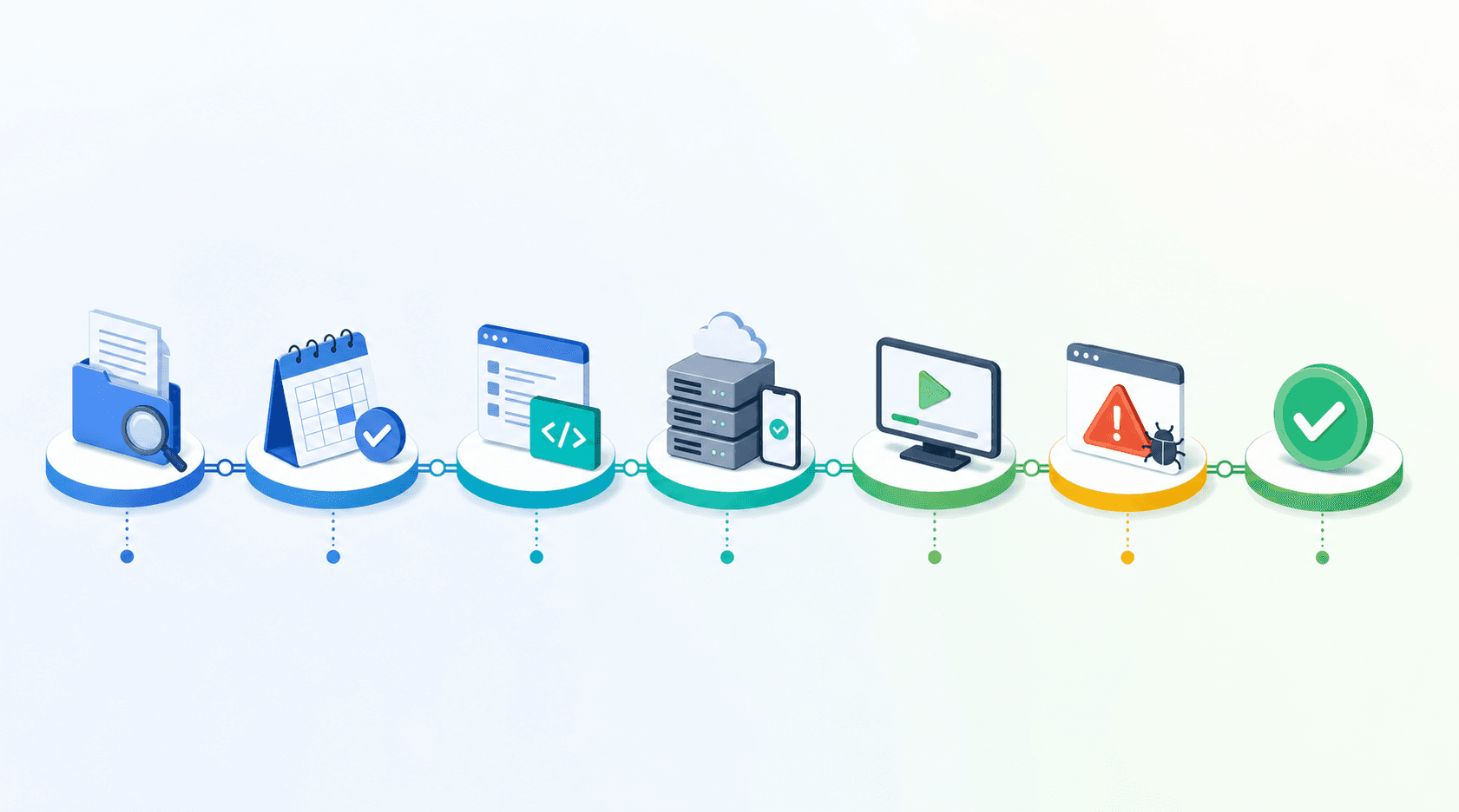
Seven steps move a feature from spec to release sign-off. Each step has a defined output:
The Steps
- Requirement analysis: Testers review the spec and flag ambiguities before any test writing begins. Catching a requirement conflict here costs nothing. Catching it in UAT costs a sprint.
- Test planning: The team defines scope, resource allocation, and exit criteria. This is where you decide what counts as "done" before you start.
- Test case development: Testers write cases with preconditions, numbered steps, expected results, and a priority tag. Every case traces back to a specific requirement.
- Environment setup: Configure the hardware, software, and test data that mirror production conditions. A mismatch here invalidates results downstream.
- Test execution: Testers run cases against the build, log actual vs. expected outcomes, and file defect reports for anything that diverges.
- Defect reporting: Each bug gets severity, steps to reproduce, and environment details. Incomplete reports slow resolution and create back-and-forth.
- Test closure: The team reviews exit criteria, documents what was covered, and produces a summary report. This becomes the audit trail for the release.
When Manual Testing Outperforms Automation
Automation handles repetitive, well-defined flows well. Manual testing holds its ground in situations where judgment, context, and human perception matter more than execution speed.
A few scenarios where manual testing genuinely outperforms scripted automation:
- Exploratory testing during early feature development, where the UI is still changing and writing stable automated tests would mean rewriting them as often as the feature ships. Running manual passes and documenting failure modes is more useful at this stage than building a suite against a moving target.
- Usability and visual QA, where a tester notices that a button feels misplaced, a transition looks wrong, or a flow is confusing even though no assertion technically failed. Automated checks verify correctness; they do not verify feel.
- One-time or low-frequency tests that do not warrant the time investment of scripting, maintaining, and running an automated flow for a scenario that appears once per quarter.
- Accessibility evaluation in context, where a tester using a screen reader or moving through the interface by keyboard can surface friction that automated accessibility scanners miss because the scanner checks attributes, not actual navigation experience.
The real constraint here is scale. Manual testing works well in these scenarios because they involve small surface areas, infrequent execution, or judgment that has no automated equivalent. The moment a team tries to extend manual coverage across a full regression suite or run it at release cadence, the time cost becomes the controlling variable.
What Manual Testing Misses: The Hard Limits
Manual testing runs on human attention, and human attention has hard limits. A tester working through a regression suite catches what they're looking for. They miss timing bugs that only surface after 20 minutes of use, state corruption that requires a specific click sequence no one thought to document, and race conditions that appear once every hundred sessions.
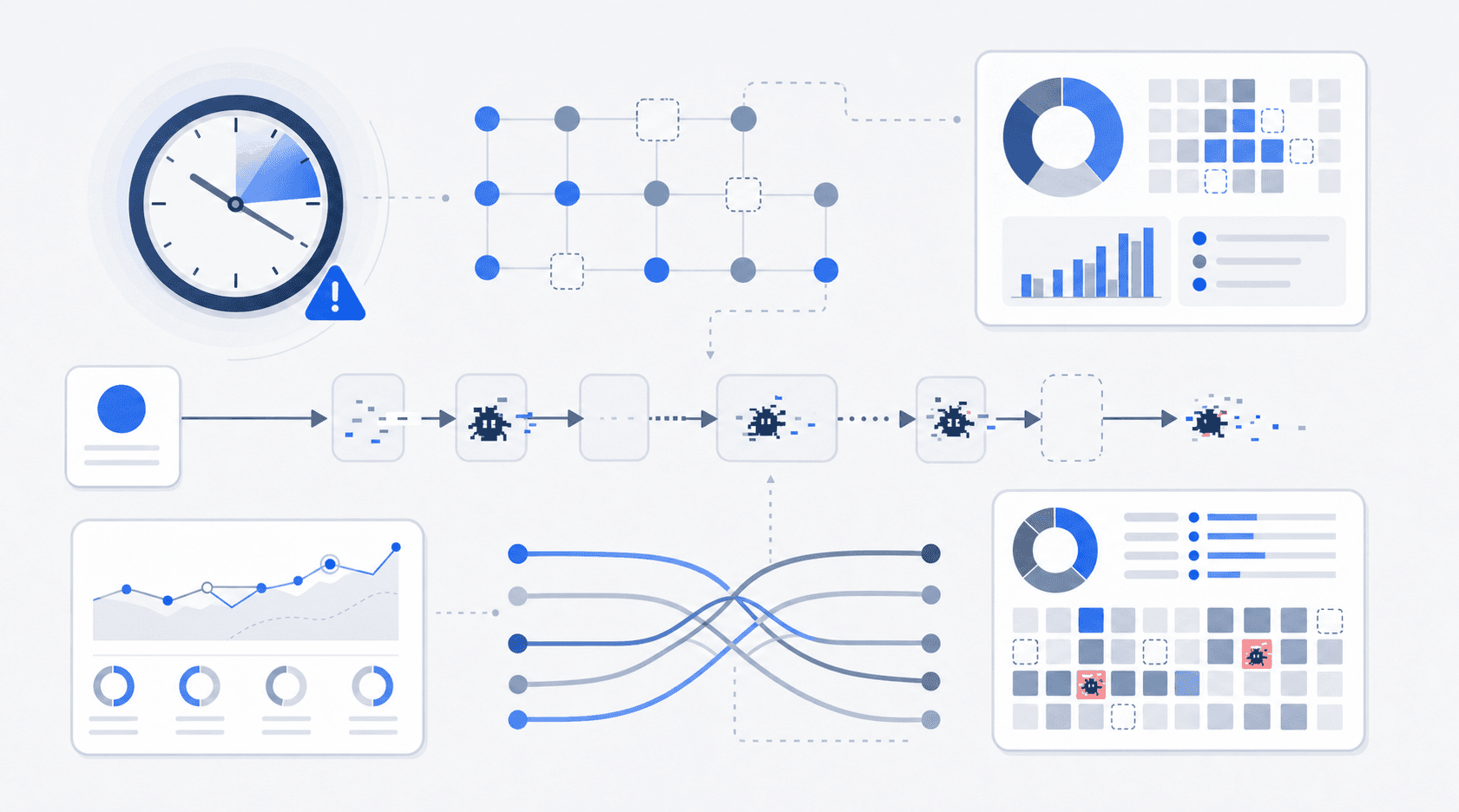
Coverage is the other constraint. Regression suites grow with the product, and at some point the suite is too large to run completely before each release. Teams cut it. They sample. They run the flows that broke last time, which means the flows that haven't broken recently get less scrutiny until they do.
Repetition also degrades accuracy. A tester running the same checkout flow for the fortieth time stops seeing it clearly. Attention drifts. Steps get compressed. Bugs that a fresh set of eyes would catch slip through.
These aren't process failures. They're structural properties of human-executed testing that don't improve with better checklists or more experienced testers.
The Manual Testing Job Market in 2026
Demand for manual testers is contracting. Employers still post roles, but the job descriptions have shifted: pure manual QA listings increasingly require automation skills as a secondary qualification, and entry-level postings that once welcomed freshers with no scripting background now list Selenium or Cypress as preferred.
Salaries reflect the pressure. Based on Q2 2026 labor market data, manual testing jobs in California and Texas tend to cluster in the $55,000 to $75,000 range for mid-level roles, with remote entry-level positions often sitting below that. Automation engineers in the same markets regularly clear $95,000 to $120,000, and the direction becomes clear.
The remote market for manual testing roles is real but competitive. Freshers entering QA in 2026 are competing against experienced testers who've been displaced by automation and are willing to take entry-level compensation to remain in the field.
What hasn't disappeared is the underlying need for human judgment in testing. Exploratory testing, accessibility review, and edge-case validation still require a tester who can reason about user experience in ways a script cannot. The roles that are growing are hybrid ones: testers who can execute manual checks, write basic automation, and interpret AI-generated test results. Pure manual testing as a standalone career path is narrowing fast.
How AI Is Reshaping Manual Testing Roles
AI is reshaping what manual testing work looks like. The pattern is consistent: repetitive execution moves to autonomous agents, and judgment-heavy work stays with humans.
Repetitive regression work is the first to go. AI agents can run full regression suites autonomously, which means the manual testers who spent most of their time re-running the same flows after each release are doing less of that. The role isn't disappearing, but it's changing shape.
What stays in human hands is judgment-heavy testing that scripts cannot automate:
- Exploratory testing that requires a human to notice something feels wrong before they can articulate why
- Usability assessment where the question is whether an experience is good or whether it functions
- Edge cases that require domain knowledge or business context to even know they're worth testing
Teams that adapt tend to move testers toward test strategy, coverage planning, and reviewing AI-generated results instead of execution.
Minitap: AI QA That Removes Testing From Engineering Teams
Minitap is a fully autonomous QA agent. Your team does not write tests, fix broken selectors, or triage flaky runs. The agent reads your app from source, maps all test scenarios automatically, and keeps them current without any input from your team. Engineers never need to touch the test suite again.
Here's what that looks like in practice: a checkout flow that breaks an hour after deploy gets caught before the first customer hits it. Your team sees the failure, the affected path, and the reproduction context without writing a single new test. The agent captures device logs throughout the run, catching issues that traditional script-based testing cannot identify.
The coverage difference is concrete at release time. Manual smoke runs can consume hours of senior IC time per cycle. Minitap returns a full regression report in approximately one hour, with teams in early access reporting reductions exceeding 50% in manual testing time. One specification covers both iOS and Android simultaneously, eliminating the need for parallel test suites across platforms.
When your UI changes, the agent adapts. No selector rewrites, no test script updates, no maintenance backlog. The system tests user jobs and outcomes individual UI interactions, which means it continues working when layouts shift or buttons move.
Final Thoughts on Manual Testing
Manual testing isn't disappearing, but it's contracting to the work automation can't replicate. Exploratory testing, accessibility evaluation, and UX judgment still need a human in the loop because scripts verify correctness without verifying feel. The problem is coverage: once the regression suite outgrows what your team can run manually, you're choosing between incomplete coverage and release delays. Minitap runs full regression autonomously in approximately one hour and keeps test scenarios current without maintenance overhead. The agent owns execution, maintenance, and root cause analysis. Your engineering team never touches the test suite. This removes all testing burden from engineers, letting manual effort stay focused on the judgment calls that matter. Connect your codebase to Minitap, and the regression work leaves your team's plate permanently.
FAQ
Can I build a career in manual testing in 2026?
Manual testing as a standalone career path is narrowing fast. Pure manual QA roles increasingly list automation skills as required or preferred qualifications, and entry-level positions face competition from experienced testers displaced by automation who are willing to take lower compensation. Hybrid roles that combine manual exploratory testing with automation and AI-generated test review are growing, but positions that involve only manual execution are contracting across the market. Focus on building Selenium or Cypress fundamentals alongside test strategy skills, those are the concrete qualifications that keep hybrid roles accessible as the market.
Manual testing vs automation testing: when does manual work actually make sense?
Manual testing holds its ground in judgment-heavy scenarios: exploratory passes on features with unstable UI, usability and accessibility review where you're checking whether a flow feels right instead of whether it functions correctly, and one-time test cases where scripting the automation would take longer than running the test manually twice. The constraint is scale: manual coverage works when the surface area is small and execution is infrequent, but breaks down the moment you try to run full regression suites at release cadence.
What's the typical manual testing jobs salary in California and Texas?
Manual testing roles in California and Texas cluster in the $55,000 to $75,000 range for mid-level positions, with remote entry-level openings sitting below that. Automation engineers in the same markets clear $95,000 to $120,000, reflecting market pressure as pure manual QA roles contract and hybrid positions requiring scripting skills become the standard.
What manual testing interview questions should I prepare for if I'm experienced?
Experienced manual tester interviews focus on process judgment and edge-case reasoning: expect questions about test planning under time constraints, how you sequence regression coverage when the suite is too large to run completely, and how you document failure modes that automation would miss. Interviewers probe for exploratory testing instincts and the ability to spot usability issues that don't violate assertions but still represent product problems.
How does AI replace manual testing work?
AI agents handle repetitive regression runs autonomously, which removes the work manual testers spent re-executing the same flows after each release. What remains is judgment-heavy testing: exploratory sessions where you investigate new features without a script, usability evaluation where the question is whether the experience is good instead of whether it functions, and edge cases that require domain knowledge to recognize as worth testing. Teams adapting successfully move testers toward test strategy and reviewing AI-generated results instead of execution.