

Mobile testing at scale has a maintenance problem. Every UI change breaks automated tests. Every OS update changes gesture behavior. Every new device tier expands the matrix you need to cover. Your QA team spends a disproportionate share of their time fixing what already worked instead of building new coverage. Managed mobile QA flips that ownership model. A provider writes the tests, runs them as real user journeys across cloud iOS simulators and Android emulators, and maintains the suite when your app changes. Your engineering team gets test results without carrying the maintenance surface that typically consumes senior hours.
TLDR:
- Managed mobile QA hands the full testing lifecycle to an external provider: test creation, device coverage, selector maintenance, and failure triage stay with the vendor, not your engineering team.
- In-house QA gives you control but demands headcount, test infrastructure, and ongoing maintenance as OS versions cycle; managed services scale with your release cadence without scaling your team.
- Device coverage means exercising your app across many iOS and Android versions, screen sizes, and OS configurations. Building and maintaining that breadth in-house is expensive and complex to run.
- The upside is whole: your team gains time back on test writing and maintenance, and keeps full visibility, since every run ships a session trace, screen recordings, and a written explanation of each finding.
- Minitap's AI agent runs your real user journeys on cloud iOS simulators and Android emulators, handles test maintenance after UI changes or OS updates, and surfaces failures with reproduction steps and screen recordings, not raw logs.
What Is Managed Mobile QA?
Managed mobile QA is a service model where an external provider takes full ownership of the quality assurance process for your iOS and Android apps. Your engineering team doesn't write tests, fix broken selectors, or triage flaky runs. All of that stays with the vendor.
The scope distinction matters more than it might initially sound. In-house mobile testing puts your team in charge of test creation, execution, maintenance, and reporting. Every UI change that breaks a script is your problem to fix. Every new feature needs coverage authored by someone on your payroll. Managed mobile QA transfers that entire workload to the provider.
The practical result: release-day confidence and bug findings without the infrastructure overhead that typically consumes senior engineering hours. Testing still happens at every release. Your team just never has to own it.
In-House Mobile QA vs Managed Mobile QA Services
Both approaches get you to tested software. What separates them is who owns the infrastructure, the expertise, and the ongoing maintenance.
- In-house QA: Your team writes test scripts, manages the test infrastructure, handles framework upgrades, and debugs flaky tests when CI breaks. You get full visibility and control. The tradeoff: building that capability takes time, headcount, and ongoing investment to keep current as OS versions and device models cycle.
- Managed mobile QA: Test writing, device coverage, maintenance, and failure triage are the vendor's responsibility. Your engineering team gets test results without owning the pipeline that produces them.
| Decision Factor | In-House Mobile QA | Managed Mobile QA |
|---|---|---|
| Test Authorship | Your team writes test scripts, manages framework upgrades, and debugs flaky tests when CI breaks. | Vendor engineers write automated tests against your app builds and maintain the suite when UI changes break scripts. |
| Device Coverage | Requires purchasing and maintaining test infrastructure, or accepting coverage gaps. | Vendor maintains coverage spanning iOS and Android versions, screen sizes, and device configurations without your team managing the infrastructure. |
| Maintenance Burden | Every UI change that breaks a selector is your problem to fix, consuming senior engineering hours that grow with shipping frequency. | Selector drift, navigation flow changes, and OS-level dialog changes become the provider's maintenance burden after UI updates. |
| Scaling Model | Scales linearly or worse with release cadence because each release requires your team to triage failures and update tests. | Scales sub-linearly with release frequency because the vendor absorbs infrastructure and maintenance costs across multiple clients. |
| Control and Visibility | Full visibility into how every test is written, sequenced, and maintained, with direct control over test authorship. | Your team gains time back on test writing but loses direct visibility into how individual tests are constructed and sequenced. |
Where the choice gets harder
The decision is rarely clean. Consider these scenarios:
- Your app ships across iOS and Android with quarterly major releases. Maintaining broad device coverage in-house means building and managing that infrastructure yourself, which is expensive and grows with each new OS version and device tier.
- Your QA engineers spend a disproportionate share of their time fixing broken selectors after UI changes, leaving less capacity for exploratory and edge-case testing.
- You need to scale test runs before a major release but lack the infrastructure to parallelize without long lead time.
Managed services fit best when maintenance overhead is consuming capacity that should go toward coverage depth.
Challenges With In-House Mobile Testing
Building and maintaining an in-house mobile QA function sounds straightforward until you're actually running one. The real friction shows up in three areas: device coverage, hiring, and test maintenance.

Device coverage is the first bottleneck. Meaningful testing demands broad coverage across iOS and Android versions, screen sizes, and OS configurations. Thousands of Android device variants are in active use globally, and building and maintaining that coverage in-house is expensive. The device matrix only grows.
Hiring is the second. Qualified mobile QA engineers are scarce, and when someone leaves, institutional knowledge about edge cases and regression history walks out with them.
Then there's the maintenance load. Mobile apps ship frequently. Every release can break existing automated tests, and someone has to triage failures, update selectors, and keep the suite current. Test maintenance carries a real hidden cost in script upkeep alone. That work is unglamorous and time-consuming, and it competes directly with new feature work.
The result is a team that's perpetually behind: test coverage lags the release cadence, bugs slip through to production, and app store ratings take the hit.
What Managed Mobile QA Services Provide
Managed mobile QA services cover the full testing lifecycle for your app, so your team owns none of the infrastructure, tooling, or day-to-day test maintenance.
At the service level, that breaks down into five core functions:
- Broad device and OS coverage spanning a range of OS versions, manufacturers, and screen sizes that reflect your actual user base.
- Automated regression testing that runs on each build, catching regressions before they reach staging or production.
- Exploratory and manual testing performed by QA specialists who surface edge cases that scripts won't find on their own.
- Bug reporting with enough context to act on, including reproduction steps, device details, and screen recordings instead of vague failure logs.
- Test maintenance owned by the vendor, so when your UI changes, they update the test suite, not your engineers.
The distinction worth holding onto is ownership. With an in-house setup or a script-based framework your team manages, every selector change, OS update, or new device tier becomes your team's problem to fix. A managed service absorbs that maintenance surface. Your engineers get results without owning the work that produces them.
That ownership shift is a clean win. Your team gains time back and keeps full visibility, since every run ships a session trace, screen recordings, and a written explanation of what was tested. For most mobile engineering teams running lean, that is exactly the point.
When Managed Mobile QA Makes Sense
Managed mobile QA tends to fit best in a few specific situations, and recognizing them early saves a lot of wasted effort.
The first is speed. If your team is shipping frequently and QA is the bottleneck, an external service absorbs the testing load without requiring you to hire and onboard QA engineers. The coverage scales with your release cadence, not your headcount.
The second is device coverage. Standing up broad iOS and Android coverage in-house is expensive and complex to maintain. Managed services run your app across many cloud simulator and emulator configurations in parallel, so you get broad coverage without managing the infrastructure.
When to Think Twice
Even for apps with highly sensitive data flows, managed QA works through scoped access: you control exactly what the agent can touch, so coverage scales without exposing systems you want kept internal. The vendor works against the access you grant and nothing more.
It also gives teams that want full visibility into how tests run exactly that: the managed model hands you time back and ships a session trace, screen recordings, and a written explanation of each finding on every run, so you see what was tested without owning the authorship.
How Managed Mobile QA Works
Managed mobile QA follows a service model where a vendor takes ownership of building, running, and maintaining your test suite. Your team defines what matters: key user flows, regression targets, release criteria. The provider handles execution from there.
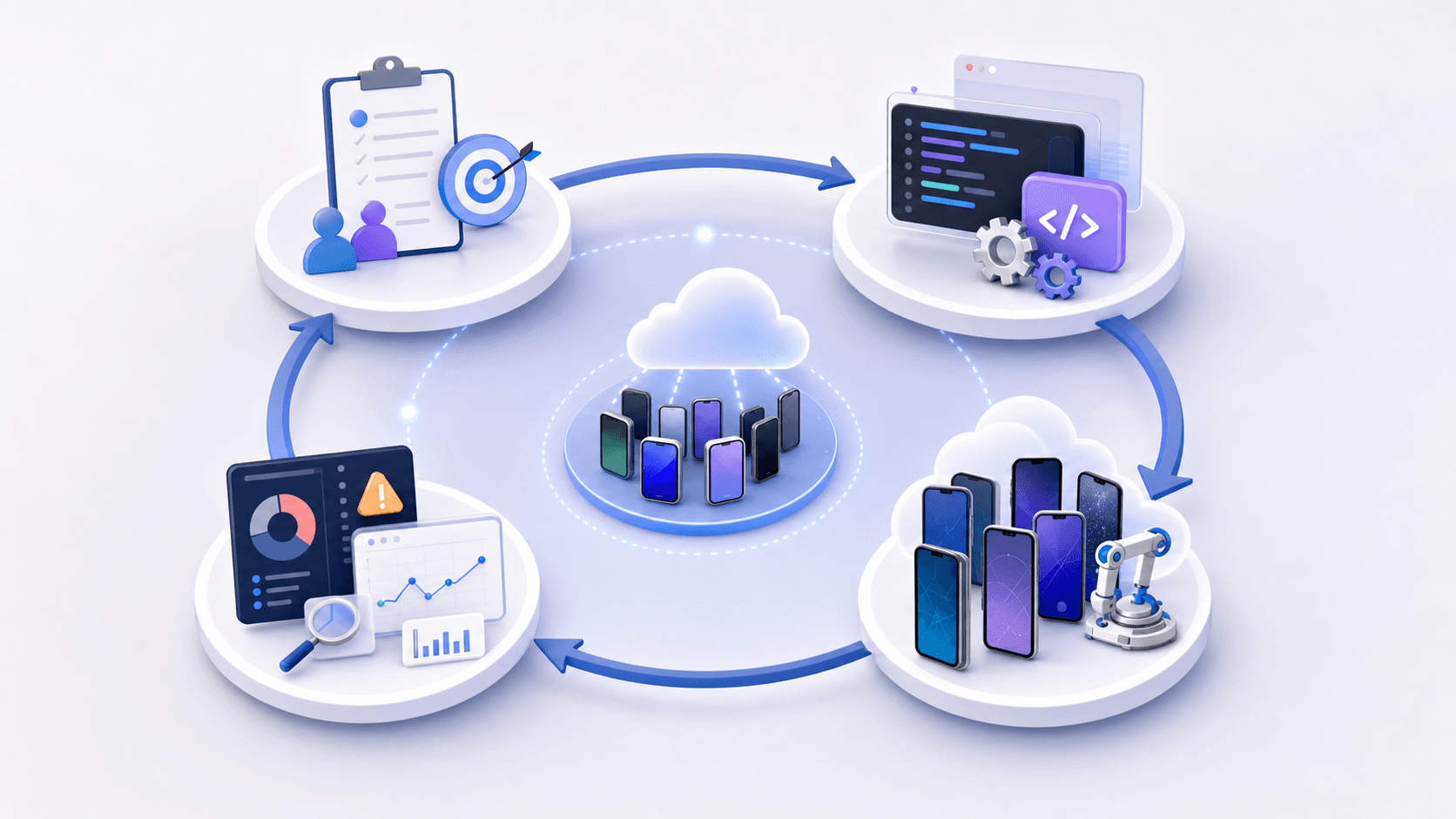
The typical setup runs in four stages:
- Onboarding and scoping: the vendor reviews your app, identifies the flows that carry the most risk, and agrees on coverage targets before writing a single test.
- Test authoring: engineers on the vendor side write automated tests against your actual app builds, covering the scenarios your team flagged as highest priority.
- Continuous execution: tests run against each new build across cloud simulators and emulators spanning multiple OS versions and screen sizes, so fragmentation issues surface before release.
- Reporting and triage: results come back as structured reports with failure details, not raw logs. The vendor flags what broke, categorizes severity, and in some models will investigate root cause before escalating to your team.
The key structural difference from self-managed automation is maintenance ownership. When your UI changes or a new OS version changes gesture behavior, the vendor updates the tests. Your team reviews results and acts on failures. That separation is what makes the model worth considering for teams that are already stretched.
Minitap as a Managed Mobile QA Solution
Minitap is a managed mobile QA service built for teams shipping iOS and Android apps at scale. You write the tests or describe what needs testing, and Minitap handles the infrastructure, execution, and maintenance from there.
The agent drives your real user journeys on cloud simulators and emulators, so results reflect what users actually encounter.
A few things that shape how it works in practice:
- Test execution runs in parallel across cloud simulators and emulators, so you get results in minutes instead of hours waiting for a sequential run to finish.
- Coverage spans gestures, push notifications, background and foreground state transitions, and OS-level permission prompts — the failure modes that most commonly reach production undetected.
- Reporting surfaces failures with enough context to act on them without digging through logs manually.
The managed model is a clean win: your team gains time back on test writing and maintenance and keeps full visibility, since every run ships a session trace, screen recordings, and a written explanation of each finding. For teams where the alternative is under-tested releases or a growing backlog of flaky scripts, that is an easy call.
Final Thoughts on Managed Testing for Mobile Apps
Test coverage either keeps pace with your releases or it doesn't. When it doesn't, you're choosing between hiring more QA engineers or offloading the infrastructure to a service that already has the cloud device infrastructure and maintenance capacity built out. Managed mobile QA works when your team needs tested builds without the overhead of running the tests yourself. If that describes your situation, Minitap's AI agent runs your real user journeys on cloud simulators and emulators and owns the maintenance work, so your engineers don't have to chase flaky scripts between releases.
FAQ
Can I build a managed mobile QA setup without hiring a dedicated QA team?
Yes. Managed mobile QA services exist for teams shipping without in-house QA headcount. The vendor owns test creation, execution, and maintenance, so your engineering team gets release coverage without the hiring or infrastructure overhead.
Managed mobile QA vs in-house testing: which scales better with release frequency?
Managed services scale sub-linearly with release cadence because the vendor absorbs infrastructure and maintenance costs. In-house testing scales linearly or worse: every release requires your team to triage failures, update tests, and manage test infrastructure, consuming senior engineering hours that grow with shipping frequency.
How do managed mobile QA services handle device fragmentation?
Managed providers run your app across cloud simulator and emulator configurations spanning iOS and Android versions, screen sizes, and OS settings that reflect actual user distributions. Your team defines coverage priorities, and the vendor runs tests across the device matrix without requiring you to purchase, configure, or maintain the underlying infrastructure.
What happens when my app's UI changes and breaks existing tests?
With managed mobile QA, the vendor updates broken tests after UI changes. Selector drift, navigation flow changes, and OS-level dialog changes become the provider's maintenance burden, not yours. Your team reviews test results and acts on failures without fixing the automation itself.
When does in-house mobile testing make more sense than a managed service?
Managed QA still works when your app has strict access controls around sensitive data flows: the agent runs against scoped access you define, so you control exactly what it can touch. And it gives you full visibility into what ran, since every run ships a session trace, screen recordings, and a written explanation of each finding. You get the coverage and the transparency without owning the upkeep.