

If you're evaluating automation QA services providers right now, you've probably already seen that the feature lists all look the same. Coverage, CI integration, reporting. What those lists don't tell you is whether your team ends up owning the maintenance or the vendor does. That single question determines whether you reclaim engineering time or just reorganize how it disappears.
TL;DR
- Traditional end-to-end testing catches a fraction of mobile bugs, with industry estimates often citing 20% or fewer. Automation QA services exist to reach the rest, including AI feature regressions, runtime failures, stateful edge cases, and device-specific issues.
- Five factors separate good providers from bad: maintenance model (vendor-owned vs. customer-owned), breadth of coverage, execution speed, where the service fits in your SDLC, and pricing transparency.
- Most tools in this space — TesterArmy, Revyl, Rainforest QA — are customer-maintained. You still define flows, manage the suite, and own coverage gaps.
- Minitap is the only fully autonomous, agent-based, mobile-native QA agent that owns the full testing loop, including execution, maintenance, and root cause analysis, and ships a session trace, screenshots, and a written explanation with every run.
- If your team has tried script-based tools and dropped them due to maintenance cost, a fully autonomous agent removes the work entirely instead of making it slightly easier to manage.
What Are Automation QA Services?
At their core, these services replace or reduce the need for manual regression testing. You give the service access to a build, and it runs structured tests against that build: functional flows like login, checkout, or onboarding; runtime conditions like low memory, airplane mode, or background-to-foreground transitions; device-specific behavior across OS versions and hardware tiers; and increasingly, AI-powered features with non-deterministic outputs that scripted assertions cannot verify. Minitap sits at the fully autonomous end of that model: the agent runs and maintains the entire suite itself, with zero configuration or maintenance required from your team.
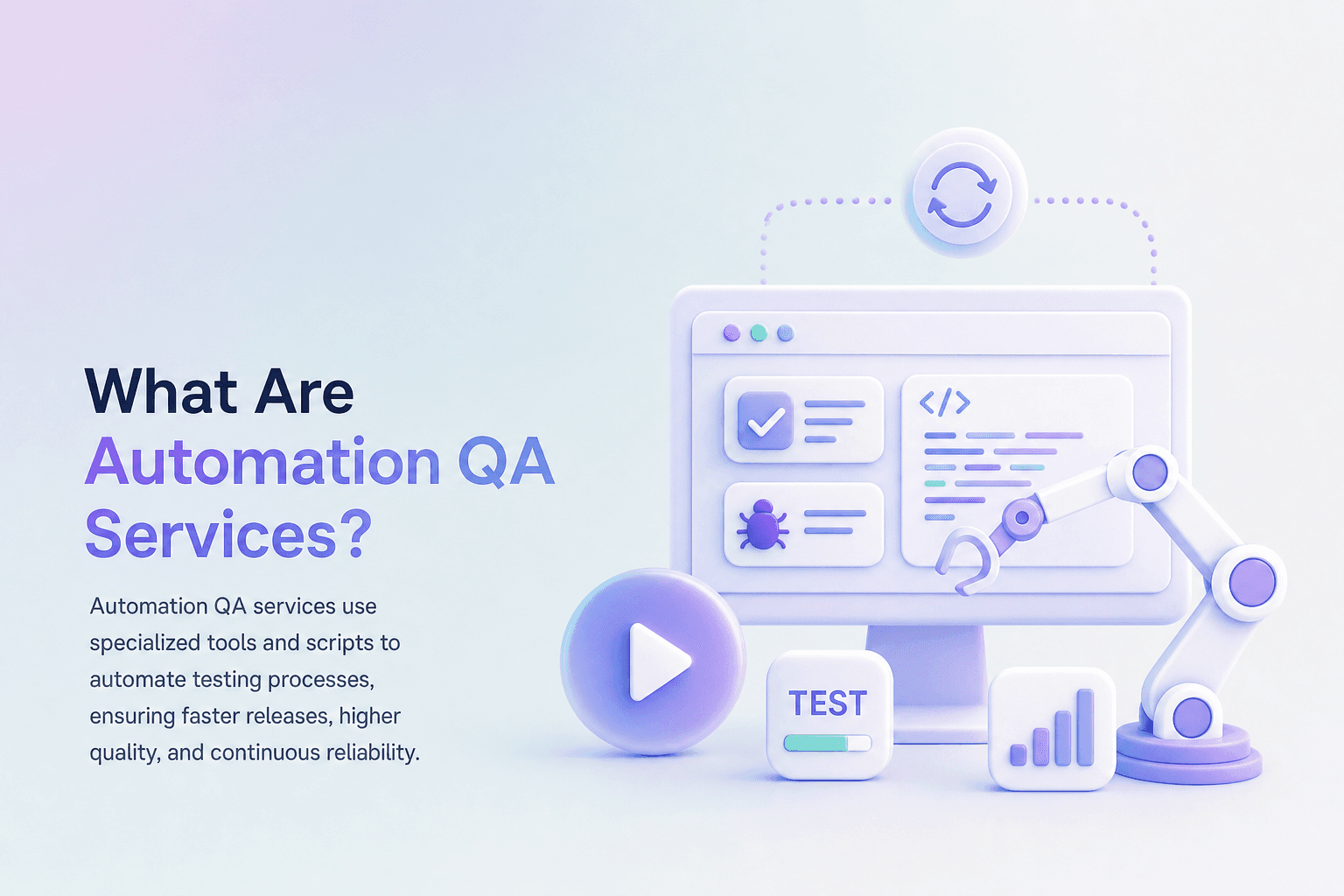
There are two delivery models. Self-service tools — which includes most script-based frameworks and customer-maintained agents — put the configuration work on your team. You write the test logic (or describe flows in natural language), schedule runs, triage failures, and update the suite when the app changes. Fully managed services shift that work to the vendor: your team provides user stories or acceptance criteria, and the provider runs and maintains the suite end to end.
For any engineering team, the delivery model matters as much as the coverage. A tool that requires ongoing maintenance still consumes engineering time, just in a different way than hiring a QA engineer. This matters most for teams shipping at high cadence, weekly releases or faster, where brittle selector-based tests and manual QA cycles slow the team down the most. A fully autonomous agent removes that work entirely instead of making it slightly cheaper.
How We Assessed Automation QA Services Providers
This section outlines the evaluation criteria used to assess automation QA services providers. It explains the framework from the perspective of what mobile engineering managers should look for when selecting a provider, grounded in publicly available product documentation and industry data.
Industry reports and team surveys suggest mobile test maintenance can consume anywhere from 40 to 70% of QA engineering time at organizations running 200+ automated tests, making vendor ownership of suite maintenance a decisive factor. Mobile test suites fail 20 to 30 percentage points more often than equivalent web test suites, which is why the deciding question is whether the provider owns execution, maintenance, and root cause analysis for device fragmentation, low-connectivity scenarios, and stateful flows, not simply how quickly it clears happy-path checks. For more insights on mobile QA trends, see our blog.
Sources
- https://www.drizz.dev/post/mobile-test-maintenance-the-hidden-cost-every-qa-lead-underestimates-2026
- https://contextqa.com/blog/mobile-testing-strategy-that-actually-works-2026/
Best Overall Automation QA Services Provider: Minitap
Minitap is a fully autonomous, AI-powered QA agent that delivers full-coverage mobile testing coverage without requiring any customer maintenance. The service tests iOS and Android apps the way real users would, covering functional flows, AI feature regressions, runtime conditions, low-connectivity scenarios, device variations, and stateful edge cases that script-based tools structurally miss. This approach represents a fundamental shift in automated mobile testing with AI agents.
Core strengths:
- Zero maintenance burden: Minitap maintains the entire test suite. You provide user stories in natural language, and the agent handles execution, reporting, and suite evolution with no scripts to write or selectors to fix.
- Full QA loop ownership: The agent owns execution, maintenance, and root cause analysis, so engineers never touch the test suite again. Coverage includes AI feature drift, ANRs, memory pressure, airplane-mode transitions, background-to-foreground state restoration, and device-specific regressions.
- Full visibility on every run: Every report lists out exactly what was tested and what the agent found, with a session trace, screenshots, and a written explanation for every finding. No maintenance overhead, no opacity.
- Pre-release coverage integration: Reports land before your release decision, delivered through Slack, letting teams ship at their desired cadence without the fear tax that slows release velocity.
Bottom line: Minitap is the only fully autonomous, agent-based mobile QA agent that owns the full testing loop, execution, maintenance, and root cause analysis, with zero customer maintenance required. Any mobile engineering team benefits from zero test maintenance and a full regression run in about an hour, and the impact is greatest for teams shipping at high cadence, where brittle script-based tools and customer-maintained agents structurally miss the classes of bugs Minitap catches.
TesterArmy
TesterArmy is an AI agent that tests your app as a real user would, where you describe what to test in natural language and the agent clicks, types, and moves through your app using vision .
What They Offer
- Natural language test creation with no selectors or scripts to maintain
- CI/CD integration with GitHub Actions, GitLab CI, and webhooks for staging and production monitoring
- OAuth and OTP handling with dedicated agent inboxes
- Screenshots, recordings, and bug reports for each test run
Good for: Web-first teams or teams with both web and mobile surfaces who are willing to define and manage their own test flows and want CI/CD monitoring for known critical user journeys.
Limitation: Customer-maintained configuration model means you define the flows in plain English, manage what gets tested, schedule runs, and own coverage gaps. The maintenance tax of adding new flows, updating existing ones, and triaging results still falls on your team, unlike fully autonomous services where the provider owns suite evolution and production escapes.
Bottom line: TesterArmy monitors the flows your team defines, which means your team carries the cost of authoring and maintaining those flows as the app changes. A fully autonomous service that owns the suite and every coverage gap eliminates that work entirely.
Sources
Revyl
Revyl is an agent-based mobile testing solution that focuses on verification-as-evidence through live device sessions, replayable test artifacts, and runtime mapping.
What They Offer
- Live device CLI for interactive testing sessions during development
- Replayable evidence with screenshots, videos, logs, and action traces
- Multi-framework support for React Native, Expo, Flutter, and native apps
- GitHub Actions and SDK integration for team-run workflows
Good for: Engineering teams that want to maintain their own test suite and need execution artifacts, runtime verification, and live device access for debugging during development, while owning the work of defining and updating those tests themselves.
Limitation: Customer-maintained suite model means you still define flows in natural language, manage test data states, triage agent results, and own the suite. The agent makes execution easier and provides better artifacts, but the work of QA remains your team's responsibility, and gaps in coverage are not owned by the vendor.
Bottom line: Revyl improves the tooling around tests your team still writes and owns. For teams that want the entire QA loop, including execution, maintenance, and root cause analysis, owned end to end, a fully autonomous agent removes that work instead of just making it easier to manage.
QA Wolf
QA Wolf is a managed QA service that combines AI-powered test automation with human QA engineers to deliver fully autonomous test coverage for web and mobile apps.
What They Offer
- Dedicated QA engineers embedded with your team writing and maintaining Playwright and Appium tests
- Unlimited test maintenance and unlimited parallel runs
- Full scripted coverage across web apps, iOS, and Android
- Video playbacks and coverage quality reporting
Good for: Teams that need or want dedicated QA capacity, have web as their primary testing surface, or want to replace or augment existing QA headcount with vendor-provided engineers.
Limitation: Web-first positioning with Playwright as the foundation and mobile added later, which means mobile testing is not the core competency. Script-based execution (even with AI assistance) means tests still rely on selectors and deterministic assertions that cannot reach AI feature regressions with non-deterministic outputs, stateful flow bugs, or runtime edge cases that agents experience directly.
Bottom line: QA Wolf relies on scripted coverage maintained by dedicated engineers. Any mobile team benefits from full-coverage coverage that reaches beyond scripted suites, and the difference is sharpest for mobile-first teams: an agent-based, mobile-native service that owns the suite end to end catches the classes of bugs script-based suites structurally miss.
Rainforest QA
Rainforest QA is a no-code QA tool powered by AI that targets web applications with visual, no-code tests that anyone can write and maintain.
What They Offer
- Visual no-code editor for step-by-step test creation
- AI-powered test creation and self-healing capabilities to reduce selector brittleness
- Activity logs and video replays for debugging
- Org-wide visibility into test results
Good for: Web-only or web-primary companies that have bandwidth to manage test suites and want a no-code tool that distributes QA ownership across Dev, Product, and QA roles.
Limitation: Web-only capability with no stated mobile support, which disqualifies it for mobile-first teams. Customer-maintained model means someone still owns test creation, suite curation, and management, and the maintenance burden of updating test logic when features change remains even with AI self-healing, unlike fully autonomous services that eliminate all customer maintenance.
Bottom line: Rainforest requires someone to own the suite, even with AI-assisted self-healing, and it has no mobile support at all. Any mobile team benefits from a fully autonomous mobile QA agent that removes suite ownership entirely, and the gap is widest for teams shipping mobile apps that Rainforest cannot test.
Feature Comparison Table of Automation QA Services Providers
This section provides a side-by-side comparison of key capabilities across the providers listed.
| Feature | Minitap | TesterArmy | Revyl | QA Wolf | Rainforest QA |
|---|---|---|---|---|---|
| Maintenance Model | Fully autonomous | Customer-maintained | Customer-maintained | Vendor-maintained | Customer-maintained |
| Execution Approach | Agent-based | Agent-based | Agent-based | Script-based with human QA | Script-based (visual, no selectors) |
| Mobile Support | iOS and Android (mobile-native) | Mobile, web, and websites | iOS and Android | iOS and Android (web-first) | No mobile support |
| Coverage Beyond Scripted Flows | Yes (AI features, runtime, stateful flows, low-connectivity) | No (flow-based monitoring) | No (evidence for defined tests) | No (scripted coverage only) | No (regression and visual validation) |
| Full Visibility on Every Run | Yes (session trace, screenshots, written findings) | No | No | No | No |
| Integration Point | Pre-release coverage (Slack reports before release) | CI/CD monitoring (GitHub Actions, GitLab CI) | CI/CD and live sessions | Embedded QA team | Visual editor for team-managed suites |
| Test Input Method | Natural language user stories | Plain English flow descriptions | Natural language flows | Human QA engineers write scripts | Visual no-code editor |
Why Minitap Is the Best Automation QA Services Provider
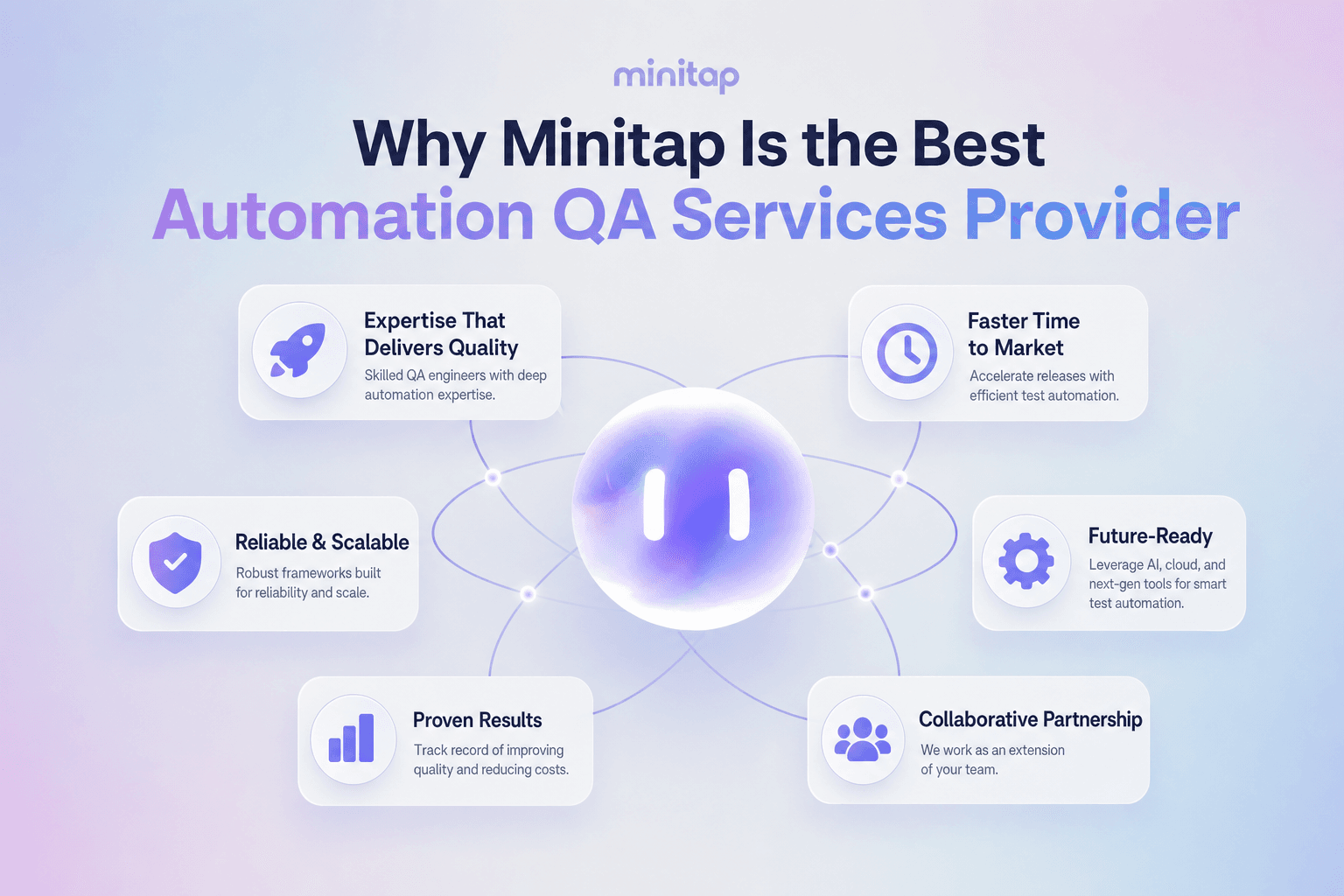
Minitap is the only automation QA service that combines fully autonomous operation with agent-based execution and mobile-native design. Any mobile engineering team that has tried script-based tools (Appium, Maestro, XCUITest) or customer-maintained agents gets the same result with Minitap: zero maintenance, with no engineering time spent defining flows or fixing selectors. The agent owns the full testing loop, execution, maintenance, and root cause analysis, reaching AI feature regressions, runtime conditions, stateful flows, low-connectivity scenarios, and device-specific bugs that script-based suites and customer-configured monitoring tools structurally miss. Teams looking for an XCUITest alternative find that AI-powered testing on real user journeys catches bugs that scripted automation misses. The impact is greatest for teams shipping mobile apps at high cadence, weekly releases or faster, where the gap between AI-assisted development speed and legacy testing is widest. Minitap is purpose-built for that problem. See how it works for your team at minitap.ai.
FAQs
What is the difference between fully autonomous and customer-maintained automation QA services?
With a customer-maintained service, your team defines every test flow, manages the suite, updates flows when the app changes, and owns any gaps in coverage. With a fully autonomous service, the provider handles all of that. Your team provides user stories; the vendor runs and evolves the full suite. The practical difference is where maintenance work lands: on your engineering team or on the provider.
Do automation QA services work for teams with no dedicated QA staff?
It depends on the model. Customer-maintained agents still require someone to define flows, triage results, and keep the suite current, so that work falls on engineers regardless of QA headcount. Minitap works for any engineering team, whether or not it has dedicated QA, because the agent owns the suite end to end and engineering time is never required to keep it running. Teams without QA staff get full coverage for the first time, and QA-staffed teams get that headcount back for other work.
What types of bugs can automation QA services catch beyond basic functional testing?
Script-based tools cover known happy paths. Agent-based services with full-coverage coverage can reach: AI feature regressions with non-deterministic outputs, ANRs and native bridge failures, low-connectivity behavior and airplane-mode transitions, background-to-foreground state restoration bugs, device-specific regressions across OS versions and hardware tiers, and stateful flows that only surface when user accounts are in specific data states. These are the classes of failure that break apps in production but do not appear in scripted regression suites.
How do automation QA services integrate with mobile CI/CD pipelines?
Integration points vary by provider. Most customer-maintained agents connect via GitHub Actions, GitLab CI, or webhooks and run on triggers you configure. Minitap delivers results through Slack before your release decision, so coverage lands ahead of the ship date instead of surfacing problems after they are already live.
How should mobile engineering teams assess automation QA services providers?
Five factors matter most: who owns the test suite and its maintenance; how broad the coverage is beyond happy-path flows; how fast results arrive relative to your release cadence; where the service fits in your workflow (pre-release, CI/CD, or production monitoring); and whether pricing scales predictably with release frequency. Teams that have already tried and abandoned script-based tools should weight maintenance ownership heavily, since reducing maintenance cost is different from eliminating it.