

You run smoke tests manually before every release because your regression suite breaks whenever the UI changes. Test execution bleeds into the next sprint because environment setup was incomplete. Defects reopen twice before they close because the acceptance criteria for fixed were never written down clearly. The software testing life cycle solves all three failure modes by defining six phases with entry and exit gates: requirements analysis, test planning, test case development, environment setup, test execution, and test closure. This breakdown explains how each STLC phase works, how the defect life cycle and bug life cycle run inside execution and closure, where SDLC life cycle models intersect with STLC phases in agile teams, what entry and exit criteria prevent broken handoffs, and how AI QA agents collapse the maintenance load that makes script-based regression unsustainable on mobile and web products that ship weekly.
TLDR:
- STLC runs alongside development, not after it. Testing in bursts at sprint-end means bugs surface late and fixes get rushed.
- The six phases break testing into clear checkpoints: requirements analysis through test closure, each with defined entry and exit criteria.
- Entry and exit criteria prevent phases from bleeding together. Skipping them lets defect clusters carry forward undocumented.
- Defects that reopen more than twice signal environment mismatches or unclear acceptance criteria for "fixed."
- Minitap's AI agent adapts to UI changes without script rewrites, shrinking regression cycles from days to hours.
What Is the Software Testing Life Cycle and Why It Matters
The Software Testing Life Cycle (STLC) is a structured sequence of activities that defines how testing is planned, executed, and closed across a software project. It runs alongside development instead of after it, which is the part most teams get wrong.
Without a defined STLC, testing tends to happen in bursts at the end of a sprint, when pressure is highest and time is shortest. Bugs surface late, fixes get rushed, and release decisions come from gut feel instead of evidence. The STLC replaces that pattern with clear phases, each with defined inputs and outputs, so the team always knows what testing is in flight and what conditions must be met before moving forward.
That structure matters on mobile and web projects especially, where environment complexity and release pressure collide in ways that make reactive testing genuinely costly. The STLC gives teams a repeatable framework instead of a recurring scramble.
STLC vs SDLC: How Testing Fits Into Development
The SDLC covers the full arc of building software: requirements, design, development, deployment, and maintenance. The STLC sits inside that arc, focused entirely on quality verification at each stage.
Think of it this way: the SDLC answers "what are we building and how," while the STLC answers "how do we know it works."
Where They Overlap
The two cycles share checkpoints. Test planning starts during requirements. Test design runs alongside development. Execution and closure happen post-build. In agile teams, these overlap continuously across sprints instead of running in sequence.
The practical consequence: testing is never a phase that starts when dev finishes. If your team treats it that way, defects accumulate until release, and fixing them gets progressively more expensive the later they surface post-release fixes routinely cost an order of magnitude more than catching the same issue during requirements review.
The Six Phases of STLC: From Requirements to Closure
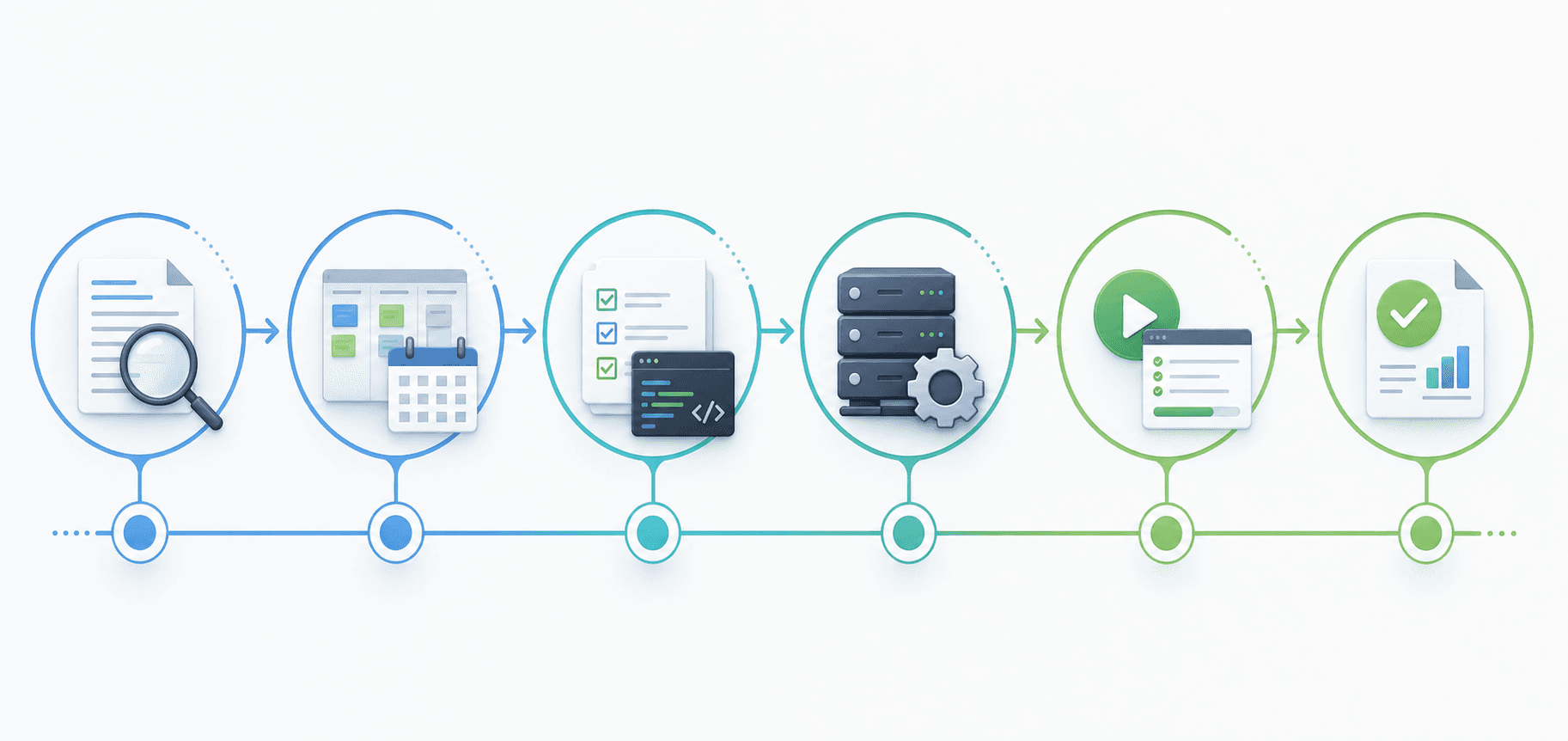
The STLC breaks into six sequential phases, each with a defined entry point, activities, and exit criteria. The 6 phases of the STLC provide the structural checkpoints that prevent coverage gaps from compounding across releases.
Phase 1: Requirements Analysis
Testing starts before a single test case exists. QA reviews the requirements document to identify what is testable, flag ambiguities, and document any gaps that need resolution before test planning begins. Catching a requirement conflict here costs nothing. Catching it in UAT costs a sprint.
Phase 2: Test Planning
The team produces a test plan covering scope, effort estimates, environment needs, risk areas, and a schedule. This is where you decide what gets automated, what gets manual coverage, and what gets deprioritized for regression coverage.
Phase 3: Test Case Development
Testers write and review test cases, prepare test data, and set up any scripts the plan calls for. Each case should include preconditions, numbered steps, expected results, and a priority tag (critical, high, medium, low). Test data sets need to cover boundary conditions beyond the happy path. Exit criteria: peer-reviewed cases with a completed traceability matrix linking every case back to a specific requirement.
Phase 4: Test Environment Setup
The environment mirrors production as closely as budget allows. For mobile teams, that means verifying OS versions, device models, network profiles (including low-bandwidth and offline states), API endpoints, and data fixtures all match the production state before execution begins. Incomplete setup here is responsible for a large share of false failures in regression runs and for defects that reproduce in staging but not production, making closure harder to confirm.
Phase 5: Test Execution
Cases run, defects get logged with steps to reproduce, severity ratings, and build references. Blocked cases get documented, not skipped.
Phase 6: Test Closure
The team produces a summary report covering defect counts by severity, coverage against the original plan, and lessons learned. This is the input to the next cycle's planning phase, not an afterthought.
Entry and Exit Criteria: Quality Gates That Prevent Premature Progression
Entry criteria define what must be true before a phase begins. Exit criteria define what must be true before moving to the next one. Without both in place, phases bleed into each other: testers run cases in incomplete environments, defects get logged against the wrong build, and coverage gaps go unnoticed until closure.
The table below maps each STLC phase to its typical checkpoints.
| Phase | Entry Criteria | Exit Criteria |
|---|---|---|
| Requirements Analysis | Requirements document available and signed off | Testability assessment complete, gaps documented |
| Test Planning | Approved requirements, resource availability confirmed | Test plan reviewed and approved |
| Test Case Development | Approved test plan, test data available | Cases peer-reviewed, traceability matrix complete |
| Environment Setup | Test cases approved, environment specs defined | Environment verified against production configuration |
| Test Execution | Environment stable, build deployed and smoke-tested | All cases executed, defects logged with severity |
| Test Closure | All exit criteria from execution met | Closure report delivered, lessons logged |
Teams that skip formal entry criteria tend to hit broken environments mid-run. Skipping exit criteria is worse: it lets unresolved defect clusters carry forward without documentation, which compounds into release-day surprises that nobody can trace back to a root cause.
Understanding the Defect Life Cycle Within STLC
The defect life cycle runs inside the STLC's execution and closure phases. A defect gets logged, assigned a state, and moves through a defined workflow until it's closed or deferred.
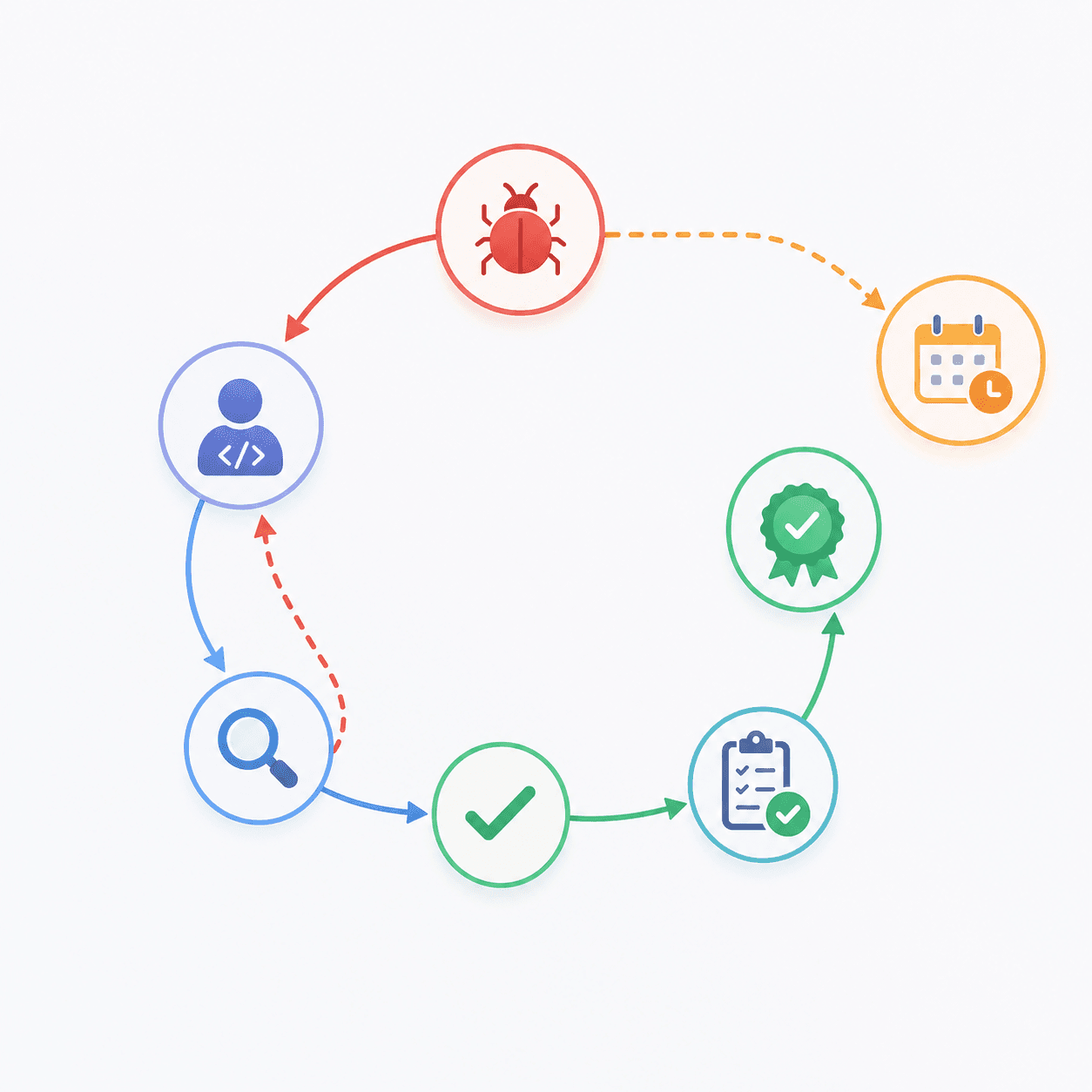
Here are the core states most teams work through:
| State | What It Means |
|---|---|
| New | Defect is logged but not yet reviewed |
| Assigned | A developer has been handed the defect |
| Open | Active investigation is underway |
| Fixed | Developer marks the fix as complete |
| Retest | QA verifies the fix in the same environment |
| Reopened | Fix did not hold; defect returns to Assigned |
| Closed | Fix confirmed; defect exits the cycle |
| Deferred | Valid defect, deprioritized to a future release |
Where Teams Lose Track
The reopen loop is where defect life cycle management gets expensive. A defect moves from Fixed to Retest, fails verification, and goes back to Assigned. If that cycle repeats more than twice on the same defect, it usually signals one of a few things: the fix was tested in an environment that does not match production, the root cause was misidentified the first time, or the acceptance criteria for "fixed" were never written down clearly.
Tracking reopen rate per defect gives engineering managers an early signal on which parts of the codebase are generating rework instead of resolution.
STLC in Agile and DevOps: Adapting Traditional Phases to Iterative Development
Agile breaks the software testing life cycle into sprint-sized slices instead of long sequential phases. Testing no longer waits for a handoff at the end of the build. It runs alongside development, inside the same two-week window where code is written.
The practical effect is that each sprint contains a compressed version of the full STLC: requirements are reviewed during sprint planning, test cases are written as acceptance criteria get defined, execution runs while the feature is still being built, and defects get resolved before the sprint closes. Nothing carries over to a separate QA phase.
In a DevOps context, that compression goes further. CI/CD pipelines run automated test suites on every commit, which means the defect life cycle collapses too. A bug found three minutes after the offending commit is filed, traced, fixed, and verified within the same pipeline run.
Three changes matter most here:
- Testing entry criteria become sprint entry criteria. A story does not move into active development until acceptance tests are drafted. That forces requirement clarity before a line of code is written.
- Regression coverage is a living artifact, not a one-time deliverable. Every sprint that ships a feature should also ship the tests that protect it.
- Defect triage moves from weekly bug review meetings to pull request comments. The defect life cycle runs in hours, not days.
Teams that treat Agile as a reason to skip formal STLC phases tend to accumulate coverage debt fast. The phases do not disappear; they compress.
Mobile and Web Testing Challenges That Impact STLC Execution
Mobile apps span thousands of device combinations. Web apps deal with browser engine differences, viewport inconsistencies, and cached state that test environments rarely replicate cleanly. Both create real gaps in STLC execution that manual processes and fragile script-based suites struggle to keep up with.
Three failure patterns account for most regression gaps in mobile teams:
- Runtime conditions mean a test that passes in a clean environment may fail when the app has been running for several hours with low memory and background processes competing for resources. Coverage built only from happy-path scripts often misses the conditions real users encounter, which is exactly what running full user journeys against each build surfaces.
- Release velocity puts pressure on every phase of the STLC. When sprint cycles compress, requirement analysis gets abbreviated, test case design gets deferred, and regression runs cover less of the actual product with each release.
- UI churn breaks script-based tests faster than most teams can fix them. Selector updates, layout changes, and navigation restructuring all require test rewrites, which means maintenance load scales with feature output instead of staying flat.
- Environment parity gaps mean defects found in staging may not reproduce in production, and defects in production may not reproduce in staging, which makes defect life cycle tracking harder to close reliably.
These are structural constraints, not execution failures. The STLC phases exist to manage exactly this kind of complexity, but only if the tooling and process underneath them can keep pace with how mobile and web products actually ship.
How AI-Powered QA Changes STLC for Mobile Teams
AI-driven QA agents change where testing work actually lives in the STLC. Instead of manually writing and maintaining test scripts after each release, the agent reads your app from source, maps all test scenarios automatically, and reruns them against every build without maintenance from your team.
For mobile teams, this matters at the execution and maintenance phases. A UI change that would previously break dozens of selector-based scripts gets handled by the agent adapting to the new layout instead of your team spending a sprint rewriting tests.
A few places this shows up concretely:
- Regression coverage runs automatically against each build, so the gap between "code merged" and "regression complete" shrinks from days to hours.
- Test authorship moves from manual script writing to reviewing what the agent generated, which is a lighter lift per release.
- Failures get flagged with session replays attached, so engineers debug against what actually happened instead of reconstructing it from logs.
Final Thoughts on Running the Software Testing Life Cycle
The STLC gives you entry and exit criteria so testing stays ahead of release pressure instead of reacting to it. The challenge on mobile and web is that UI churn breaks tests faster than most teams can fix them, which means regression coverage shrinks with every release unless the maintenance model changes. If your team is spending sprints rewriting selector-based scripts, Minitap handles test generation and reruns automatically so coverage compounds instead of decaying. The framework works when the tooling underneath it keeps pace with how fast you ship.