
You're running end-to-end testing with Playwright, Cypress, or one of the mobile-focused e2e testing frameworks like Appium or Maestro. Your automation testing tools list is solid. The e2e testing react setup works. Cypress react integration is fast. Your best react e2e testing framework choice was deliberate. But your production bugs are not coming from the flows you scripted. They are coming from scenarios your e2e testing tools never modeled: apps that crash after extended use, OAuth flows that fail on particular devices, sessions that corrupt when the OS suspends the app mid-transaction.
What is e2e testing actually catching? Roughly 20% of what reaches production, because e2e testing example suites run clean paths in stable environments and production runs messy paths under variable conditions. Integration vs e2e testing, e2e vs integration testing cost, end-to-end testing vs regression testing, end-to-end testing vs user acceptance testing, all of it maps coverage in theory but none of it closes the gap between what your software testing tools validate and what your users actually encounter. This is what that gap looks like and why it exists regardless of which playwright tool, playwright testing tool, or cypress js framework you run.
TLDR:
- E2E tests catch roughly 20% of production bugs because they run scripted paths in clean environments, missing low-memory states, interrupted sessions, and real device conditions.
- Integration tests verify service contracts cheaply; reserve E2E tests for flows where a full user sequence is the only way to confirm it works end to end.
- Mobile E2E testing is harder than web: you're testing against fragmented device models, OS interruptions, and app lifecycle events that web frameworks can't simulate.
- Autonomous agents adapt to UI changes without rewriting selectors, while self-healing scripts still require your team to author and maintain test logic.
- Minitap runs as an agent on real devices, testing runtime state failures and session-dependent flows that scripted suites structurally cannot reach without ongoing authorship investment.
What E2E Testing Actually Is (and What It Isn't)
E2E testing runs your app the way a real user would. It starts at the UI, works through actual network calls, hits a real backend, and validates that the outcome matches what the user expected. No mocks, no stubs, no shortcuts. End-to-end testing maintains system integrity by validating complete user flows from start to finish.
That's what separates it from integration testing, which wires two or three components together in isolation. E2E testing runs the full chain.
Here's the catch: the full chain is exactly what makes it slow, expensive, and hard to maintain at scale.
Why E2E Testing Exists: The Testing Pyramid and Where E2E Fits
Most testing strategies follow a pyramid: many unit tests at the base, a layer of integration tests in the middle, and a smaller set of E2E tests at the top. The logic is sound. Unit tests are fast and cheap. Integration tests catch contract failures between services. E2E tests confirm that real user flows work end to end.
The problem is that E2E tests are expensive to write, slow to run, and brittle on mobile. A UI change breaks selectors. A network condition flaps a test. A timing issue causes a failure that disappears on rerun. Teams respond by running E2E suites less often, trimming coverage to reduce flakiness, or skipping the layer entirely.
That gap is where production bugs live. E2E testing, done well, catches the failures that unit and integration tests miss: flows that break across service boundaries, state bugs that only appear after several user actions, and UI regressions that only surface under production conditions.
What it does not catch is everything else. Logic errors buried in edge-case data, backend failures that only appear under load, and permission issues tied to specific OS configurations all fall outside what even a thorough E2E suite will find. That scope limit is not a tooling failure. It is structural.
E2E Testing vs Integration Testing: When Each Makes Sense
Integration testing checks that two or more units work correctly together: your auth service can reach the user database, your payment module returns the right response from a third-party API. E2E testing goes further, running the full user journey from the first screen tap through backend processing and back to a displayed result.
The practical split most teams land on is using integration tests to catch contract failures early and cheaply, then reserving E2E tests for the flows where a full production walkthrough is the only way to know something actually works.
Here is where each fits:
- Integration tests run fast and give you precise failure locations. When a service boundary breaks, an integration test tells you exactly which call failed and why, without spinning up a full device environment.
- E2E tests catch the failures integration tests miss: timing issues between UI and network layers, state corruption across screens, and anything that only surfaces when a real user sequence runs from start to finish.
- Cost scales differently for each. Integration tests are cheap to run at high frequency. E2E suites on real devices carry infrastructure costs that make indiscriminate coverage financially unsustainable for most teams.
| Integration Testing | E2E Testing | |
|---|---|---|
| What it validates | Service contracts and component interactions in isolation | Complete user flows from UI through backend and back |
| Speed | Fast: runs without full device environment | Slow: requires full app stack and device/browser |
| Cost | Cheap to run at high frequency | Expensive: infrastructure and execution costs scale with run frequency |
| Maintenance burden | Low: focused on stable service boundaries | High: breaks with UI changes, selector drift, timing issues |
| Failure precision | Pinpoints exactly which service call failed | Shows that a flow broke, but not always where or why |
| Good for | Auth service reaching database, payment API returning correct response, service boundary contracts | User completing purchase, submitting form, recovering from session timeout, full production walkthroughs |
| Misses | Timing issues between UI and network, state corruption across screens, full user sequence failures | Low-memory states, runtime conditions, device-specific bugs (when using emulators) |
The decision rule is straightforward: if you need to verify a contract between two services, write an integration test. If you need to verify that a user can actually complete a purchase, submit a form, or recover from a session timeout, write an E2E test. Running E2E tests where integration tests would suffice is one of the main reasons teams end up with slow, expensive suites that still miss production bugs.
The 20% Problem: What Traditional E2E Testing Actually Catches
E2E tests simulate user journeys through a working app: log in, complete a purchase, submit a form. They're valuable. But they only cover what you script in advance, running against controlled environments with clean data and predictable network conditions.

Production is different. Real users hit edge cases, carry session state from previous app versions, encounter low-memory conditions, and face API responses your test suite never modeled. Over 60 percent of production bugs involve data states that were not present in test datasets.
The result: E2E testing catches roughly 20% of bugs, with some teams reporting coverage gaps far wider than that.
The Maintenance Tax: Why E2E Test Suites Become Liabilities
Every E2E test suite starts clean. A few flows, reliable runs, green builds. Then the app ships new features, the UI gets updated, and the tests that passed last sprint start failing this one. Not because the app broke. Because a button moved.
This is the maintenance tax. Selector drift, timing flakiness, and environment mismatches compound quietly until the team spends more time fixing tests than writing them.
E2E Testing Tools in 2026: Playwright, Cypress, and the Shifting Ecosystem
Playwright has become the default choice for frontend and web-focused teams, with strong TypeScript support, built-in auto-waiting, and a testing API that handles complex async flows without extra configuration. For React, framework choice usually comes down to what your CI pipeline already supports.
The more telling shift is what these tools still cannot do. Playwright and Cypress test what a browser displays. They simulate user flows in controlled environments where the app state, network conditions, and background processes are predictable. That gap matters more as apps move to mobile, where the test environment and the production environment diverge in ways a headless browser cannot replicate.
AI-assisted test generation is starting to close some of that gap. Tools like Minitap generate and maintain tests from observed behavior instead of requiring teams to write selectors manually. But the coverage problem underneath remains the same regardless of how tests get authored: a test suite that only runs scripted paths will miss the failure modes that surface from production runtime conditions, interrupted sessions, and state your test environment never encounters.
Mobile E2E Testing: Why It's Structurally Harder Than Web
Web E2E tests run against one browser on one OS. Mobile E2E tests face a fragmented ecosystem with varying OS behaviors and configurations that surface different failure modes under production conditions.
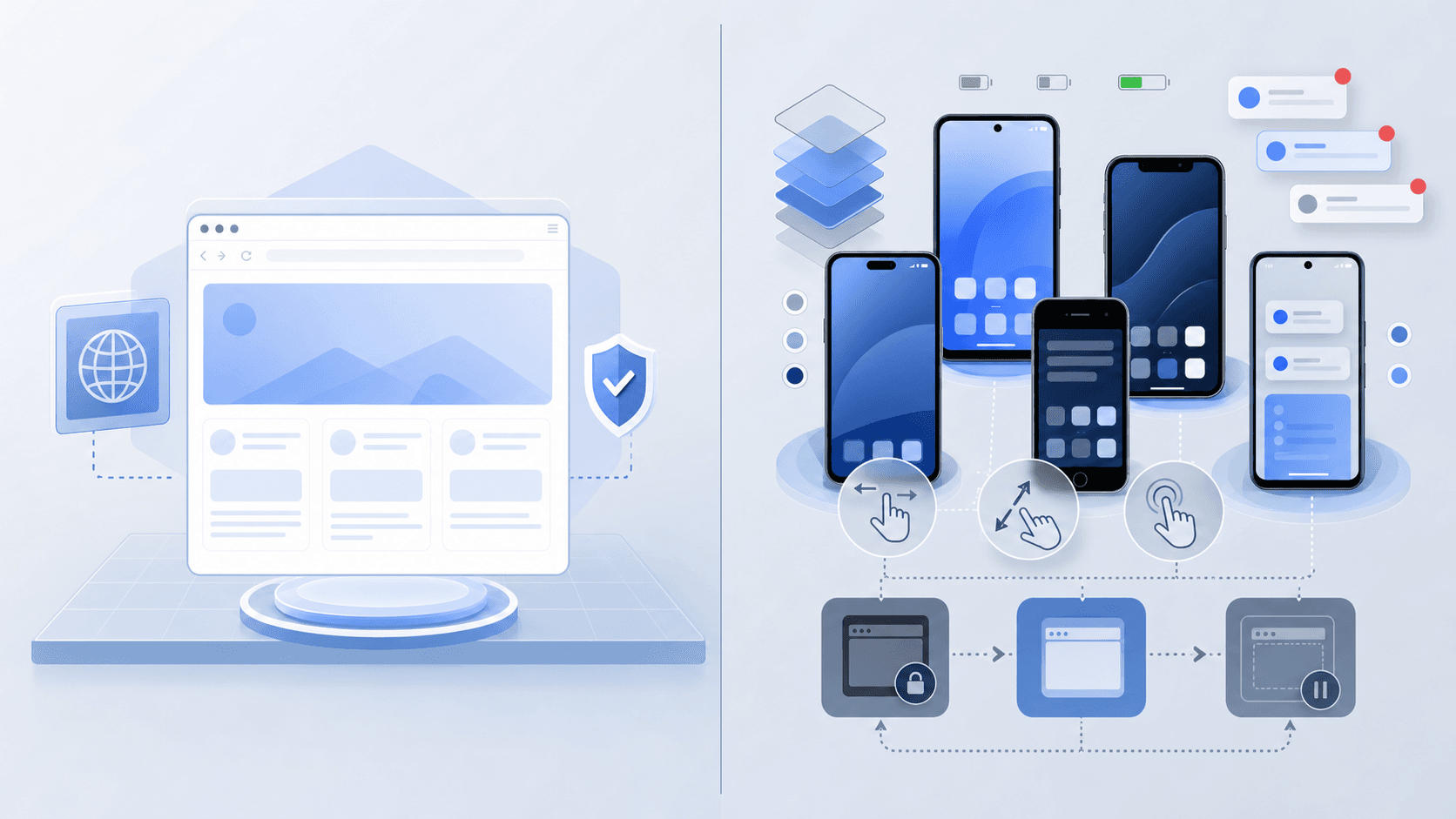
A test that passes in a clean environment may fail when the app has been running for several hours with low memory and other processes in the background. That failure mode does not exist in web testing.
There are also interaction models web testing never touches:
- Gesture handling: swipe, pinch, long-press, and multi-touch sequences that Playwright or Cypress cannot simulate because they were built for pointer events, not touch input.
- Native OS interruptions: incoming calls, push notifications, permission dialogs, and low-battery alerts that fire mid-flow and break test state in ways no web framework accounts for.
- Deep link routing: URLs that launch the app into a specific state, which can bypass authentication middleware or trigger flows the test suite never anticipated.
- Background and foreground transitions: app lifecycle events that flush state, cancel network requests, or drop WebSocket connections depending on how the OS manages memory.
Web frameworks like Playwright and Cypress were designed for a stable, predictable DOM. Mobile apps run under OS conditions that change with updates, inside an app lifecycle that web testing does not model at all.
The Classes of Bugs E2E Tests Structurally Cannot Catch
Script-based E2E tests can only verify outcomes they were written to expect. Several bug classes fall structurally outside that boundary:
- AI feature regressions: when a model-driven feature returns a different valid output on each run, a hard assertion fails even when the feature is working correctly. Non-deterministic outputs require outcome-range validation, which scripted tests cannot express.
- Data-state bugs: flows that break only when an account has specific history, like a user who has cancelled and resubscribed, or one with a partially completed onboarding. Clean test data never triggers these paths.
- Low-connectivity failures: intermittent network conditions that corrupt local state or produce silent write failures that appear correct in the UI but leave the backend out of sync.
- Memory leaks under prolonged load: a leak that takes forty minutes of active use to cause a crash will not appear in a test that runs a flow once and exits.
- Background-to-foreground restoration failures: state that gets partially flushed when the OS suspends the app and then restored incorrectly when the user returns, producing a session that looks valid but has stale or missing data underneath.
These are not rare edge cases. They are the failure modes that reach production most often, precisely because every team's test suite was built to avoid them.
AI Testing in 2026: Autonomous Agents vs Self-Healing Scripts
Two distinct approaches have taken hold in 2026, and they solve different problems.
Self-healing scripts are an evolution of traditional E2E frameworks. When a selector breaks because a developer renamed a class or restructured the DOM, the script attempts to locate the element through alternative attributes instead of failing immediately. It repairs itself. Teams keep their existing test architecture and gain some resilience against minor UI churn.
Autonomous agents work differently. Instead of following a predefined script, the agent observes the app state, decides what action to take next, and adapts based on what it sees. There is no selector to break because the agent reads the interface the way a user would.
Here is where the gap matters for mobile engineering managers:
- Self-healing scripts still require your team to author and maintain the test logic. When product flows change in non-trivial ways, a script that heals a broken button selector cannot rewrite the checkout sequence it was testing.
- Autonomous agents cover untested paths by default. They do not need a human to anticipate every scenario in advance, which is how they surface bugs in flows no one wrote a test for.
- The maintenance cost profile is different. Self-healing reduces breakage frequency but does not eliminate authorship overhead. Agents shift that overhead to the vendor or the model, depending on implementation.
Neither approach eliminates the core constraint covered earlier: neither catches what happens in production under real user conditions, with real network variability, and real device states.
When E2E Testing Delivers Value (and When It Doesn't)
E2E testing earns its keep in a specific situation: when you need confidence that a complete user flow works end-to-end before shipping. Login to checkout, onboarding to first action, payment initiation to confirmation. These are the flows where a break costs you real users.
The trouble is that E2E tests only catch roughly 20% of production bugs. The rest surface from conditions scripted tests were never built to reach: low memory states, background process interference, interrupted network transitions, or real device behavior that a clean test environment never reproduces.
Where E2E testing falls short:
- Race conditions and timing bugs that only appear under prolonged load or degraded runtime conditions, not in a clean test run.
- State accumulation failures where the app behaves differently after hours of use compared to a fresh launch.
- Network edge cases like mid-request drops, retry storms, or partial responses from flaky connections.
The value calculation here is straightforward. E2E coverage on business-critical flows buys you meaningful regression protection at a manageable maintenance cost. Trying to cover every path with E2E tests inverts that ratio: maintenance scales faster than coverage, and the suite starts breaking on UI changes before it catches real bugs.
How a Fully Autonomous QA Agent Changes the Coverage Equation
Customer-maintained E2E suites scale linearly with release velocity. Every sprint that ships new screens or refactored flows creates a proportional maintenance bill: selectors to update, assertions to fix, flaky runs to triage. The team owns all of it, indefinitely.
An autonomous QA agent changes that scaling curve. When the agent owns authorship, execution, and failure triage, releases stop driving QA overhead at the same rate. A team shipping twice as fast does not need twice the QA hours.
That shift also changes what coverage is realistic. Teams limited by maintenance capacity tend to narrow their suites to avoid the upkeep load. Remove that limit and covering more flows becomes viable without the corresponding headcount cost.
Agent-Based Mobile Testing: Minitap's Approach to the Coverage Gap
Minitap approaches mobile testing as an agent that actually uses your app the way a user would, moving through flows instead of executing scripted selector checks against a static DOM.
The agent finds the login form, fills credentials, submits, and confirms the dashboard loaded without a human in the loop. When your UI changes, the agent adapts without requiring your team to rewrite selectors or update test scripts. Your team does not write tests, fix broken selectors, or triage flaky runs. Minitap owns execution, maintenance, and root cause analysis: the full QA loop.
Where this matters is in closing the QA loop without engineering involvement:
- Runtime state failures that only appear after several hours of use with low memory and background processes competing for resources
- Permission and OS interaction bugs that surface under specific configurations
- Flows that require continuous session context across multiple screens, which scripted tests reset between runs and never actually validate end to end
Your team gains time back on test writing and maintenance while keeping full visibility into test runs, failures, and root cause analysis. The full QA loop stays off your team's plate, which changes what coverage is realistic without adding headcount to own the system.
Final Thoughts on E2E Testing Strategy
Your E2E suite should cover the flows where a failure directly costs revenue or tanks your app rating, not every path through the product. The maintenance burden scales with UI churn, and most teams end up narrowing coverage to keep the suite from breaking faster than it catches bugs. Minitap takes a different approach: an autonomous agent runs on real devices, owns authorship and execution, and adapts to UI changes without requiring your team to rewrite tests, which changes what coverage is realistic without adding QA headcount. The question is whether the 80% gap between what E2E catches and what reaches production matters enough to rethink how testing gets done.
FAQ
E2E testing vs integration testing: which one should I actually use?
Integration tests verify that two or more units work correctly together (your auth service can reach the user database, your payment module returns the right response from a third-party API), while E2E tests run the full user journey from the first screen tap through backend processing and back to a displayed result. Use integration tests to catch contract failures early and cheaply: they run fast and give precise failure locations. Reserve E2E tests for flows where you need to verify a user can actually complete the full sequence: login to checkout, onboarding to first action, payment initiation to confirmation.
Can E2E testing frameworks like Playwright work for mobile apps?
No. Web E2E frameworks like Playwright were built for browser testing. They test what a browser displays and simulate user flows in controlled environments. Mobile apps require gesture handling (swipe, pinch, long-press), native OS interruptions (incoming calls, push notifications, permission dialogs), and app lifecycle events (background/foreground transitions) that web frameworks cannot model. A test that passes in a headless browser cannot reproduce the failure modes that surface from production runtime conditions.
What bugs do E2E tests structurally miss?
Script-based E2E tests only verify outcomes they were written to expect. They miss AI feature regressions (non-deterministic outputs that differ on each run), data-state bugs (flows that break only with particular account history), low-connectivity failures (intermittent network conditions that corrupt local state), memory leaks under prolonged load, and background-to-foreground restoration failures. These are not edge cases. They are the failure modes that reach production most often because every team's test suite was built to avoid them.
Which E2E framework should I use for React testing?
Playwright has become the default for React and frontend teams. It offers native TypeScript support, built-in auto-waiting, and handles complex async flows without extra configuration. The real question is not which framework to choose, but whether any script-based framework can catch the failures that matter. All script-based tools test scripted paths in controlled environments and miss the runtime state failures and session-dependent issues that break in production. Minitap takes a different approach: an autonomous agent runs on real devices, adapts to UI changes without selector rewrites, and surfaces the failure modes that scripted suites structurally cannot reach.
When does autonomous agent testing make sense over customer-maintained E2E suites?
When maintenance cost scales faster than your team's capacity to keep pace with release velocity. Customer-maintained E2E suites create a proportional maintenance bill with every sprint: selectors to update, assertions to fix, flaky runs to triage. An autonomous QA agent moves that authorship and maintenance off your team entirely. Your team stops writing tests, fixing broken selectors, and triaging failures, while keeping full visibility into test runs, failures, and root cause analysis through the agent's reporting.