
Your test suite breaks every time the UI changes, and someone on your team spends hours rewriting selectors before the next release ships. Artificial intelligence testing tools are supposed to solve that by reading your interface at runtime and adapting when flows shift, but the category spans open-source AI testing frameworks your team maintains to fully managed services that own test authoring and upkeep end-to-end. Most of the free AI testing tools online and generative AI testing platforms still put selector updates, script fixes, and flaky run triage on your team. The autonomous ones remove that work entirely and ship full visibility into every run, with session traces, screenshots, and written findings included. If you're researching artificial intelligence testing courses, AI testing certification programs, or trying to figure out which AI tools for test case generation fit your workflow, the decision isn't about features. It's about whether your team can handle the maintenance load that comes with script-based automation or needs coverage that holds across releases without engineer involvement. What follows is how the best artificial intelligence testing tools break down across both models, where the ownership question lands in practice, and what the trade-offs look like for teams shipping mobile and web apps on a regular cadence.
TLDR:
- AI testing splits into two categories: agents that write and self-heal tests, and testing apps with AI features.
- Most tools help write tests faster but still require your team to maintain them when UI changes.
- Self-healing tests adapt at runtime so selector breaks don't kill coverage between releases.
- Minitap builds, runs, and maintains test suites without engineer involvement, matching AI coding velocity.
- Minitap is the answer when you want coverage that holds across releases with no maintenance work from your team.
What Is Artificial Intelligence Testing
AI testing covers two related ideas that often get conflated. The first is using AI to do the testing itself: agents that generate test cases, execute them on real interfaces, and adapt when the UI changes without someone rewriting selectors. The second is testing software that already contains AI features, where outputs are non-deterministic and hard-coded assertions stop working reliably.
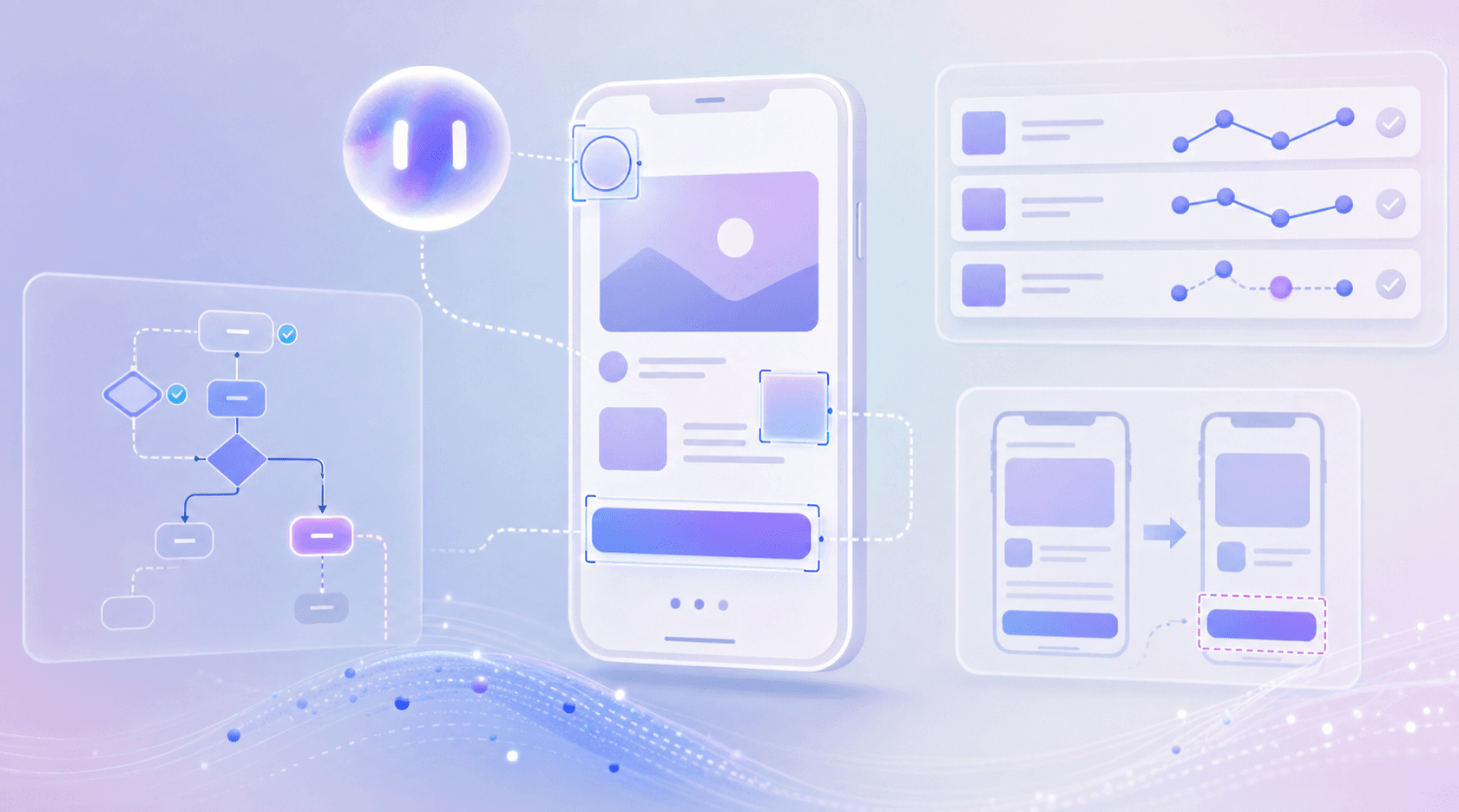
Traditional script-based automation encodes specific human knowledge into selectors, steps, and assertions. When the UI changes, the test breaks. AI-driven testing reads the interface at runtime and adjusts, so a button that moves or gets labeled differently does not kill the run.
How We Ranked Artificial Intelligence Testing Tools
Four criteria shaped every pick on this list: whether the tool actually reduces manual work, how well it handles shifting UI elements without constant selector updates, whether there's a free or open-source tier worth using in practice, and how the maintenance ownership breaks down between your team and the vendor.
Pricing transparency mattered too. A tool that looks free until you hit scale isn't free.
Best Overall Artificial Intelligence Testing Tool: Minitap
Minitap is a fully autonomous QA agent built for teams that need reliable coverage without owning the maintenance pipeline. You don't write tests, fix broken selectors, or triage flaky runs. Minitap's agent handles that.
Here's what sets it apart: the agent adapts when your UI changes. Selectors don't break and stay broken until someone files a ticket. The system self-heals, so your coverage holds across releases without manual intervention from your team.
Minitap covers both mobile and web and integrates into your CI/CD workflow so results surface before code ships.
- The agent maps your app, identifies flows, and builds test coverage without requiring your team to author scripts from scratch.
- When UI changes between releases, the agent adjusts without requiring selector rewrites or test script updates.
- Test results feed directly into your pipeline, so failures block bad builds before they reach users.
For mobile engineering teams spending hours on manual regression before each release, that's the right choice. Every agent run ships a session trace, screenshots, and a written explanation of each finding, so visibility into what was tested and what was found is built into the output, with no maintenance work required from your team.
Good for any team shipping mobile apps on a regular release cadence that wants broad coverage without the overhead of maintaining a script-based suite.
Semaloop
Semaloop is an AI-powered test generation tool that reads your codebase and produces test cases without requiring manual scripting. You point it at a repository, and it maps application flows, generates assertions, and outputs runnable tests.
The appeal is speed. Teams that have no existing coverage can go from zero to a running test suite without writing tests by hand, though choosing an automation QA provider carefully still matters.
The trade-off is ownership. The tests Semaloop generates are yours to maintain. When your UI changes or a flow gets refactored, your team updates the suite. That maintenance load scales with your release cadence.
Good for teams that need a coverage baseline fast and have engineering capacity to own ongoing upkeep. Less suited to teams already stretched thin on QA headcount who need the maintenance work to stay off their plate.
Digital.ai
Digital.ai is an enterprise AI testing and release orchestration suite. It combines test generation, impact analysis, and continuous testing for mobile and web within a single managed workflow.
The trade-off is structural. You get broad coverage across multiple platforms and deep integration with CI/CD pipelines, but the system is built for large engineering orgs with dedicated DevOps capacity. Smaller teams will find the configuration overhead scales faster than the coverage benefit.
Good for teams running complex release pipelines who need test impact analysis baked into the release process. Teams without dedicated infrastructure ownership will hit friction early.
Heal.dev
Heal.dev is an AI-powered test generation tool that watches how users interact with your application and converts those sessions into automated test scripts. You paste in a user flow or describe a feature, and it produces tests without requiring you to write selectors or step through the UI manually.
The tool targets teams that want coverage without the upfront cost of scripting everything from scratch. It works for web and mobile and positions itself around reducing the gap between "we should test this" and "we have a test running."
Where it stops: the generated tests still need a home. You're responsible for testing infrastructure basics, like the execution environment and CI integration, plus the maintenance when your UI drifts. Heal.dev handles authorship, not the full pipeline.
Good for teams that have the infrastructure in place and need to close coverage gaps faster. Less useful if your bottleneck is maintaining existing tests instead of writing new ones.
Momentic
Momentic is an AI-driven test authorship tool built for engineers who want to write fewer manual test scripts. You describe what you want to test in plain language, and Momentic generates the underlying test logic from that description.
The workflow is straightforward: you write a natural language goal, Momentic interprets the intent, maps it to UI interactions, and produces a runnable test. Teams use it to cut the time spent on initial test authorship, particularly for flows that change frequently and would otherwise require constant selector updates.
Good for teams that want faster test creation without abandoning code-level control entirely. The tool gives engineers a middle ground between writing everything from scratch and handing ownership to a fully managed service.
Limitation: Momentic still puts maintenance ownership on your team. When the UI changes, someone needs to review and update the generated tests. The authorship step gets faster, but the upkeep loop stays with you.
Autosana
Autosana is a managed QA service that handles test writing, execution, and maintenance on behalf of engineering teams. Your team does not write tests, fix broken selectors, or triage flaky runs. All of that stays with the vendor.
The service targets mobile and web applications. When your UI changes, Autosana updates the affected tests without requiring your team to touch anything.
Good for teams that want coverage without staffing a QA function. Limitation: the managed model cuts both ways. Your team gains time back on test authorship, but loses direct visibility into how tests are structured and sequenced. If you need to audit test logic or export your suite to another tool, that becomes a conversation with the vendor instead of a file you already own.
Bottom line: fits teams that are comfortable trading ownership for speed. If your team needs to inspect, modify, or migrate test logic independently, the fully managed model creates dependency that compounds over time.
Feature Comparison Table of Artificial Intelligence Testing Tools
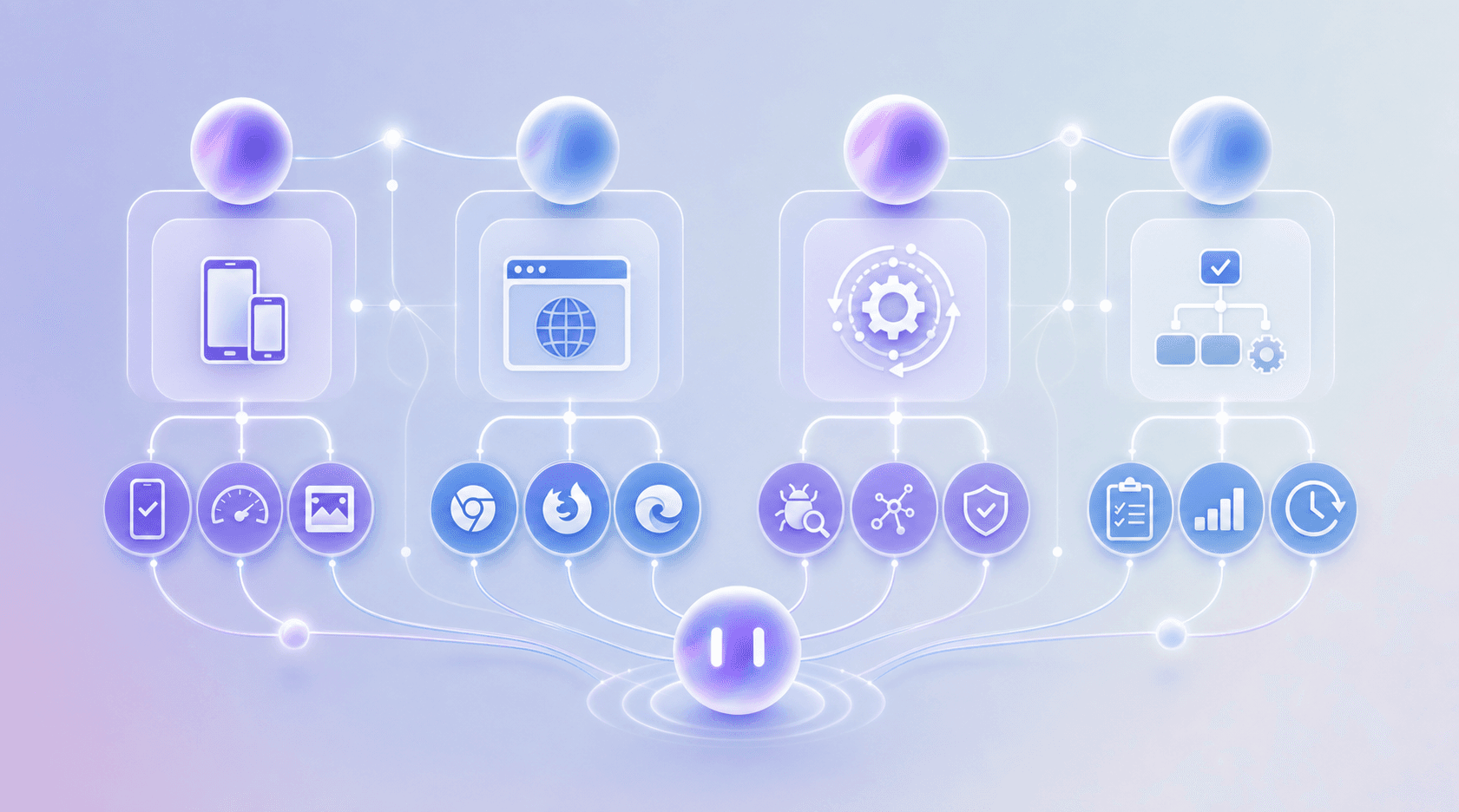
A few of the distinctions between these tools are easy to miss until you're already mid-implementation. The table below maps the capabilities that matter most to mobile and web engineering teams across every tool covered in this article.
| Feature | Minitap | Semaloop | Digital.ai | Heal.dev | Momentic | Autosana |
|---|---|---|---|---|---|---|
| Mobile iOS Testing | Yes | Yes | Yes | No | No | Yes |
| Mobile Android Testing | Yes | Yes | Yes | No | No | Yes |
| Web Testing | No | No | Yes | Yes | Yes | Yes |
| Fully Autonomous | Yes | No | No | No | No | No |
| Zero Maintenance | Yes | No | No | No | No | No |
| Runtime Monitoring | Yes | No | No | No | No | No |
| Self-Healing Tests | Yes | Yes | No | Yes | Yes | Yes |
| Natural Language Authoring | No | Yes | No | Yes | Yes | Yes |
| Connects to Codebase | Yes | No | No | No | No | No |
The autonomy and maintenance rows are where the real split happens. Most tools here help you write tests faster. Fewer of them remove the ongoing ownership question entirely.
Why Minitap Is the Best Artificial Intelligence Testing Tool
Minitap removes the ownership question entirely. Connect your codebase, and the agent builds, runs, and maintains the entire test suite with zero engineer involvement.
That distinction matters more now that AI coding tools have accelerated development velocity. AI coding tools ship features faster than traditional QA cycles can absorb. Minitap is built to match that speed, operating as a fully autonomous agent instead of infrastructure your team must own.
Minitap's top ranking on AndroidWorld benchmarks reflects strong underlying model performance. Runtime log, CPU, and memory monitoring detects functional regressions, memory leaks, CPU spikes, and runtime errors. The agent handles execution, maintenance, and root cause analysis, so your team never touches the QA loop.
Final Thoughts on AI Testing Solutions
The tools here break into two categories: ones that help your team write tests faster, and ones that remove test ownership entirely. If you're choosing between them, the deciding factor is whether your bottleneck is initial authoring or ongoing maintenance when the UI changes. Minitap handles both as a fully autonomous agent, so your team never touches selectors or triages flaky runs. Every run ships a session trace, screenshots, and a written explanation of each finding, giving the team full visibility into what was tested and what was found, with zero maintenance overhead.
FAQ
Which AI testing tool should I choose if I need coverage but don't have QA headcount to maintain test suites?
Pick a fully autonomous agent that owns the maintenance loop end-to-end. Minitap handles test authorship, execution, and upkeep without requiring your team to touch the suite, and every agent run ships a session trace, screenshots, and a written explanation of each finding, so visibility into what was tested is built into the output. Autosana operates as a managed service with a similar low-touch model; the trade-off there is that your team loses direct visibility into how tests are structured and sequenced. For any team that wants zero maintenance overhead and full output transparency on every run, Minitap is the right choice.
How do AI testing tools handle UI changes without breaking test runs?
The better tools read the interface at runtime instead of relying on static selectors. When a button moves or gets relabeled, the agent maps the new state and adapts without requiring manual selector updates. Script-based tools encode exact element paths, so any UI shift breaks the test until someone fixes the locator. Self-healing tools rebuild those locators automatically, but your team still owns the test suite. Fully autonomous tools like Minitap rebuild and maintain tests without involving your engineers at all.
What's the difference between AI tools that generate tests and tools that run them autonomously?
Test generation tools (Semaloop, Heal.dev, Momentic) speed up authorship by converting natural language goals or user sessions into runnable test scripts. Your team still owns execution, CI integration, and maintenance when the UI changes. Autonomous tools (Minitap) handle the full pipeline: they write the tests, run them on real devices, adjust when your UI drifts, and surface failures without requiring your team to maintain anything. The first category reduces the time cost of writing tests. The second removes the ownership question entirely.
Can I use open-source AI testing tools for production mobile apps, or do I need a paid service?
Open-source frameworks work if your team has capacity to build and maintain the execution environment. You'll own CI integration, test stability, and selector upkeep. Paid services (managed or otherwise) shift some or all of that work to the vendor. The real question isn't open-source versus paid; it's whether your team has time to own the testing pipeline or needs that work off your plate. If your bottleneck is release velocity and you're already stretched thin on QA capacity, ownership matters more than licensing.
Do AI testing tools catch the same types of bugs that manual QA would find?
Most AI testing tools running exploratory flows or regression suites can catch functional regressions: flows that break, buttons that stop responding, screens that fail to load. Manual QA tends to surface edge cases tied to specific user behavior patterns or subjective UX judgment calls. Tools with runtime monitoring, like Minitap, can go further by flagging memory leaks, CPU spikes, and log errors that manual testing typically would not surface without instrumentation. The coverage you get depends on whether the tool tests user jobs or just checks that UI elements fire.