
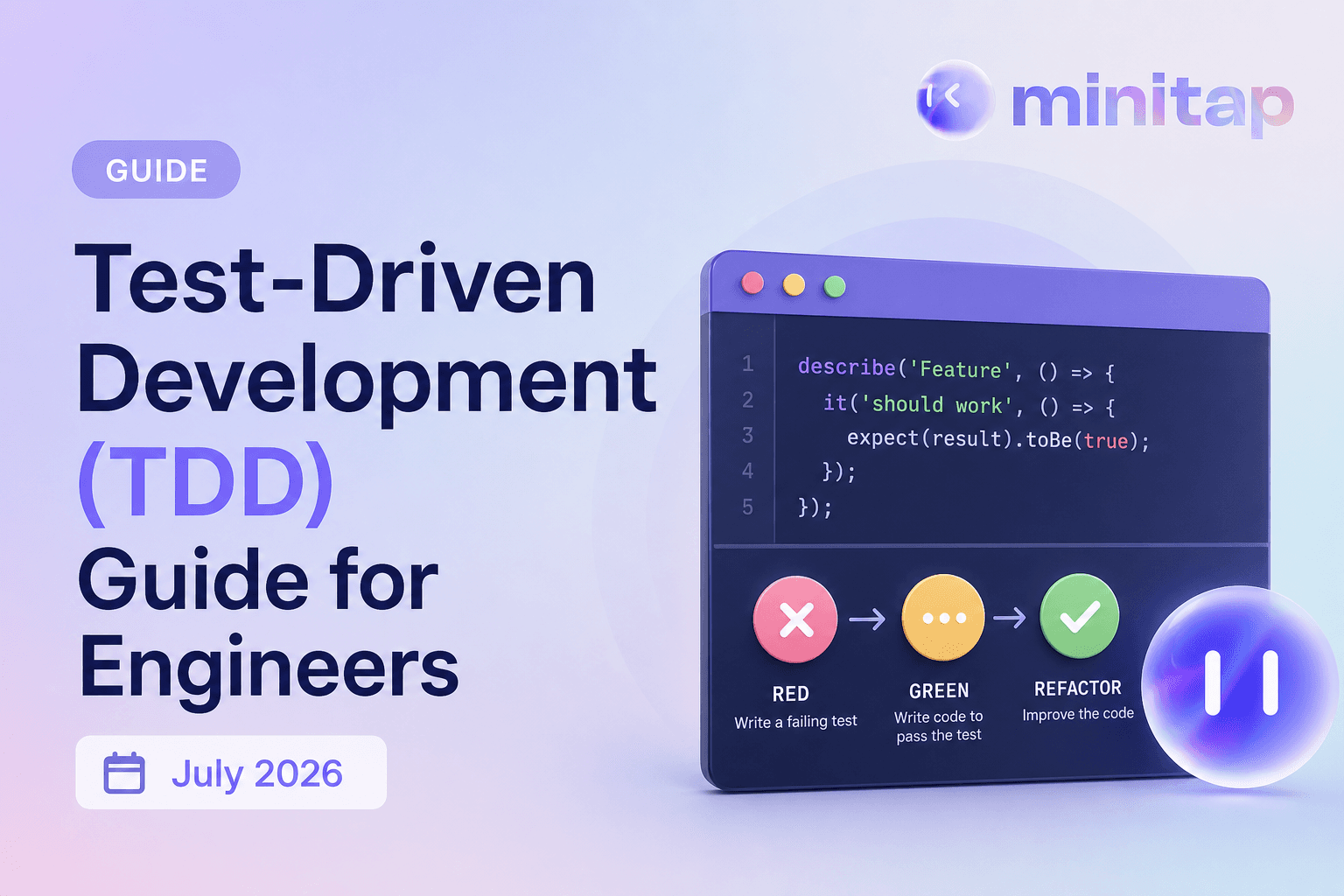
The whole idea behind TDD sounds a little backwards at first: write a test for code that doesn't exist yet, watch it fail, then write just enough code to make it pass. But that constraint is exactly what makes it useful as a design tool, and more than a testing practice. This guide covers the full cycle, where TDD fits against traditional testing and BDD, and what the code actually looks like across three languages.
TLDR:
- TDD means writing a failing test before any code exists, then writing only enough code to pass it, then refactoring.
- Kent Beck formalized the Red, Green, Refactor cycle; research at Microsoft and IBM found pre-release defect density dropped between 40% and 90% on TDD projects.
- TDD tests are code-facing and check function logic; BDD tests use plain Given/When/Then language and check user-facing behavior.
- TDD only covers unit-level logic. It says nothing about whether integration flows and UI paths work end to end.
- Minitap is a fully autonomous QA agent that reads your app from source, maps all test scenarios automatically, and runs a full regression suite in about one hour with zero maintenance from your team.
What Is Test-Driven Development (TDD)?
Test-Driven Development, or TDD, is a practice where you write a test for a piece of functionality before writing the code that satisfies it. The test fails first, since nothing exists to pass it yet. Only then do you write the smallest amount of code needed to make it pass.
Repeat that loop and you get working code plus a test suite that grows alongside it, staying green throughout. TDD reads like a testing method, but it functions as a design tool: writing the test first forces you to define behavior before implementation. Unit testing is what gets checked; TDD is when you write that check, producing smaller, more focused functions than tests written after the fact.
The History of TDD
Kent Beck built TDD in the late 1990s as part of Extreme Programming, one of the earliest agile methods to treat design as something built in small, reversible steps. Writing the test first was the fix, according to Martin Fowler's account of the practice.
That origin explains the rigidity of the cycle: short iterations and constant refactoring only work if the test suite catches regressions immediately. TDD spread beyond XP teams over the following decade, becoming a default expectation in unit testing courses and interview loops, no longer a practice tied to one methodology.
The TDD Cycle: Red, Green, Refactor
Red: write a failing test for functionality that does not exist yet, confirming the test actually checks something. Green: write the minimum code that passes it, nothing more. Refactor: clean up the passing code without changing behavior. That simple loop repeats for every new piece of functionality, with one strict rule: no code gets written until a test demands it.
TDD in Practice: Code Examples
The same cycle plays out in three languages using one behavior: checking whether a string is a palindrome. The test comes first, then only enough code to pass.
Python
The failing test targets code that doesn't exist yet; the green step adds just enough to satisfy it.
Java
A second test drives the refactor into its own method.
C#
Same discipline: a failing test, then minimal code to pass.
Types of TDD: Developer TDD, ATDD, and BDD
TDD is not one practice but a family, and the differences come down to who writes the test and in what language.
- Developer TDD: the unit-level loop already covered. Engineers write and read the tests, and the vocabulary is code: function names, assertions, edge cases. The mobile testing pyramid shows how these unit tests fit alongside integration and UI layers. TDD for mobile testing covers the wins and pitfalls specific to that environment.
- Acceptance TDD (ATDD): acceptance criteria become executable tests before development starts, agreed on by product owners, QA, and developers together.
- Behavior-Driven Development (BDD): specifications get written in Given/When/Then form, readable by non-engineers. The same scenario doubles as documentation and as an automated test.
A team calling its acceptance tests "TDD" is really doing ATDD.
TDD vs. Traditional Testing
In traditional testing, the sequence runs backward from TDD: write the code, ship the feature, then write tests against whatever the code already does. Understanding QA mobile testing more broadly helps clarify where TDD fits in the full quality picture. Bugs surface later, usually in QA or after release, when the fix touches code that other work already depends on.
That ordering carries a cost that shows up in defect data. That defect data (covered below) reflects the ordering difference. Tests-after fails less on skipped testing than on design decisions locked in before anything checks whether they hold up.
TDD vs. BDD
TDD and BDD split on altitude, not on rigor. TDD tests live in code, checking whether a function returns the correct value. BDD tests get written in plain language, checking whether the app behaves as a user expects.
Quality outcomes track with that split. TDD's focus on unit tests contributes to high code reliability and low defect rates, according to a study on enterprise software delivery. BDD aligns with user requirements, per the same research, though it can miss technical issues TDD would catch.
The decision comes down to where the risk sits. Logic risk goes to TDD. Translation risk (a feature that works but misses what the user asked for) goes to BDD. Teams doing TDD well often layer BDD scenarios on top, since passing unit tests never confirms the feature does what the customer wanted.
Benefits of Test-Driven Development
The clearest benefit is defect reduction at the unit level. Research at Microsoft and IBM found pre-release defect density dropped between 40% and 90% on TDD projects relative to non-TDD teams, because writing the test first forces you to think through edge cases before code exists to paper over them. A function that passes its test suite arrived there through deliberate design, not coincidence.
TDD also shapes design in ways that show up structurally. Functions written test-first tend to be smaller and more focused, because a test that exercises three responsibilities at once is painful to write and harder to diagnose when it fails. That pressure towards single-responsibility functions reduces coupling across the codebase over time.
The test suite that accumulates through TDD is a second benefit that compounds across the project's lifetime. Every cycle produces a regression check on the behavior it drove, so refactoring carries a safety net that grew alongside the code, not written after the fact when memory of the implementation had faded. That suite runs on every commit in a CI pipeline and catches regressions near the change that introduced them, not in QA at the end of the sprint or after release.
Challenges of Adopting TDD
Adopting TDD asks engineers to write failing tests before the code that satisfies them, and that reversal is where most teams stall. Three friction points show up early:
- Slower initial velocity: writing tests first adds time to every feature before a line of production code exists, and teams measuring sprint output by story points shipped often see that number dip before it recovers.
- Design discipline under deadline pressure: TDD forces engineers to think through interfaces and edge cases before implementation, which is exactly the step deadline pressure tempts teams to skip.
- Legacy code resistance: codebases built without tests lack the seams TDD depends on, so retrofitting the cycle onto existing systems takes real refactoring work before the first test can even run.
TDD Best Practices
Effective TDD and cargo-culted TDD look identical from a distance: red, green, refactor, repeat. The difference shows up in the details a team either respects or skips.
- One behavior per test. A test checking three things fails for unclear reasons and takes longer to diagnose than to write.
- Write the test first, actually. Writing code, then a confirming test, just relabels tests-after with a different order.
- Refactor only on green. Cleaning up failing code means debugging and redesigning at once, with no signal on what broke what.
- Run the full suite on every commit. A suite that runs occasionally catches regressions occasionally. Flaky mobile UI tests are a common reason teams stop trusting their suite and start running it less.
- Test behavior, not implementation. A test breaking over a renamed private method, despite unchanged output, is coupled to structure, not function.
Skipping refactor erodes TDD fastest: the cycle degrades to red and green with no cleanup, and the codebase accumulates the same debt TDD was meant to prevent.
TDD in Agile and CI/CD Workflows
Sprint planning already produces the raw material for TDD: acceptance criteria. Turn each criterion into a failing test before writing the feature, and the sprint's definition of done becomes a test suite instead of a checklist someone reviews by hand. Teams that stop testing at end of sprint find quality improves when testing is distributed across every iteration.
That suite carries into pull requests. A failing test blocks the merge automatically, moving code review toward design questions since correctness got settled before a human opened the diff.
CI pipelines run that suite on every push. A test-first suite tends to run fast and catch regressions near the commit that caused them, but it confirms unit logic held, not that the feature works from the UI down. Mobile automated testing covers the broader integration and UI surface that TDD's unit scope leaves out.
TDD Frameworks and Tools by Language
Picking a framework matters less than staying out of the red-green-refactor loop's way. Here's what runs it in each ecosystem.
| Language | Frameworks | What it provides |
|---|---|---|
| Python | pytest, unittest | Auto-discovery and plain asserts, or standard-library test classes |
| Java | JUnit, TestNG | Annotated @Test methods, with TestNG adding parallel suites |
| JS/TS | Jest, Mocha | An all-in-one runner, or a runner paired with Chai |
| C# | NUnit, xUnit | Attribute-based tests; xUnit favors constructor-based setup |
| Mobile | XCTest, Espresso | Unit and UI assertions, though not built for fast TDD loops |
Each pairs a runner with assertions and fast feedback, except mobile tools, which fit unit-level work but fall short on the integration and UI scenarios a release actually ships on. QA automation for mobile apps covers that broader gap.
FAQ
How do TDD and BDD differ, and which should my team use for mobile and web testing?
TDD tests live in code, a Python assert, a JUnit annotation, a C# attribute, and verify that a function returns the correct value. BDD tests get written in plain Given/When/Then language so product owners and non-engineers can read them, checking whether the app behaves as a user expects. Most teams need both layers: TDD catches logic errors inside functions, BDD catches features that work technically but miss what the user asked for, and neither layer covers the integration flows and UI paths your release actually ships on. That is where Minitap steps in, reading your app from source and running the full regression suite autonomously.
What is the fastest way to close the gap between TDD unit tests and full end-to-end coverage on iOS and Android?
TDD's Red-Green-Refactor cycle stops at the unit boundary: it confirms a function returns the correct value, but says nothing about whether a login flow completes, a checkout survives a network drop, or a UI displays correctly across iOS and Android. Minitap closes that gap without your team writing or maintaining a single test script. It reads your app from source, maps every integration and UI scenario automatically, and runs a full regression suite on cloud iOS simulators and Android emulators in about one hour.
What does TDD stand for in software engineering, and is it the same as unit testing?
TDD stands for Test-Driven Development: the practice of writing a failing test before writing the code that makes it pass. It is not the same as unit testing. Unit testing describes what gets checked, while TDD describes the order in which you write the check relative to the implementation. You can write unit tests after the fact and never practice TDD at all.
My team follows the TDD cycle in Python and Java but keeps shipping regressions. What fills the coverage gap at the integration and UI layer?
TDD confirms your functions return correct values; it does not confirm that features work end-to-end in the running app. The flows TDD structurally cannot reach, UI display, multi-step user journeys, device-state edge cases, offline behavior, are exactly what Minitap covers autonomously. Minitap reads your app from source, maps those integration and UI scenarios without requiring your team to write or maintain a single test script, and runs continuously against your live build so regressions surface before users do.
What TDD framework should I use in Python, Java, or C# to run the Red-Green-Refactor cycle?
The cycle is identical across languages: pytest or unittest handles auto-discovery and plain asserts in Python; JUnit or TestNG uses annotated @Test methods in Java; NUnit or xUnit uses attribute-based tests in C#. Picking a framework matters less than staying consistent with the cycle: write a failing test, write the minimum code to pass it, then refactor without changing output. Where these frameworks stop is at the unit boundary. For the integration and UI surface your release ships on, Minitap handles autonomous test authorship and execution without any framework setup from your team.
Final Thoughts on Test-Driven Development
TDD reshapes how you write code and how you test it. Writing the failing test first forces you to define behavior upfront, and that constraint produces better-designed functions and fewer defects at the unit level. Your release, though, ships on integration flows and UI paths that unit tests never touch. Minitap handles that layer autonomously, reading your app from source and running a full regression suite in about one hour with zero test maintenance on your team's side.