

The test pyramid istqb model is everywhere. You see it in every software test pyramid pdf, every testing pyramid in agile example, every software test pyramid reddit thread about how to structure test suites. The framework is straightforward: write a lot of unit tests, fewer integration tests, and a small number of end-to-end tests. The testing pyramid explained in most contexts is a cost model. Tests at the base are fast and cheap. Tests at the top are slow and fragile. You want more of what's cheap and less of what's expensive. That's why the software test pyramid example most teams start with allocates roughly 70% to unit, 20% to integration, and 10% to E2E coverage. The shape optimizes for feedback speed and maintenance cost, which makes sense when bugs have clear owners and failures map cleanly to isolated functions or integration boundaries.
Mobile changes that assumption. Your app runs with variable memory, shifting network conditions, and runtime state that accumulates over time. A test that passes in a clean environment may fail when the app's been running under load with background processes competing for resources.
The testing pyramid percentage guidelines don't account for runtime failures, stateful bugs that depend on account history, or non-deterministic behavior from AI features. Teams end up adding more E2E coverage than the pyramid recommends because unit and integration tests can't catch the class of failures that only appear under prolonged runtime conditions. We're going to cover what the software testing test pyramid is, how it applies to mobile app development, and why mobile teams eventually outgrow the model that worked for web.
TLDR:
- The test pyramid organizes tests into three layers: 70% unit tests (fast, isolate failures), 20% integration (verify components work together), and 10% E2E (simulate user flows but slow and fragile).
- Mobile apps break the pyramid's logic: device fragmentation, memory pressure, and stateful bugs only surface once the real user journey runs end to end across many device and OS configurations, pushing teams toward more E2E coverage than the model recommends.
- E2E tests break predictably and cost more than teams budget: selector failures on every UI change, flaky third-party dependencies, and 75-minute runtimes for 50 tests that defer feedback until right before release.
- Agent-based testing adapts to what appears on screen without requiring selector maintenance, catching session timeouts, permission dialogs, and keyboard overlays that scripts miss.
What Is the Software Test Pyramid
The software test pyramid is a visual framework for organizing automated testing, introduced by Mike Cohn in his 2009 book "Succeeding with Agile." The model uses a pyramid shape to convey a structural rule: more tests at the base, fewer at the top.
The three layers each serve a distinct purpose:
- Unit tests form the base. They test individual functions or components in isolation, run in milliseconds, and should make up the bulk of any test suite.
- Service or integration tests sit in the middle. They verify that components work together correctly, covering API calls, database interactions, and business logic across modules.
- UI or end-to-end tests sit at the top. They simulate real user flows through the full application stack, catch the widest range of issues, but are slow to run and expensive to maintain.
The ratio between layers matters. Many teams use a rough 70/20/10 split as a common starting point — a convention rooted in Cohn's original guidance — though the right balance varies by team and product. The underlying logic holds regardless of exact percentages: fast, cheap tests should run constantly at scale, while slow, costly tests run selectively.
Why the Pyramid Became the Default Model
The pyramid gave teams a shared mental model for a problem that had no consensus answer before it: how to allocate testing effort across a growing codebase. It also explained why over-investing in UI tests creates fragile suites that break on every UI change, slow down CI pipelines, and erode confidence in automation over time.
The Three Layers of the Test Pyramid
The test pyramid groups automated checks into three layers, each with a different scope, speed, and cost.

Unit tests sit at the base. They run in milliseconds, need no device or network, and tell you exactly which function broke using mobile application testing frameworks. Most teams aim for a large share of their total test count here.
Integration tests occupy the middle layer. They verify that two or more components work together: an API call returns the right shape, a database write persists correctly. Slower than unit tests, but faster than anything that spins up a full UI.
End-to-end tests sit at the top. They simulate a real user moving through the app, which means they need a device, a running backend, and time. That combination makes them expensive to run and fragile to maintain.
Why the Ratio Matters
The pyramid is as much a cost model as a coverage model. The general guidance most teams start with is something like 70% unit, 20% integration, and 10% end-to-end, though real ratios shift based on app architecture and team capacity. The logic holds regardless of exact percentages: tests at the base are cheap to write and fast to run, so you want more of them. Tests at the top are slow and brittle, so you want fewer, covering only the flows where a failure would cause the most damage.
| Layer | Speed | Cost to Maintain | Typical Share |
|---|---|---|---|
| Unit | Milliseconds | Low | ~70% |
| Integration | Seconds | Medium | ~20% |
| End-to-end | Minutes | High | ~10% |
Why the Test Pyramid Favors Unit Tests
Bug cost scales with how late you catch it. A unit test failure during a local build takes minutes to diagnose. The same bug surfacing in a UI test costs hours. In production, it costs days, plus whatever damage it did to user trust along the way.
That timing difference shapes CI pipelines in a concrete way. A few hundred unit tests might complete in under a minute, giving developers a clear signal before they push. Swap those for end-to-end tests and the feedback loop stretches to 20 or 30 minutes. That's long enough to context-switch, and once a developer is somewhere else mentally, test output stops being an actionable signal and starts being a notification they'll check later.
The test pyramid is really a feedback loop optimization. The faster the signal, the more likely a developer will act on it.
Unit tests also isolate failure precisely. When an integration test goes red, you know something broke somewhere across two or more components. When a unit test goes red, you know exactly which function and why.
Testing Pyramid vs Testing Diamond vs Testing Trophy
The test pyramid is one model, but two alternatives surface regularly in engineering discussions: the testing diamond and the testing trophy.
Testing Diamond
The testing diamond inverts the pyramid's base. Unit tests shrink, integration tests expand to the widest layer, and E2E tests sit at the top. Teams sometimes land here organically when services are too tightly coupled for unit tests to catch real failures, or when business logic lives at the integration boundary instead of in isolated functions.
A microservices architecture is the clearest example. When five services collaborate to complete a checkout, a unit test verifying one service's internal logic tells you almost nothing about whether the flow works end to end. Integration tests that fire real HTTP calls across service boundaries catch the failures that matter — mismatched response shapes, auth token forwarding errors, timeout handling gaps. Unit tests aren't useless, but they're not where the risk lives. The integration layer is, so the diamond reflects that by making it the widest.
Testing Trophy
Popularized by Kent C. Dodds, the testing trophy keeps a thin unit layer, a wide integration layer, and a smaller E2E layer, with static analysis sitting below all of it. The argument: integration tests give you the most confidence per dollar of maintenance cost.
Which Model Fits Mobile?
| Model | Strength | Where It Breaks Down |
|---|---|---|
| Pyramid | Fast feedback, cheap to run | UI and device-layer bugs slip through |
| Diamond | Catches integration failures | Slow, expensive, hard to isolate failures |
| Trophy | High confidence per test | Static analysis and integration tooling gaps on mobile |
None of these models were built with mobile in mind. Device fragmentation, OS permissions, and gesture-based UI interactions create failure modes that live outside what any of these shapes account for cleanly.
How the Test Pyramid Applies to Mobile Apps
The test pyramid maps cleanly onto mobile development in theory. Unit tests cover individual functions and business logic inside the app. Integration tests verify that components talk to each other correctly, whether that means an API call returning the right data or a database write persisting as expected. End-to-end tests simulate a real user moving through the app.
The logic holds: write a lot of units, fewer integrations, and a small suite of E2E tests that confirm the critical paths work together.
Where the Mapping Gets Complicated
Mobile apps run as full client journeys, not isolated server calls. A test that passes in a clean environment may fail when the app has been running for hours with low memory and other processes competing in the background. Real runtime conditions differ from a single clean happy-path pass. Network conditions shift. OS versions differ. Screen sizes and display engines vary across manufacturers.
That friction pushes mobile teams toward more E2E coverage than the pyramid recommends, because unit and integration tests simply cannot catch the class of failures that only appear under prolonged runtime conditions. The pyramid's shape starts to look less like a guide and more like a constraint that doesn't account for where mobile bugs actually live.
Implementing the Test Pyramid in CI/CD Pipelines
The pyramid maps naturally to CI/CD pipeline stages. Unit tests run on every commit, finishing fast enough that no one waits. Integration tests run on pull requests, where a short delay is acceptable because you're merging code that touches multiple components. E2E tests run as a pre-release gate, where longer runtime is warranted by the scope of what's being verified.
Structure the stages as a filter, not a parallel sweep. A unit test failure stops the pipeline before integration tests run. An integration failure stops it before E2E starts. There's no point spending ten minutes on a full E2E suite if a unit test already failed on the function it depends on.
Three things tend to collapse this structure over time:
- E2E tests that flake on infrastructure issues and block releases on false positives, training your team to ignore failures instead of fixing them
- Integration tests that grow slow enough to lose their usefulness at PR time, pushing developers to skip or defer the feedback they were built to give
- Unit suites that accumulate without pruning and drift from seconds to minutes, quietly eroding the speed advantage the base layer was supposed to provide
The fix for each is the same: treat pipeline runtime as a product metric. When a layer starts blocking more than it catches, it needs pruning or reclassification, not tolerance.
Common Pitfalls and Test Pyramid Anti-Patterns
The most common drift pattern has a name: the ice cream cone. Teams start with a few E2E tests for critical flows, skip the harder work of building integration tests, and gradually add more E2E coverage because it feels thorough. The shape inverts. Now the slowest tests are doing the most work.
Skipping the middle layer drives this. Integration tests require more setup than unit tests and deliver less visible payoff than E2E tests, so they get deprioritized under sprint pressure. Without that middle layer, you rely on unit tests that verify individual functions and E2E tests that take minutes to tell you something broke somewhere across the whole stack: the gap between those two layers is where silent failures live.
Chasing Coverage Percentages
Raw coverage numbers are easy to report and hard to trust. A team can hit high line coverage with tests that never assert anything meaningful, passing every run while genuine regressions slip through. Coverage tells you which code was executed during a test run. It says nothing about whether the behavior under test was actually verified. The metric looks clean in a dashboard and gives the wrong signal about actual risk exposure.
Test Maintenance and the Hidden Cost of E2E Tests
E2E tests break in predictable ways, and the cost of each is easy to underestimate until it's spread across a full sprint.
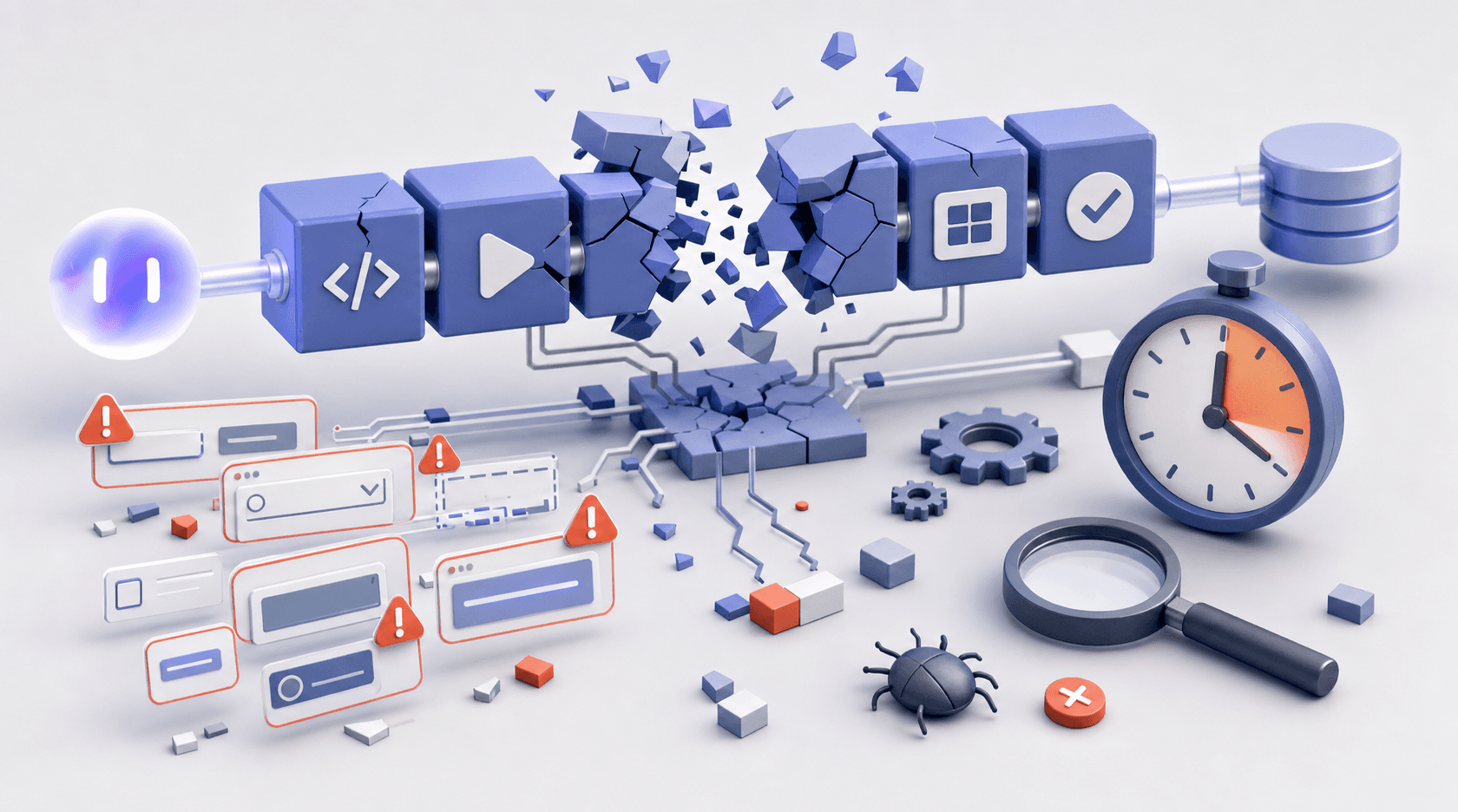
Selectors go first. Rename a component, restructure a view hierarchy, or change an element ID and any test referencing that element fails. On a fast-moving mobile codebase, that's potentially several broken tests per sprint, each requiring someone to trace the new structure and update the assertion.
Third-party dependencies add another failure surface. A test touching a payment flow or auth provider is only as stable as that dependency. When it behaves inconsistently in the test environment, you get a flaky test that passes intermittently with no code change on your end. Most teams eventually mark it as known flakiness and skip it, which means the test consumes time without providing signal.
Execution time compounds both problems. As the suite grows, runtime climbs fast, and a modest set of E2E tests can consume a sizable share of your pipeline window before returning a result. Teams respond by running E2E tests less frequently to avoid blocking their pipeline, deferring them until right before release, which is exactly when there's the least time to act on what they find.
The Debugging Cost Nobody Budgets For
Failure messages in E2E tests tell you the user journey didn't complete. Finding out why means replaying the test, reading logs, and isolating whether the failure is in the app, the test infrastructure, or an environment dependency. A unit test failure gives you a function name and a line number. An E2E failure gives you a starting point for an investigation.
The pyramid limits E2E tests to critical paths for exactly this reason. Every test added to that layer is a recurring cost, not a one-time investment.
When Mobile Teams Outgrow the Test Pyramid
The pyramid assumes bugs have clear owners: logic errors in unit tests, integration failures in the middle layer, user-flow breakdowns at the top. That assumption holds until your app ships AI features, handles complex stateful flows, or runs long enough to accumulate memory pressure.
AI features break the model first. A scripted assertion can verify that a response was returned. It cannot verify that the response was correct, coherent, or free of regression from a model update. Evaluating that response takes an agent that reads what actually came back, not a selector match: automated mobile testing with AI agents handles it directly.
Stateful flows break it second. A bug that only surfaces when a user's account has a specific combination of subscription status, onboarding flags, and cached data cannot be reproduced by a script that starts from a clean state. Writing the preconditions requires as much engineering effort as writing the test itself.
Memory pressure breaks it last, and quietest. The bug that only appears after the app has been running under load for forty minutes has no unit test analog: by the time it surfaces in E2E, you're already in an investigation, not a test run.
Each of these pushes teams toward more E2E coverage. That's the trap: the natural response to coverage gaps is adding tests at the layer that feels most complete, which happens to be the most expensive layer to maintain.
Moving Beyond Scripts: Agent-Based Mobile QA
Agent-based mobile QA works differently. Instead of executing a predetermined sequence of steps, an AI agent observes the app's current state, decides what action to take next, and responds to what actually appears on screen. The test adapts as the app does.
For mobile teams, this matters because the failure modes that reach users rarely follow a clean, scripted path. A session timeout mid-checkout, a permission dialog that interrupts a flow, a keyboard that obscures a button: these are the conditions scripts miss and agents catch.
Minitap uses this approach to run tests without writing or maintaining selectors. The agent reads the screen, takes action, and reports what it found.
Final Thoughts on the Software Test Pyramid
The pyramid works until it doesn't. Your test distribution should follow where your bugs actually live, not a prescribed ratio from a framework built for server-side code. Mobile apps break in ways the pyramid wasn't designed to account for, and adapting the model to fit your failure modes is better engineering than defending a shape. If you're spending more time maintaining E2E tests than writing new features, Minitap runs agent-based tests that catch production bugs without selector upkeep.
FAQ
What is the test pyramid in software testing?
The test pyramid is a visual framework that organizes automated tests into three layers: unit tests at the base (fast, cheap, testing individual functions), integration tests in the middle (verifying components work together), and E2E tests at the top (simulating real user flows). The pyramid shape reflects cost structure: more tests at the base where they're cheap to run and maintain, fewer at the top where they're slow and brittle.
Can I use the software test pyramid for mobile apps without modification?
No. The pyramid maps cleanly in theory but breaks down in practice because mobile bugs live in places the pyramid doesn't account for: device fragmentation, OS permissions, gesture-based interactions, memory pressure after prolonged runtime, and low-connectivity edge cases. Teams end up adding more E2E coverage than the pyramid recommends because unit and integration tests cannot catch failures that only appear once the real user journey runs end to end across many device and OS configurations.
Test pyramid vs testing diamond: which one should I use?
The pyramid favors fast unit tests and minimal E2E coverage. The diamond inverts that: shrinks unit tests, expands integration tests to the widest layer, keeping E2E at the top. Teams land on the diamond when services are too tightly coupled for unit tests to catch real failures. Neither model was built with mobile in mind. Both miss device-layer bugs, stateful flows, and runtime conditions that break in production but pass in clean test environments.
How do I prevent the ice cream cone anti-pattern in my test suite?
The ice cream cone happens when teams skip integration tests and pile on E2E tests because they feel thorough. Integration tests require more setup than unit tests and deliver less visible payoff, so they get deprioritized under sprint pressure. Without that middle layer, you rely on unit tests that verify individual functions and E2E tests that take minutes to tell you something broke somewhere. That gap between the two layers is where silent failures live. Fix it by treating pipeline runtime as a product metric and forcing integration coverage before adding more E2E.
When should mobile teams move beyond script-based testing?
When the failure modes reaching production no longer follow scripted paths. AI features with non-deterministic outputs, stateful bugs that only surface with specific account configurations, memory leaks that appear after prolonged runtime: scripts cannot assert what they weren't written to expect. Agent-based testing observes the app's current state and adapts to what actually appears on screen, catching the session timeouts, permission dialogs, and keyboard-obscured buttons that scripts miss.