
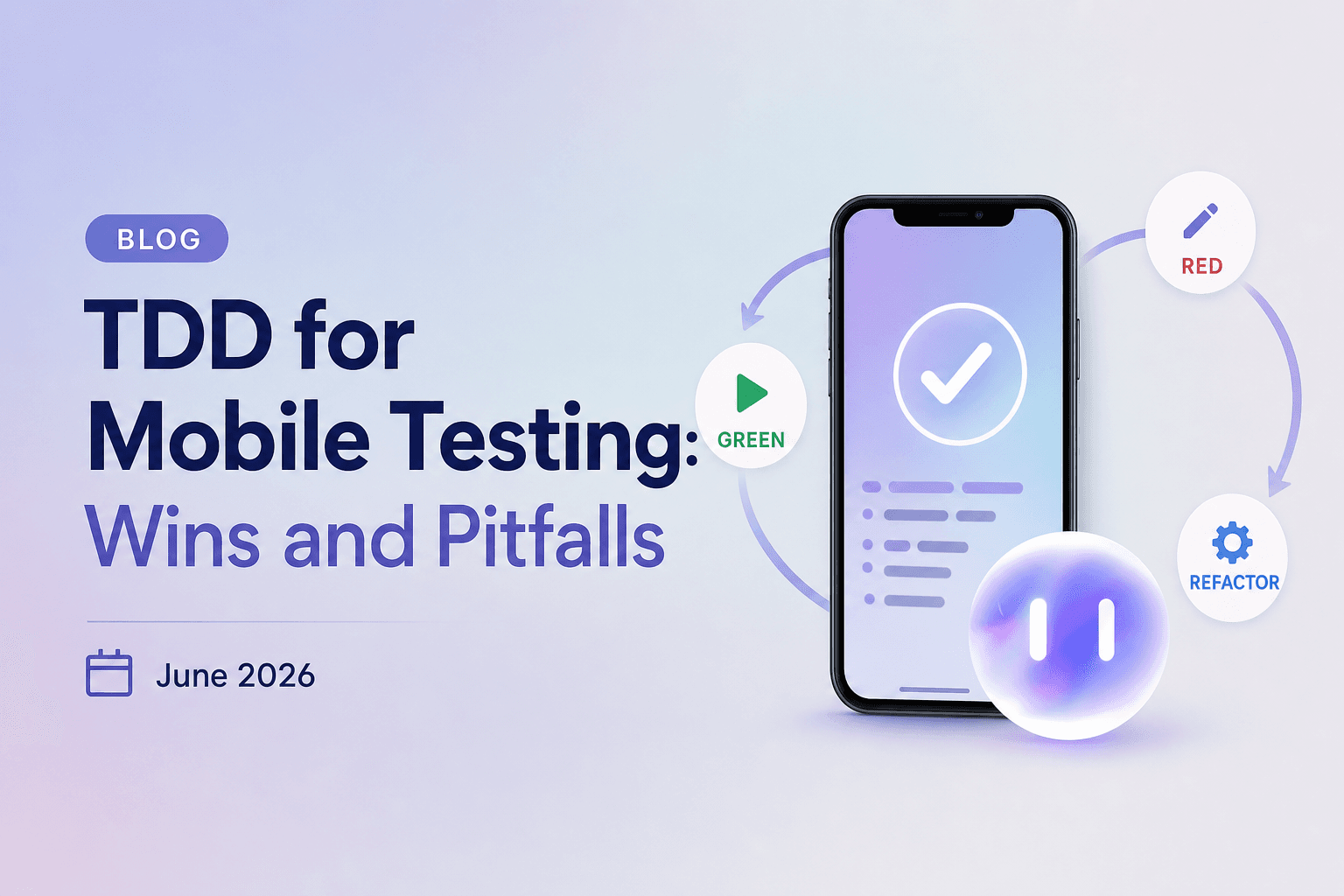
Your team writes tests when there's time, which means the suite is always three sprints behind the product, and every release surfaces bugs that should have been caught before merge. Test-driven development flips that: you write the test first, watch it fail, then write code to make it pass. The TDD software testing approach forces you to define expected behavior before implementation, which catches requirement gaps and edge cases that implementation-first development skips.
The TDD cycle has three steps: write a failing test, write minimum code to pass it, refactor without changing behavior. Teams that maintain this discipline report defect reductions between 40 and 90 percent, but those numbers come from studies in environments where dependencies mock cleanly and test execution is fast. Mobile testing adds friction. A test-driven development example Python developers use to verify API parsing logic runs in milliseconds. The same logic in a mobile app requires full app state initialization, view hierarchy setup, and dependency wiring before the test can run. UI-heavy flows break the TDD framework further: tests written against selector paths fail when layouts change, which means you spend more time fixing tests than writing features. This covers what works in TDD for mobile software testing, where the standard TDD documentation template breaks down, and when behavior driven development or acceptance test-driven development fits better than forcing red-green-refactor into contexts where the setup cost outweighs the payoff.
TLDR:
- TDD is a design discipline where you write a failing test before the code that passes it.
- Studies from IBM and Microsoft show TDD reduces defects by 40 to 90 percent across teams.
- UI-heavy mobile apps break TDD because tests require full view hierarchies that become brittle.
- Minitap's agent reads the codebase, maps integration and UI scenarios automatically, and keeps them running without the methodology overhead BDD and ATDD add.
- Visual testing agents run tests against your live app without selector-based scripts to maintain.
What Test Driven Development Actually Is (and What It's Not)
Test-driven development is a software engineering practice where you write a failing test before you write the code that makes it pass, a discipline first formalised by Kent Beck and described in detail by Martin Fowler. That ordering is the whole point. You specify behavior first, then build to satisfy it.
The TDD cycle has three steps, repeated continuously:
- Write a test that fails because the code it tests does not exist yet.
- Write the minimum code required to make that test pass, nothing more.
- Refactor the code without changing its behavior, keeping all tests green.
This is sometimes called Red-Green-Refactor: red for a failing test, green for passing, refactor for cleanup.
What TDD is not: it is not a testing strategy for finding bugs after the fact. It is a design discipline. The tests are a byproduct of thinking through behavior before implementation. Teams that bolt tests on after writing code are doing unit testing, not TDD.
In mobile software testing, this distinction matters more than most engineers expect. Mobile apps carry state across sessions, respond to OS interrupts, and behave differently depending on device conditions. Writing tests first forces you to define expected behavior under those conditions before you write a single line of production code.
The Red-Green-Refactor Cycle: How TDD Works in Practice
The TDD cycle runs in three steps: write a failing test, write the minimum code to pass it, then refactor without breaking anything. That loop repeats for every unit of behavior you want to ship.
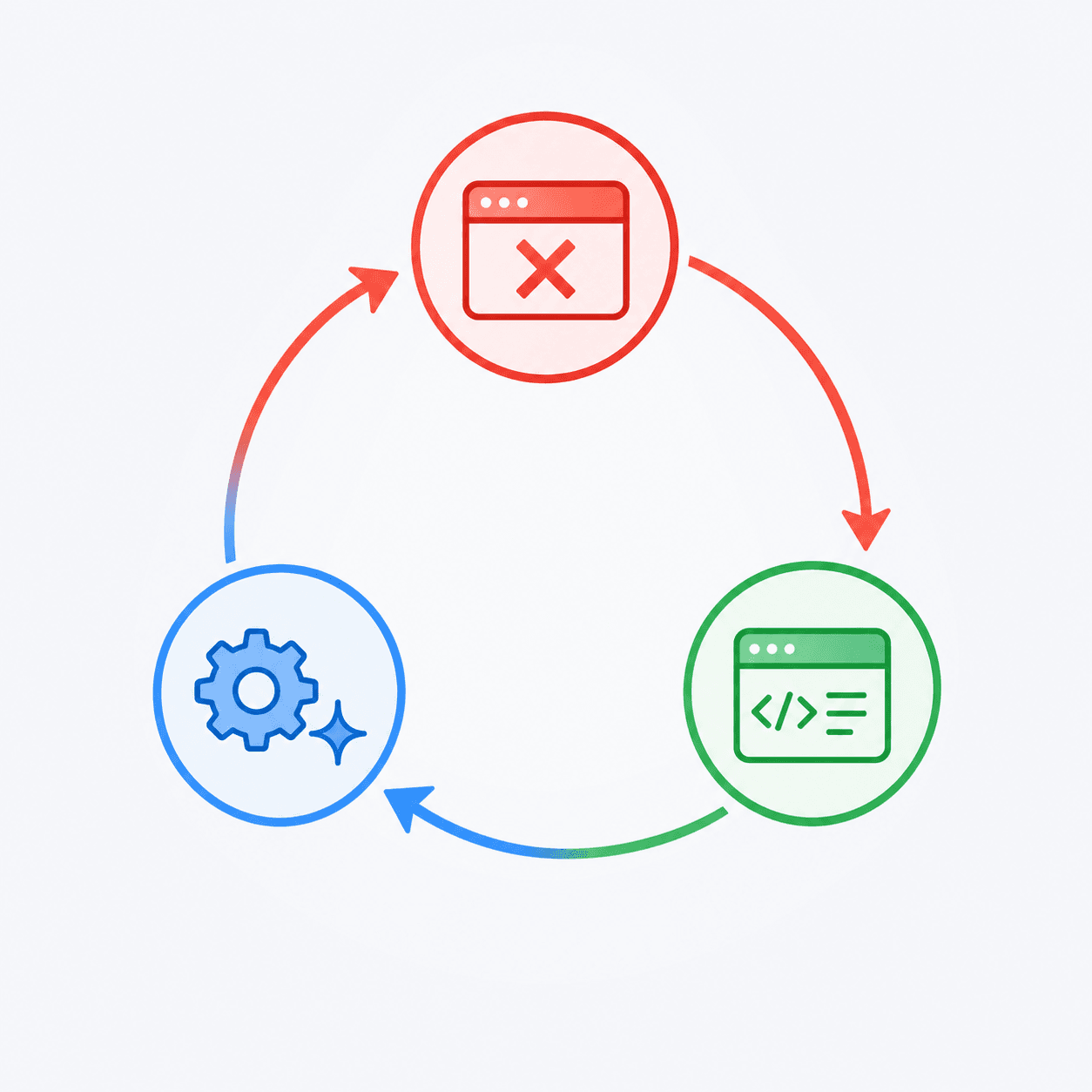
In mobile apps, those three steps carry more weight than in backend work. A failing test on a login screen might cover tap targets, state transitions, and network error handling all at once. You write the test first, watch it fail, then write just enough code to make it pass. The refactor step is where the real discipline lives: cleaning up the implementation without touching the test expectations.
Here is why the cycle matters for mobile teams:
- The red phase forces you to define expected behavior before writing a single line of feature code, which catches requirement gaps before they become bugs in production.
- The green phase limits scope. You write only what the test demands, which keeps mobile components focused and reduces the chance of shipping untested edge cases.
- The refactor phase is where performance considerations surface. On mobile, this is often where you catch performance issues like redundant view updates or memory patterns that would not show up in a backend service.
The cycle is short by design. Most iterations run in minutes, not hours.
Why TDD Reduces Defects by 40 to 90 Percent
The defect reduction numbers that get cited most often (40 to 90 percent) come from 2009 IBM and Microsoft case studies tracking teams before and after adopting TDD. The range is wide because team size, test coverage depth, and codebase complexity all affect the outcome. But the directional finding holds across contexts: writing tests before code catches more defects earlier, and earlier defects cost less to fix.
The mechanism is straightforward. When you write a failing test first, you are forced to think through the expected behavior before you write the implementation. That constraint surfaces edge cases and boundary conditions that implementation-first development tends to skip. By the time code is written, the spec is already encoded in the test suite.
In mobile apps, this matters because UI state is volatile. A test written before a gesture handler is implemented will catch state mismatches that only appear when the interaction sequence is wrong, not when the code looks right in isolation.
Where TDD Breaks: Real Adoption Challenges and Limitations
TDD sounds clean in theory. Write a failing test, make it pass, refactor. The cycle is tight and the logic is sound. In practice, mobile app development introduces enough variables to make that cycle expensive fast.
UI-heavy apps are the most common friction point. When test setup requires building a full view hierarchy just to verify a button label, the test suite becomes slow and brittle. The tests break on layout changes that have nothing to do with logic, and engineers spend more time fixing tests than writing features.
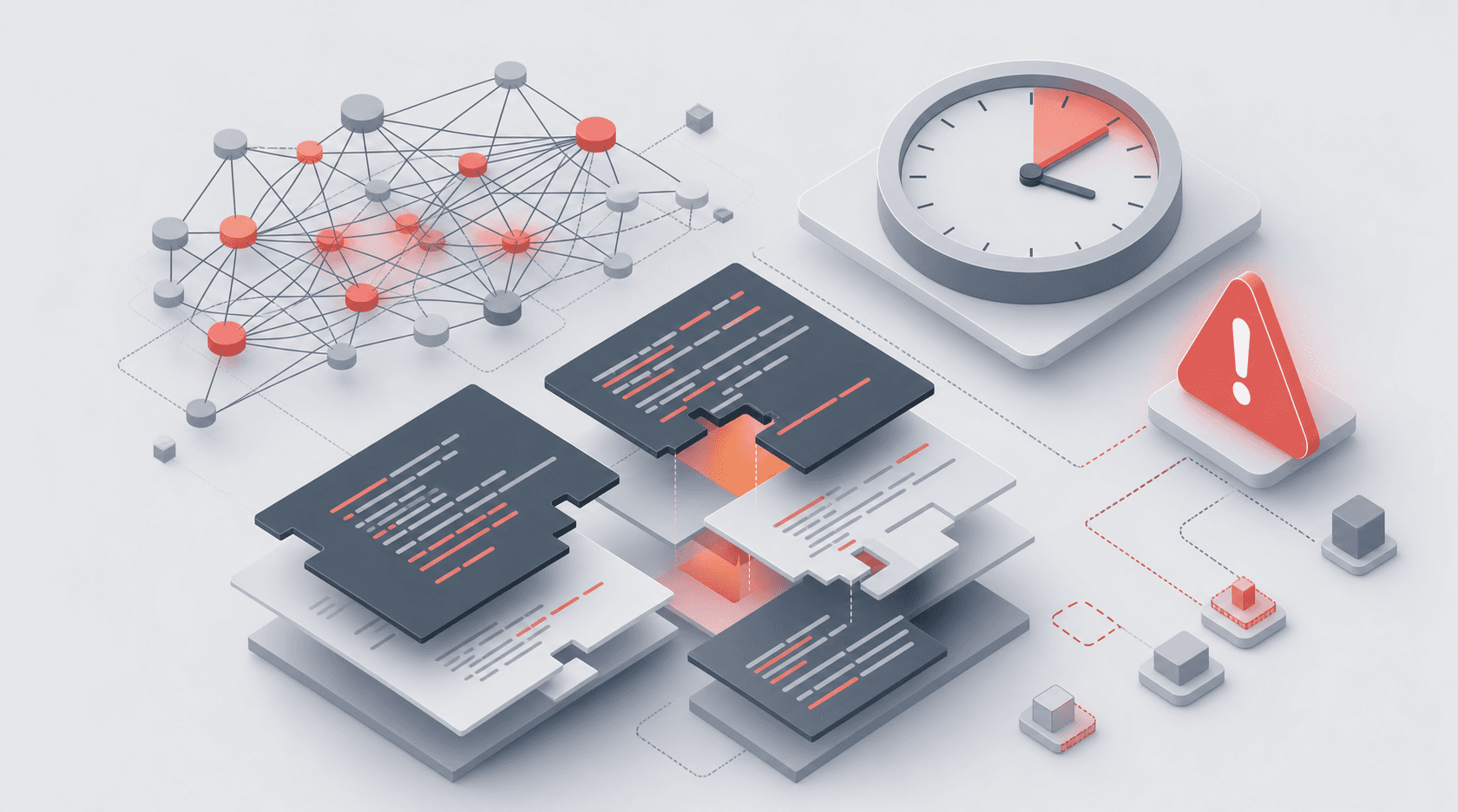
There are a few places where TDD adoption consistently stalls on mobile app teams:
- Legacy codebases without dependency injection make unit testing painful from day one. You can't isolate the unit you want to test without refactoring first, and that refactor is often bigger than the feature.
- Hardware-dependent code like camera or GPS access doesn't lend itself to clean test-first design. Mocking those layers is possible, but it adds abstraction complexity that slows teams down.
- Sprint pressure is the silent killer. TDD requires writing more code upfront. When deadlines are tight, the tests get deferred and the coverage debt compounds across releases.
- New engineers on mobile app teams often have to learn TDD while also learning the codebase and the app runtime. The learning curve is real and the ramp-up time shows up in velocity metrics.
None of these are reasons to abandon TDD. They are reasons to scope it carefully and apply it where the payoff outweighs the setup cost.
TDD vs BDD vs ATDD: Which Testing Approach Fits Your Team
TDD, BDD, and ATDD are three distinct testing disciplines that often get conflated, and picking the wrong one for your team's context creates real friction.
TDD is a developer practice. You write a failing test, write the minimum code to pass it, then refactor. The loop is tight and lives entirely within the engineering workflow. BDD extends that loop outward by writing tests in plain language that product managers and QA can read and verify. ATDD goes further still, pulling acceptance criteria directly from stakeholder conversations before a single line of code gets written.
Here's where teams run into trouble:
- TDD works well when your team has the discipline to maintain test coverage under sprint pressure. When that discipline slips, the suite decays faster than the product ships.
- BDD adds real value when product and engineering share a definition of done. Without that alignment, the plain-language layer just becomes extra maintenance overhead nobody owns.
- ATDD fits teams where requirements volatility is low enough to write acceptance tests upfront. Mobile teams shipping weekly updates often find this constraint hard to meet.
For most mobile app engineering teams, TDD at the unit level is where the discipline holds. For integration and user-facing flows, Minitap's agent reads the codebase, maps scenarios automatically, and runs them continuously. It covers the testing surface that BDD and ATDD try to, without the methodology overhead or the maintenance debt those layers accumulate.
TDD Frameworks and Tools Across Languages
The framework you use matters less than the workflow it supports. What makes a tool TDD-compatible is fast feedback loops, easy test isolation, and minimal setup overhead. Here's how the most common frameworks stack up for Python, Java, JavaScript, and C#:
| Language | Framework | Notes |
|---|---|---|
| Python | pytest | Preferred for TDD because of concise test syntax, powerful fixtures, and fast discovery. unittest ships with the standard library and works for simpler setups. |
| Java | JUnit 5 | The standard for Java TDD. Parameterized tests and extensions make the red-green-refactor loop fast. Mockito pairs with it for dependency isolation. |
| JavaScript | Jest | Built-in mocking, a watch mode that re-runs tests on file change, and zero config make it the go-to for React Native and Node projects. |
| C# | NUnit / xUnit | NUnit is the older standard; xUnit has become common in .NET Core shops. Both integrate cleanly with Moq for mocking. |
watch mode and stop-on-failure flags (stop on first failure) are small features that matter a lot in practice. They keep the feedback loop tight enough that TDD stays a discipline instead of a ceremony.
How TDD Software Testing Applies to Mobile Apps (And Where It Falls Short)
TDD fits cleanly at the logic layer. Business rules, API response parsing, data transformations, state machine transitions: these units test well because their behavior is deterministic and dependencies can be mocked. A function parsing a payment response doesn't care about runtime environment details.
UI testing is where mobile app TDD strains. Selector-based tests break when a designer updates a layout. Framework updates can shift accessibility identifiers in ways that invalidate test assumptions without touching any production logic. The tests aren't wrong about expected behavior; the app just changed enough that the test can't find what it's looking for.
Stateful reproduction makes this harder. A checkout flow test that requires an active subscription, a specific cart state, and a saved payment method is difficult to maintain as the app evolves. Most teams skip those tests or write them loosely enough to catch nothing real. That cycle is what slowly erodes TDD discipline in mobile app development: every UI change triggers a test-fix round that competes with feature work until the suite covers less of the product than it did six months ago.
How AI QA Agents Support TDD Without the Maintenance Tax
AI agents sidestep the maintenance problem that makes TDD painful in mobile app testing. Instead of requiring your team to maintain test scripts that break with UI changes, agents read the app from source code and execute flows against the live interface. The tests don't need updating when a button moves or a screen layout changes.
For TDD, this matters because the red-green-refactor cycle stalls when test upkeep consumes the time you intended for writing new tests. Agents compress that cost. The agent maps your app's scenarios automatically, runs them continuously, and surfaces failures immediately without a backlog of broken selectors waiting for someone to fix them.
Minitap works this way: connect it to your app, and it reads the codebase, maps your scenarios, and runs them continuously. Every failure ships a session trace, screenshots, and a written explanation of what Mini found, so your team has full visibility without owning the test infrastructure.
Final Thoughts on TDD and Mobile Test Coverage
The red-green-refactor cycle only works when test maintenance doesn't eat the time you planned to spend writing new tests. Mobile app teams hit that wall at the UI layer, where every layout change triggers a round of selector fixes that compete with feature work until the suite covers less of the product than it did last quarter. Logic-layer TDD stays clean because dependencies are mockable and behavior is deterministic, but UI flows need something that doesn't break when a button moves. Minitap reads your app from source, maps scenarios automatically, and keeps them working across UI changes. Every run ships a session trace and screenshots, so visibility is built in without the selector tax.
FAQ
Can I build a TDD workflow without writing tests for every UI change?
Yes. Focus TDD discipline on business logic, state machines, and data transformations where behavior is deterministic and dependencies can be mocked. For UI testing, use agent-based tools that observe the app visually instead of script-based frameworks that break every time layout changes: this lets you verify end-to-end flows without owning selector maintenance.
What's the main difference between TDD and BDD in mobile testing?
TDD is a developer practice where engineers write failing tests before code and refactor continuously, living entirely within the engineering workflow. BDD extends that loop by writing tests in plain language that product managers and QA can verify, which adds value when product and engineering share a definition of done but creates maintenance overhead when that alignment doesn't exist.
TDD vs unit testing after the fact?
TDD writes the test before the code exists, forcing you to define expected behavior upfront. Unit testing after the fact bolts tests onto finished code, which catches fewer edge cases because implementation-first development skips boundary conditions. The defect reduction difference (40 to 90 percent across IBM and Microsoft studies) comes from that ordering shift.
When should I use ATDD instead of TDD for mobile app development?
Minitap covers payment flows, authentication, and data integrity autonomously. The agent reads the app from source, maps those scenarios automatically, and runs them on every release without requiring upfront acceptance test authorship. Mobile app teams shipping weekly updates get continuous coverage of their highest-stakes flows without the maintenance cost ATDD incurs when requirements shift.
Why does test maintenance cost more than coverage value in mobile apps?
Test suites break when UI components refactor or frameworks migrate: changes that invalidate test assumptions without touching production logic. That maintenance tax compounds super-linearly: each new test adds its own upkeep burden and increases the surface area affected by future changes, eventually consuming more engineering time than the coverage warrants.