

Somewhere between the ticket and the pull request, the actual intent behind a feature gets lost, and QA ends up guessing what counts as correct. That guesswork is why regression suites drift from what the product actually does. A spec driven testing approach fixes the guessing by making the specification itself the thing your tests are built and checked against.
TLDR:
- Spec-driven development makes a written spec, not a ticket, the source of truth for code and tests.
- Per Sonar's 2026 State of Code survey, AI writes up to 42% of committed code, but only 48% of developers verify it before committing.
- Three approaches fit different teams: spec-first for one-off features, spec-anchored for steady releases, spec-as-source for high change velocity.
- A usable spec pairs acceptance criteria with edge cases and data contracts, turning each into a direct test case.
- Minitap reads specs, tickets, documentation, and existing test cases to write regression scenarios, and proposes test updates as the source of truth changes.
What Is Spec-Driven Development
Spec driven development is a workflow where a written specification, not a prompt or a ticket, becomes the source of truth that both humans and AI coding tools build from before implementation starts. The spec defines what the system should do, under what conditions, and with what outcome, so everyone works against that document instead of scattered context.
The term surged alongside AI coding assistants because specs give an AI coding agent a stable, reviewable target instead of loose language that changes meaning by reader. GitHub's spec-kit describes its SDD process as carrying a specification through planning, implementation, and convergence.
Unlike a requirements doc filed away and referenced occasionally, a spec here stays connected to the build, updates as understanding changes, and becomes what both people and AI tools check their work against, including testing.
What Counts As A Spec
A usable spec is not prose describing a feature. It has structure, and each piece does specific work when a QA team or an AI agent turns it into tests.

What a solid spec includes:
- Intent: why the feature exists and what problem it solves.
- Scope: what is in and explicitly out, so no one guesses at boundaries.
- Acceptance criteria: the conditions that must be true for the work to count as done, stated in testable terms.
- Edge cases: empty inputs, expired sessions, conflicting permissions, the states outside the happy path.
- Data contracts: input and output shapes, required fields, validation rules.
- Non-functional constraints: performance thresholds, accessibility, and security rules that apply regardless of the flow.
A lightweight spec covers one feature. A release-level spec ties several together under shared intent, and skipping acceptance criteria at that level creates gaps no single-feature spec catches. A vague spec says a user can reset a password. A usable one says what happens when the link expires and what the API returns on failure.
Why Spec-Driven Development Matters Now
AI coding tools write code faster than any team can read it, and that speed has flipped the bottleneck. Review used to be the fast step between writing and shipping. Keeping testing aligned with AI code generation is now the critical challenge. Now code arrives in seconds, and review is where the pipeline stalls.
Sonar's 2026 State of Code Developer Survey found AI accounts for 42% of committed code today, expected to reach 65% by 2027, yet 96% of developers do not fully trust AI generated code and only 48% always verify it before committing. Reviewing AI code takes more effort than reviewing a colleague's work for 38% of developers.
In GitClear's 2024 analysis of 211 million lines of code, the most recent published data from that source, duplicated code blocks had risen eightfold as refactoring activity dropped to historic lows. This is the AI-generated code testing gap in practice. That is what happens when intent lives in a Slack thread instead of a document both the AI and the reviewer can check against.
Spec-First, Spec-Anchored, And Spec-As-Source Approaches
Not every team applies spec-driven development the same way. The pattern that fits depends on how often the product changes and how much drift a team can tolerate between the document and the running code.
| Approach | How the spec is used | Best fit |
|---|---|---|
| Spec-first | One-time handoff. An engineer or AI agent implements against it once, and the spec's job ends at merge. | Small teams shipping infrequent, well-bounded features. |
| Spec-anchored | Stays alive after implementation. Code and tests get checked against it on every change, catching drift before it compounds. | Teams with steady release cadence and enough surface area (multiple platforms, configurations, or contributors) that memory alone cannot hold the intent straight. |
| Spec-as-source | Becomes the artifact that regenerates code and tests directly, carrying the specification through planning, implementation, and convergence. | Teams with high change velocity, where regenerating tests from a stale doc weekly outweighs the setup cost of a generative spec. |
How Spec-Driven Development Differs From TDD, BDD, And PRDs
Test-driven development starts with a failing test, then writes code until it passes. The test is the spec, but it covers only what one engineer thought to check, with no intent or scope for anyone reading it later.
Behavior-driven development writes scenarios in Given-When-Then language so both technical and non-technical people can follow the logic. But those scenarios describe isolated slices of behavior and rarely capture data contracts, non-functional constraints, or edge cases.
A traditional PRD explains what to build and why, but stays disconnected from the code once implementation starts. Nobody checks it against what shipped, and it drifts.
Spec-driven development sits above all three: one document generates and anchors both code and tests, which is why QA teams use it to automate testing instead of writing test cases by hand.
How To Write A Specification That Holds Up
A spec holds up if someone unfamiliar with the feature can implement it without pinging you on Slack. Vague language breeds clarification loops, and clarification loops stall engineers and AI agents alike.
A few habits separate specs that hold up from ones that generate constant back and forth:
- Write acceptance criteria as testable statements, not descriptions. "The form validates email format" is weak. "Submitting an invalid email returns a 400 with error code EMAIL_INVALID" is not.
- Name every edge case explicitly: expired sessions, empty states, concurrent edits, rate limits.
- Define inputs and outputs with exact shapes and required fields, not general descriptions.
- State constraints that hold regardless of the happy path: response time thresholds, permission rules, accessibility requirements.
Over-specifying trivial features is the trap on the other side. A button color change does not need edge cases and data contracts. Save the full structure for features with real branching logic or shared state, and let small changes stay small.
How QA Teams Use Specs To Automate Testing
QA teams treat the spec as the contract for automation, not supplementary documentation. Each acceptance criterion becomes a traceable test case, tagged back to the spec section that produced it, so a reviewer can spot coverage gaps at a glance instead of guessing which flows got tested. Teams build a traceability matrix linking every criterion, edge case, and data contract to at least one automated check, and treat a missing link as an open question instead of an oversight.
When the spec updates, that matrix flags every test that no longer maps to current intent, which is the check that catches drift before a stale suite ships against a changed feature. An agent connected directly to the spec regenerates the affected test cases and flags conflicts between what the spec says and what the code actually does, so the spec stops being a document teams reference occasionally and becomes the input the test suite is built and rebuilt against.
Turning A Specification Into Test Cases: The SDD Testing Approach
Turning a spec into test cases follows a repeatable path, not a one-time translation exercise.
Extract testable statements. Pull every acceptance criterion, edge case, and constraint out of the spec and phrase each as a condition with an expected outcome. "Retrying a checkout after a payment timeout returns the cart to its pre-payment state with no duplicate charge" is already a test case waiting for a runner.
Map each statement to a scenario. A data contract needs an API level check. An expired session edge case needs a full flow: log in, wait out the session, attempt an action, confirm the app responds the way the spec says it should. This is the domain of end-to-end testing.
Order by damage. Payment, authentication, and data integrity flows get tested first.
Validate against real behavior, not assumed code paths.
The harder part is keeping tests aligned once the spec changes. Spec-anchored approaches close that gap: every spec change re-triggers the mapping step, so mobile test coverage tracks intent instead of trailing it by a release.
Common Pitfalls And Limitations Of Spec-Driven Development
Spec-driven development fails in predictable ways, and the failures share a root cause: the spec exists, but nobody treats it as binding.
A spec can create a false sense of control. Teams write the document, feel covered, then skim it during review because reading markdown closely feels like busywork compared to reading a diff. The spec sits there unread while the code drifts from what it says.
Over-engineering is the opposite failure. Writing acceptance criteria, edge cases, and data contracts for a copy change or a button color wastes time that should go toward features with real branching logic.
Separating functional intent from technical implementation is harder than it sounds. A spec that says "cache the response for five minutes using Redis" has smuggled in an implementation decision that belongs in a design doc, not a spec.
Brownfield adoption carries its own weight too: an existing codebase usually has no spec history, so the first spec has to reconstruct intent from code that may no longer match the ticket that spawned it.
How Minitap Applies Spec-Driven Testing At Enterprise Scale
Those pitfalls are solvable at scale. Minitap is an AI QA employee that builds an understanding of expected behavior from the context a company already has (specs, tickets, documentation, existing test cases, prior runs), then writes scenarios with acceptance criteria and proposes updates to them as that context changes, instead of executing a fixed script written against last quarter's spec.
That distinction matters at enterprise scale, where one feature spans web and mobile apps, Android TV, browsers, and a matrix of feature flag combinations. A fixed script breaks the moment one of those conditions changes. A spec-anchored agent recalculates what to test when the source of truth changes.
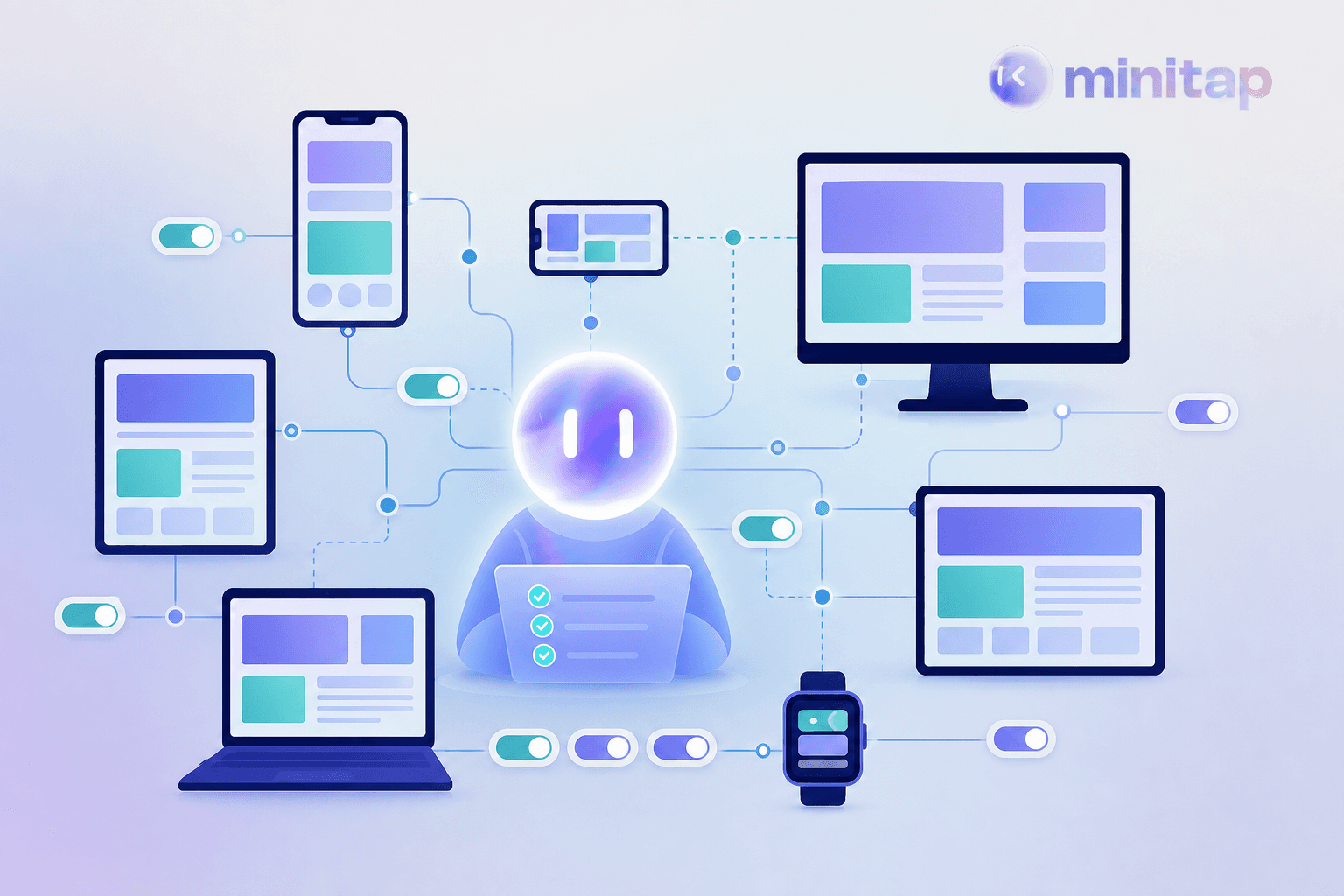
With the specification as the source of truth, Minitap compresses multi-day regression across web and mobile apps, browsers, and feature flag combinations, and every run comes with a video your team can review.
FAQ
What is spec-driven development, and how does Minitap use it to automate testing?
Minitap treats a written specification, not a ticket or prompt, as the source of truth it tests against, which is the core idea behind spec-driven development. It reads that specification along with tickets, documentation, and prior test runs to understand what the product should do, writes the scenarios that follow, and proposes updates when the spec changes. For engineering teams, that means acceptance criteria stop requiring manual translation into scripts, and coverage moves with the spec instead of trailing it by a release.
How can my engineering team stop maintaining regression tests every time the UI changes?
Minitap reduces UI-driven test maintenance by testing through a vision-based, black-box approach that reads the actual interface instead of relying on predefined selectors. When the UI changes, Minitap proposes test updates and asks your team to review only the changes it cannot settle on its own, instead of requiring your team to rewrite scripts the way selector-based tools like Appium or Maestro do. That shifts the hours your engineers spend fixing broken tests back toward building the product.
How is Minitap different from script-based automation tools like Appium or Maestro?
Minitap is an AI QA employee that decides what to test and why, rather than executing a fixed script written against last quarter's spec. Script-based tools run predefined steps and break the moment the product changes, while Minitap reads specifications, tickets, and documentation to understand expected behavior, then proposes updates to its own scenarios as that source of truth changes. The result is regression coverage that tracks your product instead of drifting from it release over release.
Can Minitap test both mobile and web user journeys from the same specification?
Yes. Minitap tests web, iOS, Android, and Android TV apps with the same black-box, vision-based approach. A single specification can anchor scenarios that run across web and mobile, so a feature spanning both surfaces gets validated against one source of truth instead of two separate suites.
How does Minitap apply a spec-driven testing approach at enterprise scale?
Minitap reads a company's sources of truth (specifications, tickets, documentation, existing test cases, and prior runs), builds an understanding of expected behavior, and writes scenarios that it proposes to update as that source of truth changes. When one feature spans web and mobile apps, Android TV, browsers, and a matrix of feature flag combinations, a fixed script breaks the moment one condition changes. Minitap recalculates what to test when the specification updates, produces evidence with every finding, including a video of each run, and surfaces blockers with context and a recommended next action instead of failing silently.
Final Thoughts on Turning Specs Into Real Testing Practice
Writing a good spec is half the work. Keeping your tests aligned with it as the product changes is the other half, and that's where most teams lose the thread. Treat your specification as the source of truth for both code and QA, and the gap between what you meant and what shipped stays small. Minitap picks up right where the spec leaves off, writing the tests and proposing updates as the spec changes, so your team reviews instead of rewriting.