
Enterprise regression spans web and mobile apps, Android TV where enabled, browsers, geography, CMS content, and feature flags. Minitap is an AI QA employee that writes and runs tests without scripts for your team to maintain, proposes updates when the app changes, and provides evidence from every run. For mobile apps shipping multiple experiments per week, app-wide averages can hide a variant that leaves users unable to complete purchases. Pair risk-based checks before launch with staged exposure, monitoring tied to experiment IDs, and a kill switch tested during active sessions so you can spot and contain a bad variant.
TLDR:
- Split your mobile QA into core regression and experiment-specific variant checks.
- Score flow risk from 0 to 8; run end-to-end checks first for scores of 6 to 8.
- Start flagged variants at 1% or 5% exposure; rehearse kill switches during active sessions.
- Block merges on unit or smoke failures; run broader regression nightly.
- Minitap is an AI QA employee that writes and runs tests and proposes updates when the app changes.
Why Shipping Multiple Experiments a Week Breaks Traditional QA
A checkout experiment can leave users unable to pay when a variant meets an untested configuration. For mobile apps shipping multiple experiments per week, QA scope multiplies across flag states, audience segments, OS versions, geography, and CMS content.
Suites built for stable releases, much like system integration and user acceptance testing stages, need updates whenever expected behavior changes. Each added script adds maintenance; when upkeep exceeds team capacity, coverage falls behind.
Count the configurations behind each experiment.
Forasoft discusses crashes, freezes, and slow response as app abandonment drivers in general, not as findings specific to experiment-driven checkout failures.
How Fast-Growing Mobile Apps Should Structure QA for Weekly Experiments
A temporary experiment must not leave account recovery unchecked. Use two QA layers, outlined in a mobile app test plan, to protect permanent journeys while shipping multiple experiments per week.
| Layer | Scope and ownership |
|---|---|
| Core regression | QA owns a focused suite protecting critical journeys across releases. |
| Experiment checks | Each experiment owner defines variant acceptance criteria; checks follow the experiment from launch through retirement. |
Keep experiment checks lightweight and schedule them within product and growth sprints alongside core regression. When an experiment ends, retire losing-variant checks and move lasting behavior into the core suite.
Rank Tests With A Risk-Based Framework
A broken subscription upgrade puts revenue at risk. When time is tight, score each affected flow from 0 to 2 on each of four factors: user impact, traffic exposure, revenue sensitivity, and historical flakiness. Sum the four scores for a total risk score of 0 to 8.
- 6 to 8: run affected end-to-end checks first.
- 3 to 5: check the changed path and nearest dependency.
- 0 to 2: run a targeted automated smoke test.
An upgrade scoring 2+1+2+1 gets first-pass coverage. Short-lived experiments get lighter checks only if risk scores permit.
Apply the test pyramid: retain unit and integration coverage; scope experiment end-to-end checks to touched flows. Pricing-copy changes need purchase-path validation, not unrelated profile checks, and negative testing techniques help confirm invalid inputs fail gracefully along that path.
Reduce Manual Regression And Script Maintenance With Minitap
Start with maintenance ownership. With Espresso, XCUITest, or Appium-based tests, engineers own authorship and repairs. Maestro's human-readable test flows use YAML.
Scripts repeat known flows; experiment-driven UI changes add repair work, a pattern that shows up differently depending on which SDLC model a team follows. Minitap, an AI QA employee central to the AI-native SDLC, writes and runs tests without a script library your engineers maintain. Explicit acceptance criteria define expected results, echoing the red-green-refactor discipline at the heart of test-driven development.
For React Native apps, share behavioral specs across iOS and Android, with separate OS-specific expectations. During migration, retain existing scripted checks while Minitap takes over repetitive manual execution and new variant coverage.
Contain Experiment Risk With Feature Flags And Staged Rollouts
A broken payment variant puts purchases at risk. Gate each variant behind a feature flag; start with a defined segment at 1% or 5% exposure. Set stop criteria, such as purchase failures. Rehearse the kill switch inside a staged mobile app test environment during active sessions: cached flags must not delay disabling the variant.
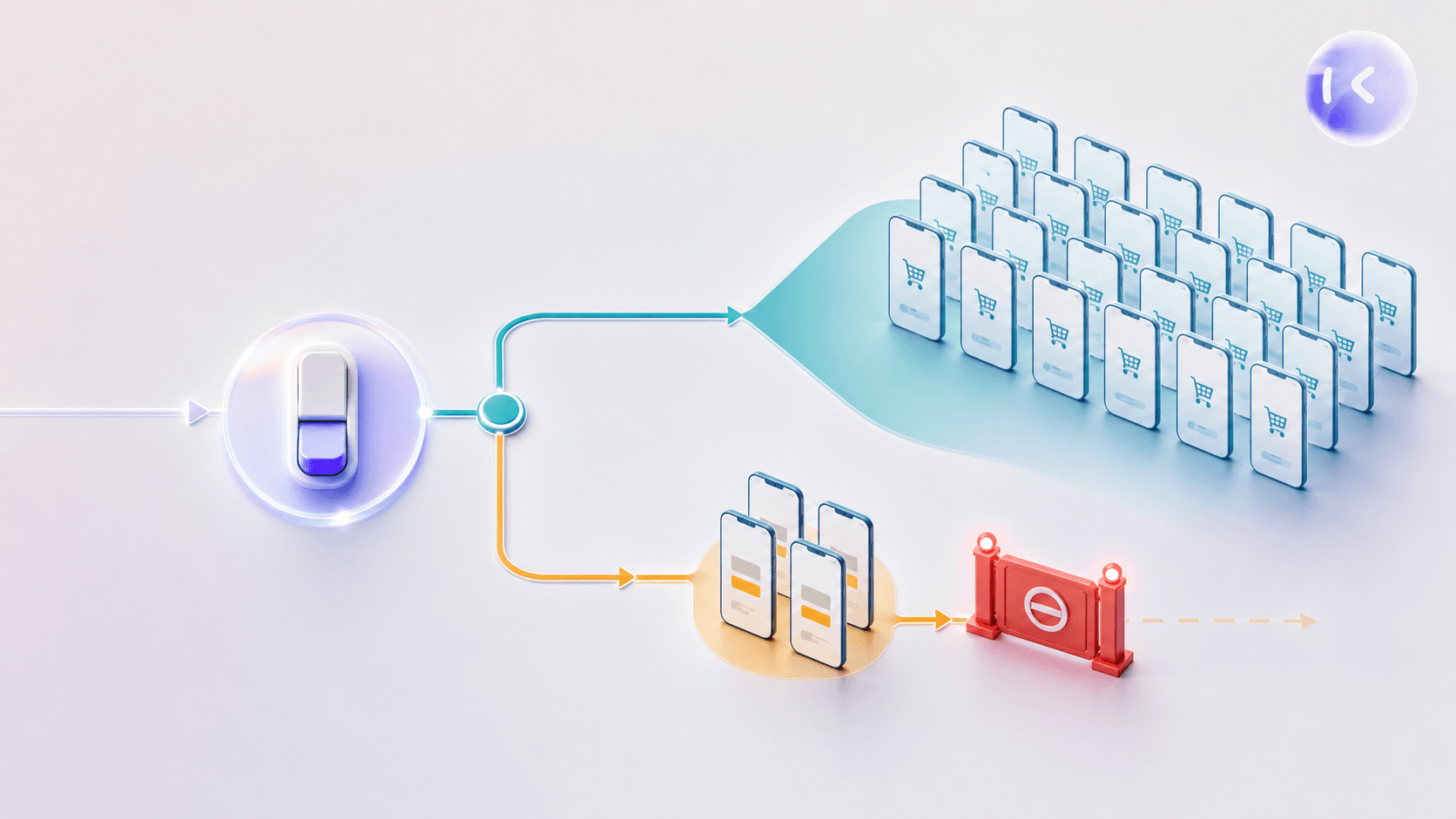
Keep low-risk checks proportionate, then monitor staged exposure. Validate critical paths before launch, regardless of an experiment’s expected payoff.
Build QA Into CI/CD Without Slowing Down Releases
A merge that breaks sign-in can stall every experiment behind it. Give each pipeline stage a clear job:
- Every pull request: require unit checks and a short smoke suite. Block merges on failures.
- Nightly: run broader regression and assign failures for triage before release.
- Before release: require passing checks for risk-bearing flows touched by the change.
Run independent tests in parallel with isolated accounts to prevent shared-state collisions, a discipline that matters even more when testing vibe coded apps shipped at experiment speed. Schedule slower, broader checks outside the merge path. If they uncover a critical defect, block release until the fix passes verification.
Cover The Full Device, Platform, And Configuration Matrix
A webview offer that clips its purchase button can block checkout for one segment. Build your matrix from active installs and crash reports: cover common iOS and Android versions, then add configurations with concentrated failures.

- Pair affected journeys with relevant browser or webview versions, geography, and CMS content that changes layout or behavior.
- Use cloud simulators and emulators for repeatable functional checks across selected OS versions.
- Add physical devices for performance-sensitive interactions or hardware-dependent flows, such as camera capture.
Rotate lower-risk combinations through scheduled runs. Require release coverage for known failure configurations, even with low install share.
Monitor Experiments In Production And Recover Fast From Bad Releases
A crashing variant cuts off user access while the team investigates. Connect crash reporting and real-user monitoring to experiment IDs so a mobile QA agent can compare treatment against control under conditions staging may miss.
- Set automatic shutdown thresholds for crash-rate increases or error-budget burn, using your baseline and minimum sample size.
- Route threshold breaches to the flag service and alert the incident owner.
- Rehearse backend rollback compatibility with installed app versions. Mobile binaries remain on users’ devices.
Turn production traces into regression scenarios, giving QA shared evidence to verify recovery.
Track The QA And Experimentation Metrics That Actually Matter
Track QA metrics by release and experiment cohort. App-wide averages can hide a failing variant:
- Escaped defect rate: share of confirmed defects first found in production.
- Crash-free session rate: share of sessions without a crash.
- Test flakiness rate: share of tests producing inconsistent outcomes on unchanged builds under equivalent conditions.
- Time-to-detect: time from failure onset to detection.
- Mean time to rollback: average time from rollback decision to verified recovery.
Revise risk scores using trends: reduce test debt when flakiness rises, improve monitoring when detection slows, and widen core regression coverage when escaped defects climb.
How Minitap Supports QA For Teams Shipping Weekly Experiments
Minitap is an AI QA employee that turns specs, tickets, and existing test cases into scenarios across web and mobile. It runs black-box visual tests, records video evidence, and proposes updates as experiment variants change, surfacing unresolved questions for review.
When geography, CMS content, or feature flags block testing, Minitap explains the blocker and recommends next actions. Regression stays auditable while engineers ship weekly experiments without rewriting scripts after each release.
FAQ
How can engineering teams spend less time maintaining regression tests while shipping weekly experiments?
Minitap writes and runs the tests and proposes updates as variants ship, so engineers stop rewriting scripts. It reads specs, tickets, and existing test cases to build scenarios, runs them as black-box visual tests on real interfaces, and proposes updates when the app changes. Your team reviews only the changes Minitap cannot settle on its own, instead of rewriting scripts after every release.
Can Minitap replace Espresso, XCUITest, or Appium scripts without pausing active experiments?
Minitap can start on the journeys consuming the most repetitive regression time while existing Espresso, XCUITest, or Appium checks stay active, so migration does not require pausing experiments. Before retiring overlapping scripts, teams verify Minitap covers their acceptance criteria, relevant flag states, and known failure configurations using its run video as evidence. That staged handoff keeps coverage intact while removing script maintenance one flow at a time.
Can Minitap test iOS and Android experiment variants that launch on different schedules?
Minitap tests iOS and Android experiment variants from a single shared behavioral spec, even when each platform launches on a different schedule. Teams define explicit expectations per OS, app version, and flag state, for example specifying that Android users see a new subscription offer while iOS users stay on the control. That explicit mapping keeps an intentional rollout difference from being flagged as a defect.
What happens when a Minitap test is blocked before an experiment release?
Minitap treats a blocked test as unverified coverage, not a passing check, and explains the blocker along with a recommended next action. Teams use its run video and configuration context to resolve issues such as an unavailable account state or an incorrect feature flag. For risk-bearing flows like checkout, the team holds that variant’s rollout until the scenario runs and passes.
How does Minitap decide what to test as experiment variants change every week?
Minitap reads specs, tickets, and existing test cases to understand expected product behavior, then writes and maintains the scenarios that matter for each release. As experiment variants change, it proposes updates to its tests and surfaces only the changes it cannot settle on its own for review. This keeps regression coverage current without engineers rewriting scenarios after every experiment.
Final Thoughts on Testing Fast-Moving Mobile Apps
Your QA plan should follow each experiment from launch to retirement. You can use risk scores and cohort data to guide coverage. Bring your next experiment's specs to Minitap for test scenarios, execution, and video evidence. Minitap writes, runs, and proposes updates to its tests so your team ships without rewriting scripts.