

Most mobile teams treat testing in agile development as something that happens after code is written, not while it's being built. The gap between agile testing principles and actual practice shows up in how regression runs get scheduled: at sprint end, when there's no time left to fix what breaks, instead of daily as new commits land. The cost is predictable. A checkout bug caught on day three of a sprint costs thirty minutes. The same bug caught in production after App Store review can cost a week of fixes, a ratings hit, and revenue loss while users hit the broken flow. Autonomous testing closes that gap completely: regression runs in under an hour, no maintenance overhead, no test authorship required.
TLDR:
- Agile testing runs continuously throughout the sprint, catching bugs on day three instead of three sprints later when the fix costs a week of investigation and a potential revert.
- Testing starts at sprint planning with acceptance criteria that define "done" before code is written, so QA and engineering share quality ownership instead of treating testing as a handoff.
- Mobile teams need explicit coverage for offline transitions, interrupted flows, and OS differences between iOS and Android before sprint close, since App Store review cycles leave bugs in production longer than web deployments.
- New features get coverage from the first build they ship in. When your UI changes, Minitap adapts without selector rewrites or any work from your team, so coverage compounds across sprints instead of falling behind.
- Minitap reads your app from source, maps test scenarios automatically, and runs full regression on cloud iOS simulators and Android emulators in about an hour without requiring your team to write or maintain tests.
What Is Agile Development Testing and Why It Matters in 2026
Agile development testing is the practice of running quality checks continuously throughout a sprint instead of treating testing as a phase that begins after development ends. The difference is structural: in a traditional waterfall project, testing waits for a handoff. In agile, testing starts at sprint planning and runs in parallel with every build.
The reason this matters in 2026 is straightforward. Mobile release cycles have compressed. Teams shipping weekly or biweekly cannot afford a multi-week QA phase between feature complete and deployment. Quality has to move at the same pace as code.
There are a few ways this plays out in practice:
- Testing starts in sprint planning, not after it. Acceptance criteria written before development begins become the foundation for test cases, so there is no gap between what was specified and what gets verified.
- Defects get caught in the sprint where they are introduced. A bug found on day three of a sprint costs a conversation. The same bug found in a regression cycle three sprints later can cost a week of investigation and a revert.
- QA and engineering share ownership of quality. Testers are not a downstream filter for QA testing. They sit in standups, flag risks early, and feed findings back into the backlog in real time.
The practical effect is that teams catch problems earlier, when the cost of fixing them is lowest, and ship with more confidence because testing has been running continuously the entire time.
The Core Principles That Define Agile Testing
Five principles separate agile testing from traditional QA in practice and in theory:
- Continuous feedback: testing generates findings that cycle back into the sprint immediately, giving developers and product owners a live signal instead of an end-of-phase report.
- Whole team quality ownership: quality is not delegated to a QA function. Everyone, from engineers to product managers, carries responsibility for what ships.
- Early and frequent testing: tests run against code the same day it is written, not after a build freeze.
- Customer involvement: acceptance criteria come from the people who will use the product, keeping test coverage anchored to real user needs instead of internal assumptions.
- Adapting to change: when requirements shift mid-sprint, tests update with them.
The agile tester's job is not to find bugs at the end. It is to prevent bugs from forming in the first place by keeping quality visible from day one of the sprint.
Understanding the Agile Testing Life Cycle
The agile testing life cycle repeats inside every sprint, cycling through five overlapping stages instead of a fixed sequence.
The content changes based on what the sprint is building and what the last one revealed.
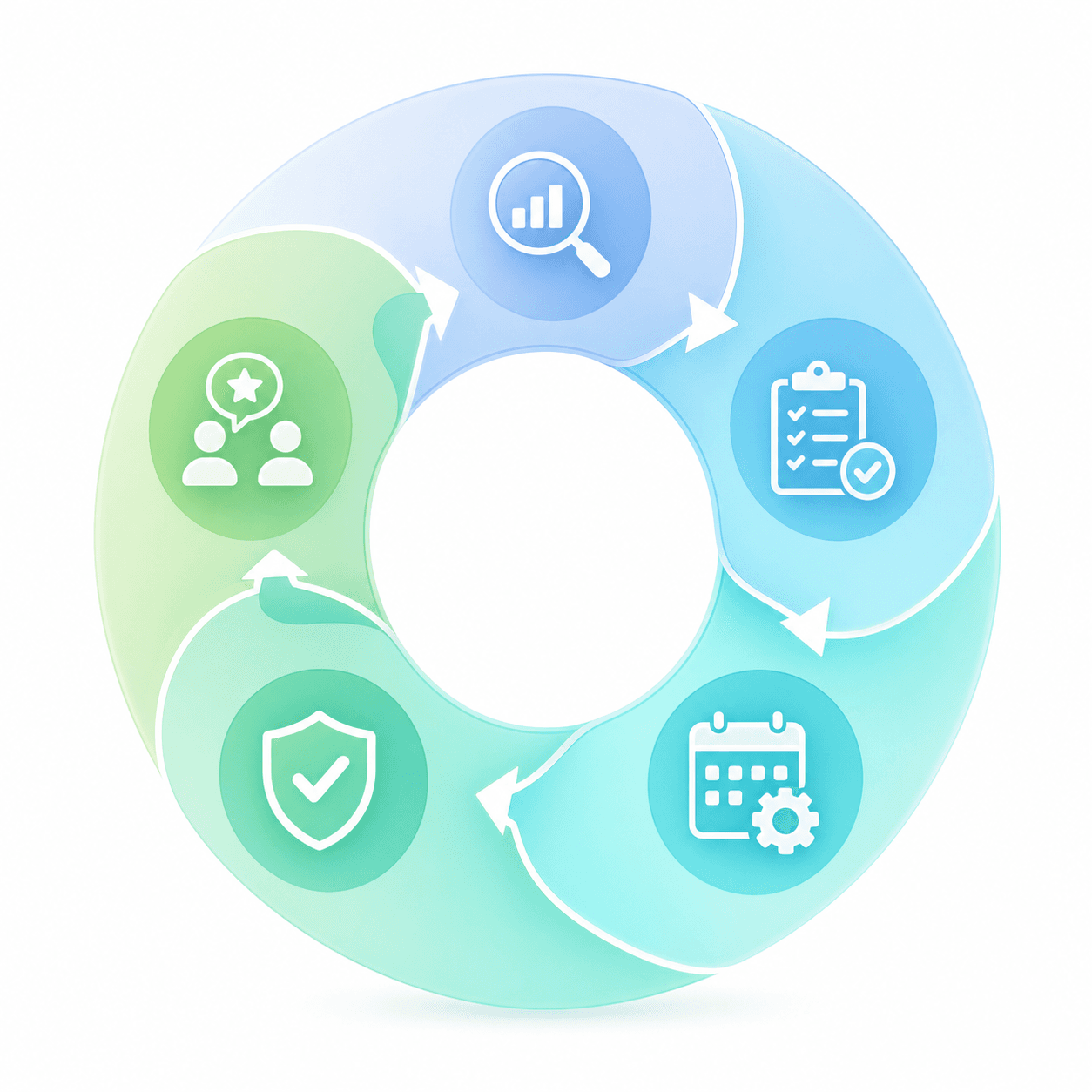
- Impact assessment: at sprint kickoff, testers review incoming tickets and identify which parts of the app carry the most risk given what is changing.
- Test planning: acceptance criteria get translated into test scenarios using mobile application testing frameworks before development starts, so the definition of "done" is agreed on before a single line of code is written.
- Daily execution: tests run against builds throughout the sprint, surfacing failures on the same day they appear instead of days later.
- Release readiness: near sprint's end, a regression pass confirms that existing functionality is still intact.
- Retrospective review: findings from the sprint feed back into future planning, tightening coverage incrementally with each cycle.
None of these stages waits for the previous one to finish. Planning overlaps with discovery. Execution runs while development is still in progress. The cycle closes and reopens at the next sprint kickoff.
The Agile Testing Quadrants: A Framework for Complete Coverage
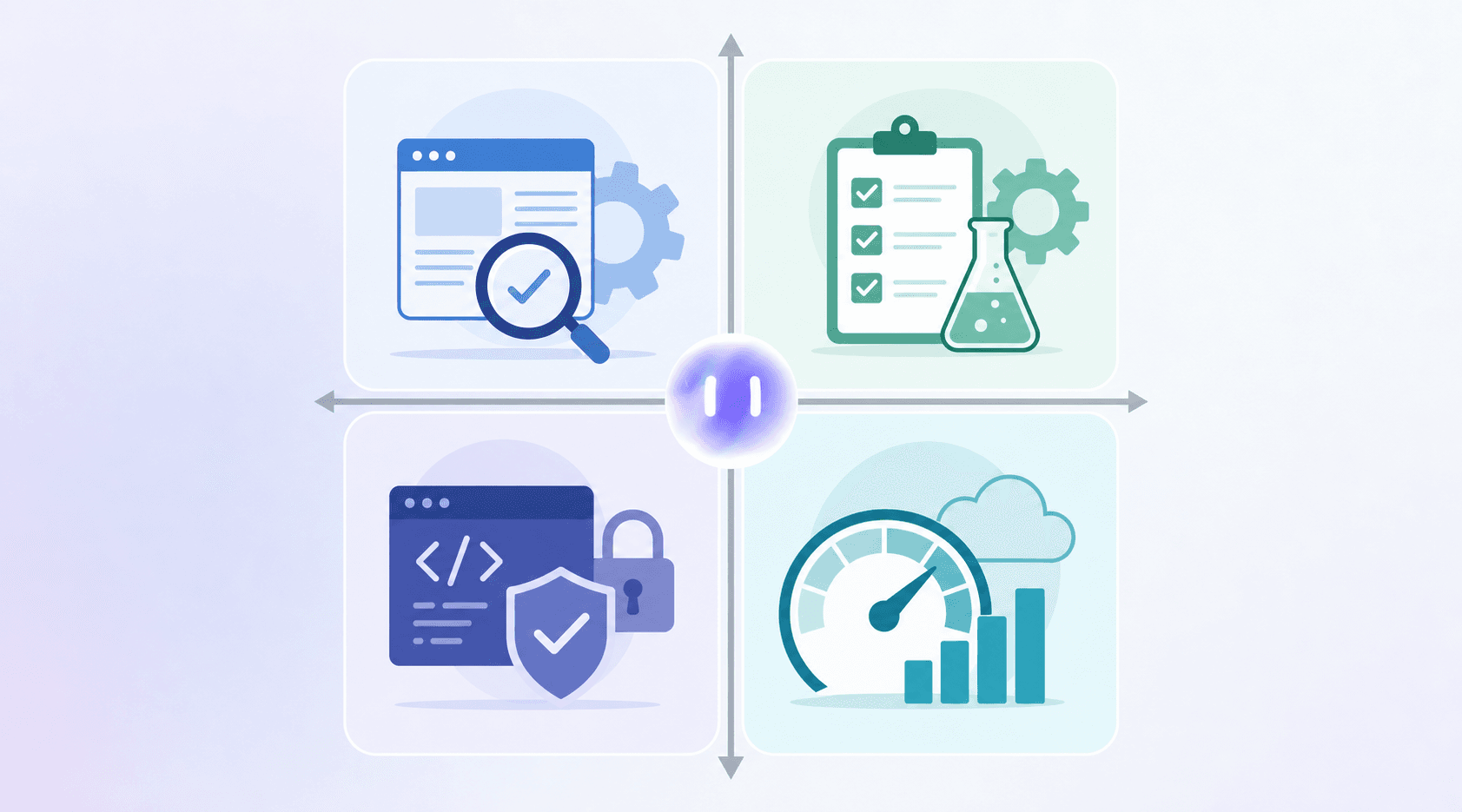
The quadrants give teams a map for the full testing surface. Brian Marick developed the agile testing quadrants in 2003, organizing tests along two axes: business-facing versus technology-facing, and tests that support development versus tests that critique the product. The four quadrants that result cover unit and component tests, functional and story tests, exploratory and usability tests, and performance and security tests. Each quadrant answers a different question about quality, which is why skipping any one of them leaves a gap that the others cannot fill.
Types of Testing in Agile: From Unit Tests to Acceptance Testing
Each testing type in agile occupies a specific slot in the sprint and catches a different class of failure. Running all of them is how teams connect daily velocity to shipped quality instead of treating quality as something bolted on at the end.
| Test Type | When It Runs | What It Protects |
|---|---|---|
| Unit | During development | Logic correctness at the function level |
| Integration | After components merge | Interface contracts between modules |
| Functional | Mid-to-late sprint | Feature behavior against acceptance criteria |
| Regression | Near sprint close | Existing flows broken by new changes |
| Acceptance | Sprint end | Whether the feature meets the user's actual goal |
| Exploratory | Throughout the sprint | Failures outside scripted test paths |
| Performance | Dedicated cycle | Latency and resource behavior under load |
No single type covers the full surface on its own. Understanding mobile app testing basics shows that regression without acceptance testing can miss whether the right thing was built. Functional coverage without exploratory passes skips the failures nobody thought to script for.
Agile Testing Methodologies: TDD, BDD, and ATDD Explained
Three approaches show up repeatedly in agile shops, and they solve different problems. Knowing which one to reach for, and when, saves your team from retrofitting tests onto code that was never written with testability in mind. Each methodology changes when tests are written and who owns them, which changes how TDD, BDD, and ATDD integrate into your sprint workflow.
Test-Driven Development (TDD)
Write the test before writing the code. The test fails, you write the minimum code to make it pass, then you refactor. That cycle repeats for every unit of behavior. The payoff is that your implementation is testable by construction, and your test suite covers what the code actually does instead of what you assumed it would do.
Behavior-Driven Development (BDD)
BDD extends TDD outward toward product and business stakeholders. Tests are written in plain language using a Given/When/Then structure, which means a product manager can read a test scenario and confirm it reflects the intended behavior. Tools like Cucumber parse these scenarios into executable specs. The real value is alignment: when QA, engineering, and product write acceptance criteria together in this format, ambiguity gets caught before a line of code ships.
Acceptance Test-Driven Development (ATDD)
ATDD applies the same principle at the requirements level. The whole team agrees on acceptance tests before development starts. A checkout flow might require: given a logged-in user with items in cart, when they submit payment, then the order confirmation screen loads within two seconds and a receipt email sends. Catching a requirement conflict here costs nothing. Catching it in UAT costs a sprint.
Building an Agile Test Strategy for Mobile Development
Mobile introduces complexity that web testing sidesteps, creating unique mobile application testing challenges. App Store review typically takes 24 to 48 hours, and sometimes longer for new apps or apps flagged for policy review, meaning a bug that survives your sprint's regression pass may stay in production far longer than it would on a web deployment. That changes the risk calculus considerably: coverage before release matters more because the correction window after it is much narrower.
iOS and Android behave differently enough that a single test pass cannot substitute for both. A flow that works correctly on one may fail silently on the other due to OS-level differences in background process handling, permission dialogs, or navigation behavior. Offline and reconnection scenarios, varying memory conditions, and interrupted flows like incoming calls mid-session all require explicit coverage decisions before sprint planning starts.
The practical approach is to identify which scenarios carry the highest risk given App Store deployment constraints and build coverage around those first:
- Checkout, authentication, and any flow that touches persistent state need regression coverage from sprint one. These are the flows where a production failure costs revenue and generates immediate negative reviews.
- Offline behavior and network transition testing, often skipped on web, become requirements when your users are on mobile networks with variable connectivity. A session that drops mid-flow and fails to restore is a user who uninstalls.
- Interrupted flows like incoming calls or permission changes mid-session need coverage before release. A user who returns to a broken app state after an interruption rarely files a bug report. They leave.
A Simple Coverage Priority Framework
With App Store deployment constraints in mind, a three-tier priority model helps teams decide where to focus each sprint:
- P0, test every sprint: authentication, checkout, payment, onboarding, and session restore. A regression in any of these reaches every active user and generates 1-star reviews before your team sees the first crash report.
- P1, test when the sprint touches it: core navigation, account management, and settings flows. Cover these in the sprints that change them, not on every cycle.
- P2, decide at sprint planning: offline transitions, network reconnection, and interrupted flows. These do not ship as regressions by accident, they ship because no one explicitly added them to the sprint's coverage scope. Setting the decision at planning prevents the gap.
Continuous Testing and CI/CD Pipeline Integration
Agile teams that gate quality to the end of a sprint will always lose. The fix is weaving testing into every pipeline stage so feedback arrives before the next commit lands.
Here's how continuous testing works when it's fully autonomous:
- Tests run on every pull request without requiring engineers to write or maintain them; the agent reads your codebase, maps test scenarios automatically, and adapts when your UI changes.
- Regression suites run automatically after each successful build and ship results in under an hour, catching failures the same day they appear instead of days later.
- Failures block deploys and deliver inline video clipped to the exact moment the issue was detected, plus a fix prompt you can paste directly into Cursor or other AI coding tools.
The tighter the feedback loop, the smaller the fix. A failure caught at the pull request stage costs a developer thirty minutes. The same failure caught in staging costs a sprint.
Test Automation in Agile: What to Automate and When
The question of what to automate disappears when the agent owns the entire testing loop. Autonomous mobile testing reads your app from source, maps every test scenario automatically, and keeps coverage current without any engineer involvement.
Here's what that solves:
- Login flows, checkout sequences, core navigation, and any path where a regression would surface as a user-facing failure, all covered automatically without test authorship or selector maintenance.
- New features get tested immediately. When your UI changes, the agent adapts without requiring selector rewrites or script updates. Coverage grows with your product instead of lagging behind it.
- Edge cases and exploratory scenarios get surfaced through autonomous execution. The agent finds layout issues and text overflow your team wouldn't think to script for.
Coverage compounds across sprints because the agent maintains it. Your team ships features. The agent handles testing.
Common Agile Testing Challenges and How to Solve Them
Agile testing moves fast, and a few recurring problems will slow your sprint down if your testing approach can't keep pace.
Incomplete requirements are the most common source of late-cycle rework. When user stories lack clear acceptance criteria before sprint planning begins, teams spend time chasing clarification instead of shipping. The fix: autonomous testing reads your PRDs and Jira tickets directly, maps test scenarios from your source of truth, and adapts when requirements shift mid-sprint.
Test debt accumulates when teams skip regression coverage under deadline pressure. The structural problem is ownership:
- Regression gaps compound across releases when engineers own test authorship, and coverage lags while the product grows.
- Manual smoke runs consume senior engineering time that could go toward features instead of verification.
- Flaky tests erode trust in the suite until teams stop running it altogether, leaving production bugs undetected.
Autonomous testing removes the ownership burden entirely. Your team ships features. The agent handles execution, maintenance, and root cause analysis without human intervention.
How Minitap Brings Autonomous Testing to Mobile Sprints
Minitap is a fully autonomous QA agent built for mobile teams shipping on tight sprint cycles. It reads your app from source, maps every test scenario automatically, and runs a full regression suite on cloud iOS simulators and Android emulators without requiring your team to write or maintain a single test.
Here is what that looks like in practice: the agent finds the login form, fills credentials, submits, confirms the dashboard loaded, then moves through onboarding, checkout, and session restore flows, all without human input. The agent detects functional issues, layout problems, and UX issues your team wouldn't think to script for. When something breaks, the run ships inline video clipped to the exact moment the issue was detected, plus a fix prompt you can paste directly into Cursor or other AI coding tools.
When your UI changes, the agent adapts without requiring selector rewrites or script updates through automated mobile testing with AI agents. The agent owns authorship, execution, maintenance, and root cause analysis. Full transparency: every run ships a session trace, screenshots, and a written explanation of each finding. A full regression report lands in under an hour, delivering continuous feedback without blocking your sprint.
Final Thoughts on Integrating Testing Into Your Sprint Cadence
Quality stops being a bottleneck when testing runs continuously instead of waiting for a handoff. Autonomous testing delivers that without requiring your team to build test cases, define acceptance criteria manually, or own maintenance. Minitap reads your app from source, maps all test scenarios automatically, and runs full regression passes on cloud iOS simulators and Android emulators in under an hour. The agent adapts when your code changes, catches defects the same day they appear, and delivers fix prompts you can paste directly into your coding tools. Your team ships features. The agent handles testing. Connect the codebase, and the QA loop runs itself.
FAQ
Can I build agile development testing into my mobile sprint without slowing down releases?
Yes. The fix is running tests continuously inside the sprint instead of treating QA as a phase that starts after development. Tests run against builds the same day they are written, defects get caught in the sprint where they are introduced, and your team ships with the confidence that quality has been running in parallel the entire time.
What's the best way to handle regression testing in agile development when your sprint cycle is two weeks?
Run regression automatically after every build, not on a weekly schedule that lets failures accumulate. Block deploys on test failures instead of routing alerts to a Slack channel someone checks eventually. A full regression suite that runs in under an hour fits inside your sprint cycle instead of blocking it.
Agile development testing is treated as a separate phase vs continuous testing: which one actually works?
Agile development testing works when it runs continuously throughout the sprint, not as a separate phase. The moment testing waits for a handoff, you are back in waterfall. Tests that start at sprint planning and run in parallel with every build catch problems when the cost of fixing them is lowest. A bug found on day three of a sprint costs a conversation, while the same bug found three sprints later can cost a week.
Who is responsible for testing in an agile development team?
Everyone. QA and engineering share ownership of quality. Testers are not a downstream filter; they sit in standups, flag risks early, and feed findings back into the backlog in real time. Quality is not delegated to a QA function. When teams treat testing as something that happens to code after it is written, they inherit the delays and rework that agile was supposed to eliminate.
What types of agile testing should run in every sprint?
Unit tests during development, integration tests after components merge, functional tests mid-to-late sprint against acceptance criteria, regression near sprint close to confirm existing flows are intact, and acceptance testing at sprint end to verify the feature meets the user's actual goal. No single type covers the full surface: regression without acceptance can miss whether the right thing was built, and functional coverage without exploratory passes skips the failures nobody thought to script for.