

You know DevOps owns the build-release-operate loop, but who's actually watching whether what ships has been tested well? That question is where TestOps lives, and it's easy to nod along without knowing what the role, the tools, or the strategy behind it actually look like. Let's get specific about what TestOps covers and how it fits next to DevOps.
TLDR:
- TestOps applies DevOps automation and shared ownership to test management across releases
- DevOps optimizes deploy speed while TestOps owns test reliability, coverage, and flaky test rates
- Katalon TestOps and Allure TestOps combine test management, execution history, and defect tracking
- TestOps engineers earn roughly $90,000 to $170,000 based on Glassdoor and LinkedIn Salary data (June 2026)
- Minitap connects to your sources of truth and executes tests across real devices without script maintenance
What Is TestOps?
TestOps is the discipline of applying DevOps principles (automation, continuous feedback, shared ownership) to test management across the delivery lifecycle. The testops meaning boils down to this: testing stops being a phase after development and becomes a continuous thread from planning through production monitoring.
The term surfaced from a mismatch. CI/CD pushed code to production in minutes, but test management stayed stuck in spreadsheets and manual handoffs. TestOps closed that gap by treating test execution, reporting, and maintenance as first-class citizens of the pipeline. In practice, test data, environments, and results flow through the same automated systems as deployments, and quality becomes a shared responsibility across developers, QA and operations instead of one isolated team's job.
The Core Components Of TestOps
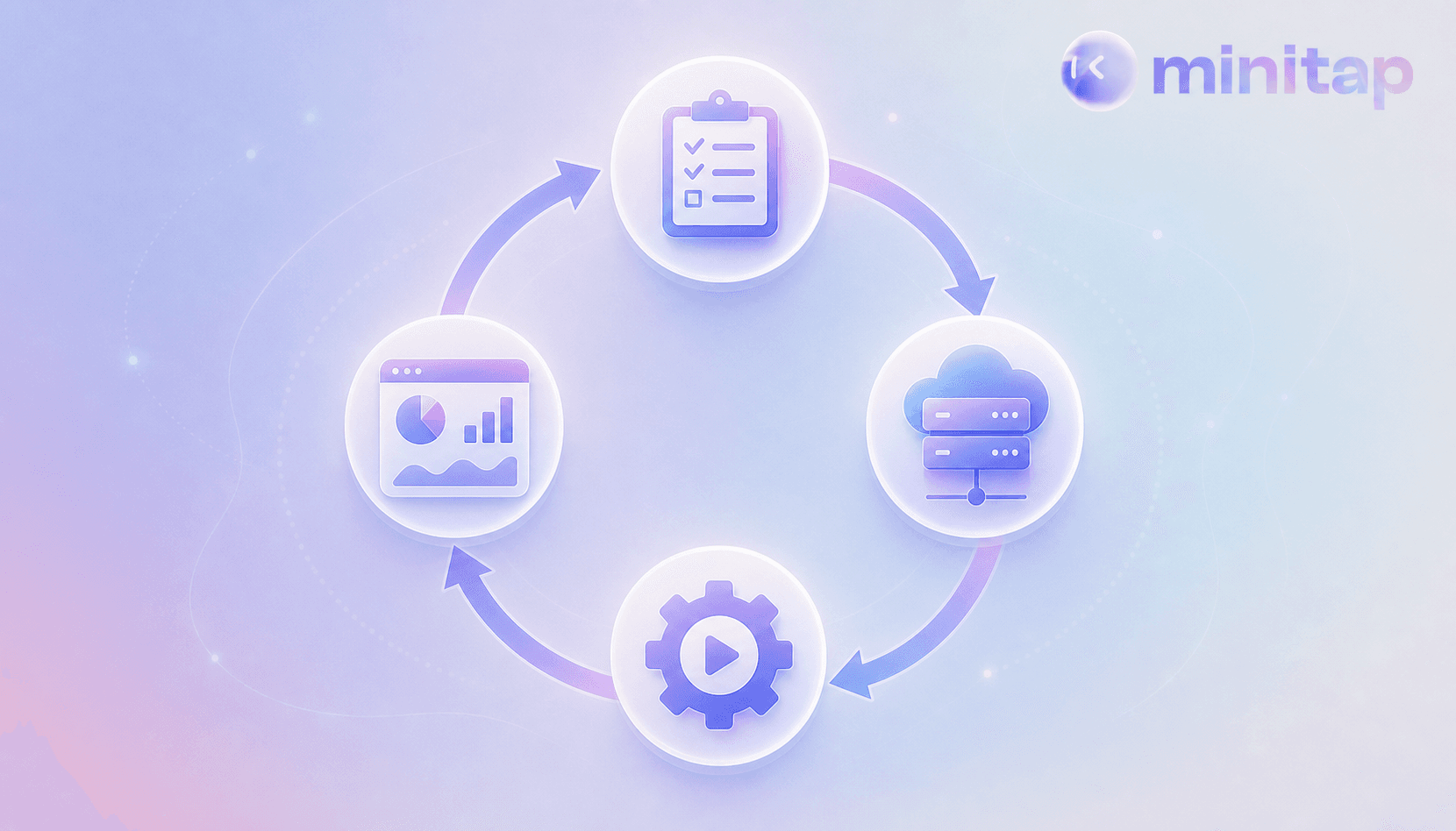
The core pillars of TestOps form a loop, not a checklist:
- **Test planning and strategy: mapping coverage to risk and business impact before a single test runs, a core principle of shift left testing.
- Test environment management: provisioning and tearing down environments on demand, often tied to CI triggers.
- Test execution and automation: running tests from commit checks to full regression testing, feeding results back into the same pipeline.
- **Monitoring and reporting: turning results into dashboards that flag flaky tests and surface trends across builds.
A flaky test found in reporting reshapes the next planning cycle. Treat any pillar as sequential, and the loop collapses back into the silos TestOps was built to remove.
TestOps Vs DevOps: What Is The Difference
DevOps governs the build-release-operate loop: shipping speed, environment provisioning, incident resolution. TestOps sits inside that loop, owning test data, environments, execution, and the quality metrics that tell you whether the mobile and web CI/CD pipeline can be trusted at DevOps speed. Both share automation and tooling, but optimization targets diverge:
| DevOps | TestOps | |
|---|---|---|
| Primary goal | Deployment frequency, lead time | Test reliability, coverage |
| Scope | Full software lifecycle | Testing lifecycle within that scope |
| Key metrics | Deploy frequency, MTTR | Flaky test rate, defect escape rate |
| Owns | Infrastructure, release pipeline | Test environments, test data, results |
A DevOps team can hit an aggressive deploy cadence and still ship regressions if reliability lags. TestOps closes that gap: DevOps sets the pace, TestOps confirms what ships has actually been tested.
Key Benefits Of Adopting TestOps
Adopting TestOps pays off through specific mechanisms, not a promise of better quality. Automated environment provisioning cuts the wait between a commit and a test run. Shared dashboards give developers, QA, and operations the same view of flaky tests and failure trends instead of separate spreadsheets. Integrated reporting flags coverage gaps automatically as systems scale.
The cost argument closes the case: research shows catching bugs before users do saves more time and resources than fixing the same defect caught later, with some analyses putting the multiplier at 10x or more depending on severity and detection timing.
Common TestOps Challenges And Pitfalls
Four pitfalls surface again and again once a team commits to TestOps.
- Flaky tests erode trust fast. A test that fails intermittently for reasons unrelated to the code gets ignored after the second false alarm, and once engineers start skipping red builds, the reporting layer loses credibility.
- Test debt outpaces maintenance capacity. Automation gets written under deadline pressure and rarely revisited, so suites grow faster than anyone can prune them and coverage numbers stop reflecting what actually gets checked.
- Tool chain complexity multiplies quietly. A CI platform, test framework, reporting layer, and ticketing system each need integration. Adding a second framework for a new platform doubles the maintenance surface without anyone deciding it should.
- Cultural resistance slows the shift. Moving ownership from a dedicated QA team to shared engineering responsibility means developers now maintain tests they never touched before, and that handoff stalls without clear expectations from both sides.
None of these argue against TestOps. They explain why a rollout without a maintenance plan runs into trouble by month three.
TestOps Tools And Platforms Overview
A TestOps tool aggregates results from wherever tests run, manages test cases as living artifacts, and wires execution into CI/CD so a build trigger becomes a test run without manual clicks. For a broader comparison, see AI QA testing tools compared. That is what separates a TestOps tms from a basic test case repository.
The category breaks into a few layers:
- Test management and reporting: Katalon TestOps and Allure TestOps combine test case management, execution history, and defect tracking in one place.
- CI-native orchestration: Testkube runs and schedules tests inside Kubernetes pipelines as a native CI/CD workload.
- Reporting and analytics: Allure Report and Katalon Analytics turn execution data into dashboards and flaky test signals.
- **Automation frameworks: Selenium, Playwright, and Cypress generate the results these tools ingest, forming the execution layer of any test automation platform for mobile and web.
No single tool covers every layer. A stack stitches a management platform, an orchestration layer, and a framework together through integrations.

Katalon TestOps Explained
Katalon TestOps is the test management and orchestration layer inside the Katalon ecosystem, sitting alongside Katalon Studio (test authoring) and Katalon Runtime Engine (test execution). It tracks execution history, generates analytics, and wires into CI/CD tools like Jenkins so builds trigger runs automatically.
Login runs through a Katalon account tied to your organization's workspace. Deployment splits two ways: cloud, where Katalon hosts the tool and executions run through Katalon TestCloud, or on premise, where a team installs and maintains the server for stricter data control. Either way, the Katalon Runtime Engine runs the test cases and reports results back to TestOps.
On pricing, Katalon Studio itself is free, and paid tiers start at $167 per seat per month billed annually, per Katalon's published pricing page. What costs money is the infrastructure needed to run tests at scale in CI.
Allure TestOps Explained
Allure TestOps is Qameta Software's test management platform, built on top of the open source Allure Report framework that already handles test reporting for tools like JUnit, TestNG, and Pytest. Where Allure Report visualizes results after a run finishes, TestOps adds the layer Katalon TestOps provides on the Katalon side: test case management, execution history across releases, and defect tracking tied back to specific runs. It integrates with CI/CD tools including Jenkins, GitLab CI, and TeamCity, so a pipeline trigger pushes results straight into TestOps without a manual export step. Deployment splits the same way Katalon's does, cloud hosted or self managed on premise, which matters for teams with data residency requirements. Pricing runs on a quote based, per seat model instead of Katalon's published node locked and floating license tiers, so teams weighing the two typically request a demo before committing budget.
Choosing Between TestOps Tools
The choice usually comes down to three questions: what's already in the pipeline, who needs to see pricing before committing budget, and how much control the team needs over deployment. Teams already running Selenium, TestNG, or Pytest lean toward Allure TestOps, since it builds directly on the open source Allure Report those frameworks already produce, and its CI integrations with Jenkins, GitLab CI, and TeamCity slot into pipelines that never touched Katalon Studio. Teams starting from scratch or already inside the Katalon ecosystem tend to get more value from Katalon TestOps, because Studio, Runtime Engine, and TestOps share one workspace and one login, cutting the integration work Allure still requires. Budget approval flips the decision for some teams: Katalon publishes node locked and floating license prices up front, while Allure's quote based, per seat model means finance sees a number only after a demo call. Data residency requirements point teams toward whichever platform they can run on premise, since both offer that option, though the self-hosting overhead differs between the two. None of that changes what either tool actually does once it's running: aggregate results, manage test cases as living artifacts, and wire execution into CI/CD, so the decision comes down to fit with what's already built.
The TestOps Engineer Role
A TestOps engineer owns the plumbing behind continuous testing: maintaining environments that spin up and tear down on demand, managing CI/CD pipelines so builds trigger the right suites, and keeping dashboards accurate and flaky tests contained. The skill set leans infrastructure-heavy: scripting, CI/CD tools like Jenkins or GitLab, frameworks such as Selenium or Playwright, and cloud fluency. Unlike an SDET, who writes test code for specific features, a TestOps engineer builds the systems that run everyone else's tests. For a full breakdown of QA automation for mobile teams, see the dedicated guide.
Based on data from sources including Glassdoor and LinkedIn Salary (June 2026), TestOps focused roles fall in a similar band to test automation and software test engineering, with total pay commonly ranging from roughly $90,000 to $170,000 depending on seniority and location.
How To Build A TestOps Strategy
A workable testops strategy starts narrow, not company-wide. Five steps, in order:
- Assess current maturity. Map what already runs in CI, what's still manual, and where flaky tests or slow feedback loops cause the most pain.
- Define measurable goals. Pick two or three metrics up front (flaky test rate, defect escape rate, time from commit to test result) so the pilot has a clear before-and-after.
- Select tools that fit existing infrastructure. Match reporting and orchestration layers to what your team already runs.
- Integrate incrementally. Wire one pipeline or team into the new setup before touching anything else.
- **Build feedback loops. Route results into channels developers already watch, and revisit metrics on a set cadence. Teams adopting agentic testing can close these loops without manual intervention.
A single team running this loop cleanly for one release cycle beats any rollout plan drafted in advance.
Where Minitap Fits Into A TestOps Strategy
Minitap slots into the execution and monitoring layers of the TestOps loop, the same layers Katalon TestOps and Allure TestOps manage, but it removes the maintenance burden that usually erodes trust in that loop. The agent connects to your sources of truth (specs, tickets, and existing test cases) and decides what to test and how, instead of running a fixed script that breaks the moment a selector changes. It executes regression across real devices and interfaces without your team writing or maintaining test code, so the flaky-test problem that erodes TestOps credibility never gets a foothold. When a run is blocked or a result is ambiguous, Minitap explains why and recommends the next action instead of failing silently, which keeps the reporting layer trustworthy build over build. That combination, continuous execution paired with a working feedback loop, is the exact mechanism a TestOps strategy is built to achieve through tooling and process, and Minitap replaces both with one system that owns the loop end to end.
FAQ
What is TestOps and how does it differ from DevOps?
TestOps is the discipline of applying DevOps principles (automation, continuous feedback, shared ownership) to test management across the delivery lifecycle. DevOps governs deployment frequency and pipeline speed; TestOps owns test reliability, coverage, and the quality metrics that confirm what ships has actually been tested. The key difference is optimization target: DevOps measures deploy frequency and mean time to recovery, while TestOps tracks flaky test rate and defect escape rate.
Katalon TestOps vs Allure TestOps: which should my team use?
Teams already running Selenium, TestNG, or Pytest tend to get more from Allure TestOps, since it builds directly on the open-source Allure Report those frameworks already produce. Teams starting fresh or already inside the Katalon ecosystem get more value from Katalon TestOps, because Studio, Runtime Engine, and TestOps share one workspace and one login. Budget approval often decides it: Katalon publishes node-locked and floating license prices upfront, while Allure's per-seat model requires a demo call before finance sees a number. Either way, Minitap sits underneath both: it's the AI QA agent that authors, executes, and maintains the actual tests across releases, so the Katalon-versus-Allure decision comes down to test management preference, not to who keeps your suite running.
How do I build a TestOps strategy without overhauling my entire pipeline at once?
Start narrow: assess what already runs in CI, pick two or three metrics like flaky test rate and defect escape rate, then prove the loop on one pipeline before touching anything else. Minitap fits directly into that loop, since it owns execution and maintenance so the strategy holds up past the pilot.
What's the best way to handle enterprise regression testing across mobile, web, and feature flag combinations without scaling the QA team?
The core problem is that traditional TestOps tooling manages test cases and aggregates results, but your team still owns authoring and maintaining every script across each system and configuration combination. Minitap removes that constraint entirely: it connects to your sources of truth (specs, tickets, existing test cases), decides what to test and how across iOS, Android, web, and feature flag combinations, and executes regression on real devices without your team writing or maintaining test code. When a run is blocked or a result is ambiguous, Minitap explains why and recommends the next action, so the reporting layer stays trustworthy build over build.
What does a TestOps engineer do, and what does the role pay?
A TestOps engineer owns the infrastructure behind continuous testing: maintaining environments that spin up and tear down on demand, managing CI/CD pipelines so builds trigger the right suites, and keeping dashboards accurate with flaky tests contained. The skill set leans infrastructure-heavy, covering scripting, CI/CD tools like Jenkins or GitLab, frameworks such as Selenium or Playwright, and cloud fluency. Based on Glassdoor and LinkedIn Salary data (June 2026), TestOps-focused roles fall in a similar band to test automation and software test engineering, with total pay commonly ranging from roughly $90,000 to $170,000 depending on seniority and location.
Final Thoughts On Bringing TestOps Into Your Workflow
A solid TestOps practice comes down to closing the loop between planning, execution, and reporting so your team catches problems while they're still cheap to fix. Tools matter less than the discipline behind them: start narrow, track a couple of metrics, and build from what actually works in your pipeline. Your next release cycle is a good place to test the approach before rolling it out further. If you'd rather skip the maintenance grind altogether, Minitap runs your regression testing continuously so your team doesn't have to.