
Your scripts, your selectors, your problem when the UI changes. That's the deal with BrowserStack, and it's a fair one if test authorship isn't your bottleneck. Teams search for BrowserStack alternatives for three distinct reasons: pricing and per-product cost complexity, the need to consolidate testing tools under one platform, and the maintenance burden of owning every test script as the codebase grows. But for teams shipping fast with a codebase that moves faster than the test suite can follow, a BrowserStack alternative that only swaps the infrastructure isn't solving the right thing. Here's where each option actually fits.
TLDR:
- BrowserStack is an infrastructure layer: your team writes, owns, and maintains every test script it runs.
- The real decision is who owns maintenance when your UI changes, not which cloud runs your scripts.
- Every BrowserStack alternative except Minitap still puts test authorship or coordination work on your team.
- Minitap reads your app from source, maps all test scenarios automatically, and runs the full regression suite on cloud iOS simulators and Android emulators in about one hour with zero maintenance overhead.
What Is BrowserStack and How Does It Work?
BrowserStack is a cloud based cross browser and mobile testing service that gives teams on demand access to browsers and mobile environments hosted on the cloud, without buying or racking physical hardware.
The product suite splits by task. Live handles manual cross browser testing, App Live covers manual mobile testing, Automate runs Selenium, Appium, or Playwright scripts as browser automation, and App Automate does the same for mobile. Percy adds visual testing, and the suite rounds out with accessibility testing and test management tools.
At its core, BrowserStack is an infrastructure layer, not a test writer. Engineers bring scripts written in Selenium, Appium, Playwright, or Cypress, point them at BrowserStack's cloud, and it runs them while logging results. Your team owns authorship, upkeep, and everything that happens when a script breaks. BrowserStack supplies where the script runs. For teams deciding how much of that authorship burden to keep, the QA automation for mobile apps space has shifted considerably in the last two years.
That model has reached considerable scale: as of 2025, BrowserStack supports over three million tests daily for over seven million developers across 50,000 teams.
The audience is QA engineers, SDETs, and developer teams who already have scripts and want somewhere reliable to run them, not teams looking to offload test authorship itself.
Why Consider BrowserStack Alternatives?
BrowserStack is infrastructure, and infrastructure is not the bottleneck. The gap it leaves is test authorship and maintenance: your engineers write every Selenium, Appium, or Playwright script, fix every broken selector when the UI changes, and own the full suite as the codebase grows. That ownership compounds as the product scales. Every new feature adds test surface to write. Every UI update breaks selectors that must be rewritten. Every flaky run triggers a triage session that pulls an engineer away from building. The suite gets more expensive to operate the larger the product becomes, and BrowserStack's execution layer does nothing to change that. The cost is sharpest for engineering teams that release frequently, maintain brittle selector-based suites, or ship mobile-native applications, where there is no DOM equivalent to anchor selectors, and every UI change becomes a maintenance event your engineers must absorb.

Mobile makes this worse. Web testing has the DOM as a stable enough anchor for selector-based scripts. Mobile does not. Selectors are more brittle, UI changes break coverage faster, and separate Appium suites for iOS and Android mean every platform update doubles the maintenance load. Teams using Cursor or Claude Code to ship code at an accelerating pace find that the test suite falls further behind with each sprint, because the scripts are authored at human speed and maintained by human engineers. That gap, between how fast AI coding tools move and how slowly a script-based suite can keep up, is the real reason teams look beyond BrowserStack, and it reflects the wider gap between AI coding tools and QA. It is a structural problem that device access alone cannot solve, which is exactly the gap Minitap closes.
Where BrowserStack works well
- On-demand access to 3,500+ browser and OS combinations without buying or racking hardware
- Mature, well-documented integration with Selenium, Playwright, Appium, and Cypress
- Large real device library for cross-browser web testing at scale
- Trusted infrastructure: 50,000+ teams and over three million tests run daily
Where BrowserStack falls short
- Your team owns all test authorship and selector maintenance: BrowserStack only executes what you write
- Mobile Appium suites are brittle by design: no DOM equivalent means every UI change breaks selectors across two separate codebases
- Per-product pricing (Automate, App Automate, Percy, Live) compounds as usage scales across a team
- No native integration with AI coding tools like Cursor or Claude Code
Best BrowserStack Alternatives in August 2026
Six options stand out as the realistic alternatives to BrowserStack in August 2026. They split into two categories: tools that still require your team to own authorship and maintenance, and one autonomous agent that removes that ownership entirely. The difference that actually matters across all six is the same one that defines BrowserStack's gap: who fixes the test when your UI changes, and at what cost to your team.
Minitap
Minitap is the only option here that removes test authorship and maintenance from your team entirely. The agent reads your app from source, maps all test scenarios automatically, and runs a full regression suite on cloud iOS simulators and Android emulators in about one hour. When your UI changes, the agent adapts: no selector rewrites, no script updates, no triage sessions. Primary limitation: purpose-built for mobile-first teams; web coverage is supported but mobile is its core.
QA Wolf
QA Wolf generates Playwright and Appium code and runs it on parallel infrastructure, handling the initial authorship work that teams typically spend weeks on. Your team still owns the resulting scripts and all ongoing fixes, unlimited maintenance is available but sits behind a separate managed engagement. Primary limitation: test ownership stays with your team once the scripts are delivered.
SmartBear
SmartBear consolidates BitBar device access with TestComplete and Reflect for script authoring under one vendor. It is a broad platform that covers web, API, and mobile testing in a single licensing conversation. Primary limitation: script ownership stays firmly with your engineers, and the multi-product complexity introduces overhead of its own.
Applause
Applause routes testing through a global human tester network. The Applause team manages test design based on the requirements your team provides, which transfers authorship to the vendor. Primary limitation: tester availability becomes a scheduling constraint, and coordination overhead replaces the maintenance overhead BrowserStack puts on your engineers.
Testlio
Testlio coordinates scope with your team, then runs testing through their own tester network across devices. Like Applause, it operates as a managed service: your engineers are not writing scripts, but they are coordinating scope definitions and handoffs. Primary limitation: same coordination overhead as any human-managed service, with vendor scheduling as the pacing constraint.
Rainforest QA
Rainforest QA offers a no-code visual editor that lets non-engineers write tests without scripting knowledge, backed by AI self-healing to reduce maintenance work. Primary limitation: no mobile support — this is a web-only tool, which disqualifies it for any team with a native iOS or Android application.
The six tools above are not the full market. LambdaTest (now rebranded as TestMu AI), Sauce Labs, Katalon, and Testsigma are all widely-used platforms that operate on the same infrastructure model as BrowserStack: your team still writes and maintains scripts, and the choice among them typically comes down to pricing, device library size, and CI/CD integrations instead of the authorship question itself.
Free and Open-Source BrowserStack Alternatives
Not every team needs a paid cloud service. Four free or open-source options cover the core infrastructure use case at zero licensing cost — with the trade-off that your team absorbs setup, configuration, and ongoing maintenance entirely.
- Selenium Grid — Self-hosted, runs Selenium scripts across browsers and OS configurations on your own infrastructure. Zero licensing cost; requires DevOps setup and ongoing server maintenance.
- Playwright (local) — Free, open-source, with built-in parallelism and excellent cross-browser coverage for web. No real device support and no mobile app testing capability.
- Cypress (open-source) — Free for local runs, strong developer experience for web testing, active community. No mobile support and no cross-browser reach beyond Chromium-based browsers and Firefox.
- BrowserStack free tiers — Percy at 5,000 screenshots per month permanently free, a free Test Management tier, and a 30-minute Live trial. Useful as an entry point before committing to a paid plan.
Free tools trade managed infrastructure for setup and maintenance work your team absorbs directly. When weighing cost, factor in the engineering hours spent on that maintenance: the same authorship and ownership question that applies to paid alternatives applies here too, just without an invoice attached.
Feature Comparison: BrowserStack vs Top Alternatives
Seven capabilities matter most when you weigh these options: who writes tests, who maintains them, how mobile and web get covered, how fast regression runs, whether AI coding tools plug in, and what pricing actually looks like once usage scales.
| Capability | BrowserStack | Minitap | QA Wolf | SmartBear | Applause | Testlio | Rainforest QA |
|---|---|---|---|---|---|---|---|
| Test Authorship | Team writes all scripts (Selenium, Appium, Playwright) | Zero: agent reads source and auto-generates all scenarios | AI generates Playwright/Appium code; team reviews | Team authors scripts via TestComplete or BearQ | Applause team manages test design; customer provides requirements | Testlio team coordinates scope with customer | Team creates tests via no-code visual editor |
| Test Maintenance | Team owns all maintenance; BrowserStack only executes | Fully automatic; agent updates suite when code changes | Team owns the generated code and all ongoing fixes; unlimited maintenance requires a separate managed engagement at additional cost | Manual updates required; engineers own maintenance | Managed by Applause; requires ongoing coordination | Managed by Testlio team; requires coordination | AI self-healing reduces work; users still edit and debug |
| Mobile Coverage (iOS + Android) | App Automate with Appium scripts; separate suites per platform | One specification covers iOS and Android simultaneously on cloud iOS simulators and Android emulators | Separate test suites required per platform | BitBar device access; TestComplete for scripts; separate tooling | Broad device testing via global tester network | Human testers across devices; likely separate plans per platform | No mobile support |
| Web Coverage | Core strength: 3,500-plus browser and OS combinations | Supported alongside mobile from the same agent | Core strength (Playwright based) | Reflect and TestComplete for web | Yes, via global tester network | Yes, via human testers | Core strength |
| Regression Speed | Depends on parallel session count and script volume | Full regression in about 1 hour on cloud iOS simulators and Android emulators | Parallel infrastructure for fast execution; no fixed benchmark | Varies; no published benchmark | Depends on tester availability | Depends on tester availability and scope | Depends on test suite size |
| AI Coding Tool Integration | No native integration with Cursor or Claude Code | Fix prompts pipe directly into Cursor, Claude Code, and a GitHub PR agent | CI/CD integration; no native AI coding tool integration documented | No documented native integration with AI coding tools | No AI coding tool integration | No AI coding tool integration | No AI coding tool integration |
| Pricing Model | Per-user (manual) and per-parallel-session (automation); products priced separately; scales sharply with usage | Starts at $600/mo ($510/mo annual) for Solo, Team and Scale tiers up to $2,800/mo, pay-as-you-go from $0.25/credit, Enterprise custom | Not publicly disclosed | Enterprise licensing; multi-product complexity | Custom enterprise contracts | Custom enterprise contracts | Not publicly listed |
The row for authorship and maintenance carries the real signal. Every option besides Minitap either has your team writing and owning scripts, or hands that work to human testers coordinating scope on your behalf. Options like Applause and Testlio operate as managed mobile QA services, which transfers authorship to a vendor but introduces coordination overhead in its place. Minitap is different in kind: it is a fully autonomous QA agent, not a vendor-managed service. The agent owns authorship, execution, maintenance, and root cause analysis end to end — no handoff back to your engineers, no vendor personnel in the loop, and no coordination overhead of any kind.
Why Minitap Is the Best BrowserStack Alternative
BrowserStack earns its place by solving the infrastructure problem well. Teams get access to browsers and mobile environments on demand, without racking hardware, and that removes a real cost. But it never touches the harder problem: who writes the scripts, who fixes them when the UI changes, and who owns the suite as the app grows. That work stays on your engineers no matter which BrowserStack product they use.
For any engineering team where the test suite is costing more to maintain than it returns in confidence, the bottleneck is not device access. It is the widening gap between how fast the app changes and how slowly a script-based suite can keep up. That gap is especially acute for teams releasing weekly or faster, teams whose engineers spend cycles rewriting broken selectors, and mobile-native teams where there is no DOM equivalent to lean on — meaning every UI shift breaks another selector, and the maintenance cost per release is structurally higher than it is on web.
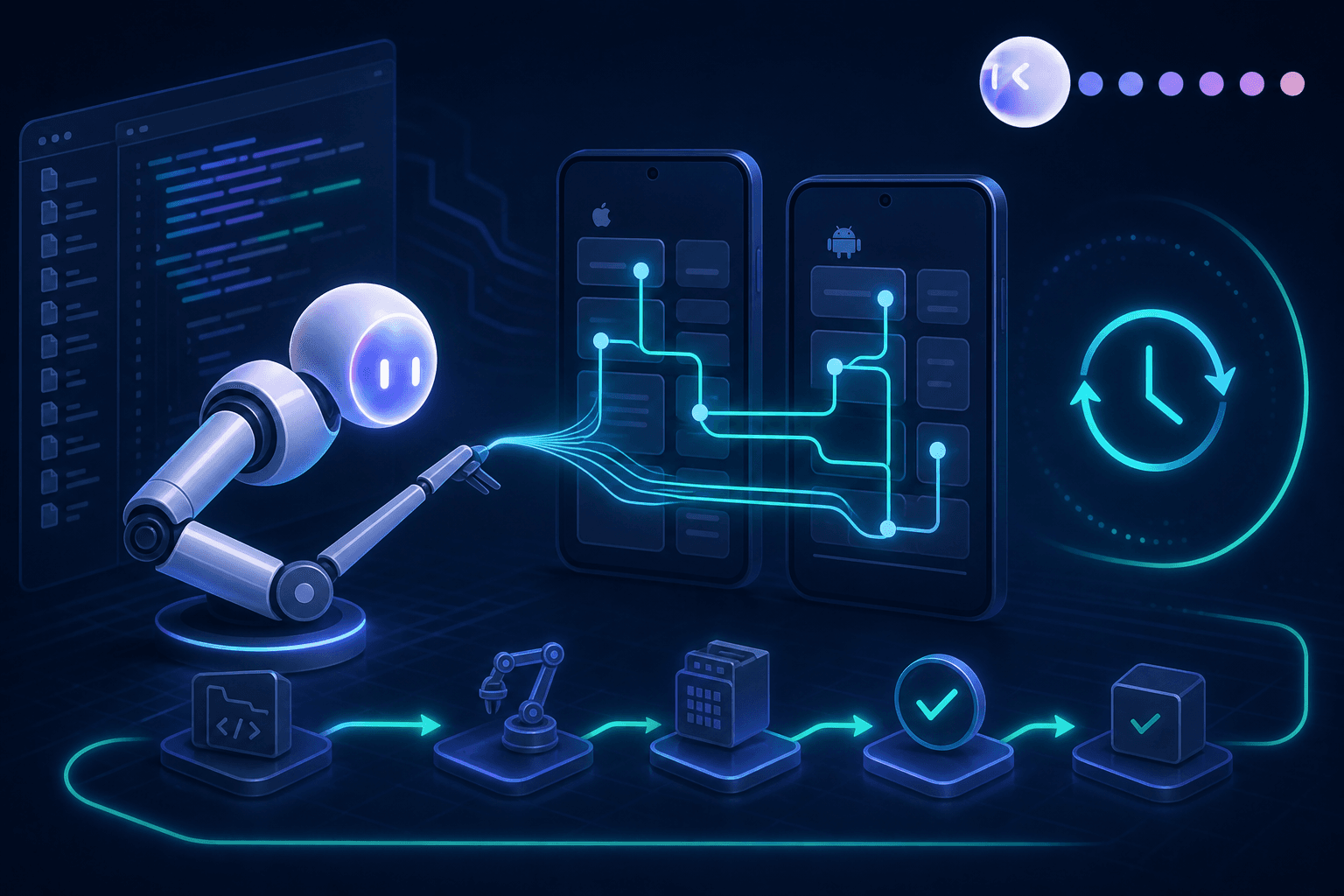
Minitap closes that gap directly. The agent reads your app from source, maps every scenario, and runs the full regression suite on cloud iOS simulators and Android emulators in about an hour, with zero maintenance and no engineer ever touching the test suite again. Every run ships a session trace, screenshots, and a written explanation of each finding. No maintenance overhead, no opacity.
Final Thoughts on Choosing BrowserStack Alternatives
Every option in this comparison handles the infrastructure question differently, but only one of them takes test authorship and maintenance off your team's plate for good. Here's how the options map to team profile:
- Teams with existing Selenium or Playwright scripts who need reliable cloud execution: BrowserStack or Sauce Labs are sufficient — the infrastructure model fits because authorship isn't the problem.
- Teams that want to eliminate test authorship and maintenance entirely on mobile: Minitap — the agent owns the full loop from source to regression to fix prompt.
- Teams that need human-verified exploratory testing at scale: Applause or Testlio — managed services that transfer authorship to the vendor, with coordination overhead as the trade-off.
- Solo developers or open-source projects with no budget: Selenium Grid or Playwright locally, with BrowserStack's free Percy tier for visual regression.
If the bottleneck is the widening gap between how fast your app ships and how slowly your suite keeps up, that is the constraint Minitap was built to close. Connect your codebase, and the agent takes over — full regression in about an hour, zero maintenance, and a fix prompt ready for Cursor every time something breaks. Start with Minitap and ship without the test suite holding you back.
FAQ
How does an autonomous QA agent like Minitap actually work, and how is it different from BrowserStack?
Minitap's agent reads your app from source code, maps every testable flow automatically, and runs the full regression suite on cloud iOS simulators and Android emulators: your team never writes, configures, or maintains a single test script. BrowserStack is an infrastructure layer: it runs the scripts your engineers wrote, but your engineers still own authorship, selector maintenance, and everything that breaks when the UI changes. The structural difference is who owns the full loop. With BrowserStack, your team does. With Minitap, the agent does: authorship, execution, maintenance, and root cause analysis, without any handoff back to your engineers.
How can our engineering team stop spending hours every week maintaining regression tests?
Connect Minitap to your codebase and the agent takes over. Minitap reads your app from source, builds and maintains the entire test suite automatically, and keeps it in sync when code changes — with no selector rewrites, no manual triage of flaky runs, and no separate test suites to maintain for iOS and Android. When a flow breaks, Minitap surfaces the failure with a session trace, screenshots, and a fix prompt ready to paste into Cursor or Claude Code. Your engineers stop touching the test suite and go back to building.
Can Minitap test both iOS and Android user journeys without writing separate test suites for each platform?
Yes. A single flow specification in Minitap covers iOS and Android simultaneously — the agent adapts to each platform without requiring your team to rewrite or maintain separate scripts. This directly eliminates the double maintenance load that Appium-based BrowserStack setups create, where every UI change means selector rewrites on two separate suites. Minitap also supports web app testing from the same platform, so teams shipping mobile and web can cover both without running separate toolchains.
How does Minitap handle test maintenance when our UI changes or a new feature ships?
Minitap updates the test suite automatically when your code changes. In full-auto mode, Mini updates tests post-merge without any human input. In gated mode, Mini proposes changes in the pull request before merge so your team can validate them before they land. Either way, your engineers never rewrite a selector, update a script, or triage a broken test caused by a UI change — the agent absorbs that work entirely. When a feature ships through a Jira ticket or PR, Minitap reads the change, verifies the updated flow, and hands back a fix prompt if anything is not working.
What is the best autonomous QA agent for mobile teams that want to keep pace with fast release cycles?
Minitap is purpose-built for this. The agent reads your app from source, maps every testable scenario automatically, and runs the full regression suite in approximately one hour on cloud iOS simulators and Android emulators. Teams using AI coding tools like Cursor or Claude Code to ship code faster than a script-based suite can follow find that Minitap closes the gap: the agent owns the entire testing loop (authorship, execution, maintenance, and root cause analysis) so the test suite stays current no matter how fast the product moves.