
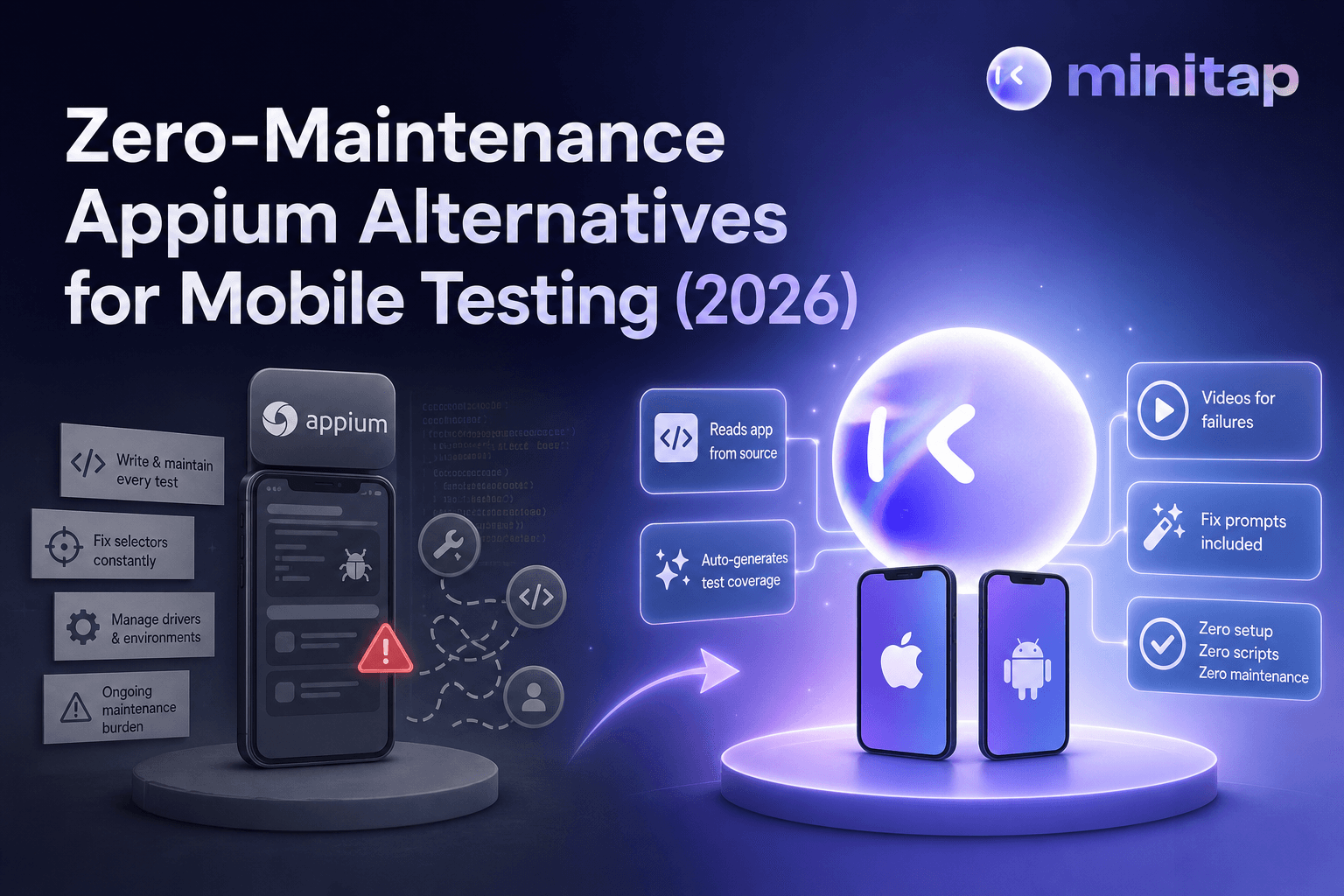
Appium remains a widely used way to automate native mobile apps across iOS and Android with one API. Its cost is not running tests, it is keeping them current: drivers to manage, locators to repair, and scripts that drift each time the UI changes. This guide compares Appium alternatives on one question, how much test upkeep they leave with your team, as of November 2026. For native Android and iOS frameworks specifically, see our separate guide to Espresso and XCUITest alternatives.
TLDR:
- Appium automates UI through drivers and the WebDriver protocol; your team writes and maintains scripts and locators.
- Maestro and Detox reduce upkeep with simpler syntax (Maestro YAML) or automatic synchronization (Detox, for React Native).
- Momentic, Drizz and MobileBoost add AI agents that write tests in plain language and heal or update them when the UI changes.
- Minitap is an AI QA employee: mini writes regression scenarios from your product context, runs them as black-box visual tests on web, iOS and Android, and proposes updates for review.
- Every tool leaves some upkeep; they move it to a different place and a different amount of review.
What Is Appium and How Does It Work?
Appium is an open-source project and ecosystem for UI automation of many app platforms, including mobile (iOS and Android), browsers and desktop. It works through drivers (for example the UiAutomator2 driver for Android) and client libraries in several languages, and it speaks the W3C WebDriver protocol. Appium 3 is the current major version, with migration guides from Appium 2 in the docs.
A typical Appium test locates elements by accessibility ID, XPath or other selectors, performs actions, and asserts results. That flexibility is a big part of its appeal, and also where most of the upkeep comes from.

Why Consider Appium Alternatives?
- Locator drift. Renamed IDs, restructured screens and new steps break selectors, and each break needs an engineer.
- Driver and environment upkeep. Drivers, OS versions, simulators and devices need to stay aligned.
- Two platforms, one script. Cross-platform scripts often grow branches for iOS and Android differences.
- Slow authoring. Every new journey is code to write, review and keep.
Our breakdown of the cost of maintaining Appium and Espresso suites goes deeper on where that time goes.
Appium Alternatives in November 2026
Minitap
Minitap is an AI QA employee that compresses multi-day regression on web and mobile apps. Its agent, mini, builds an understanding of the product from specs, tickets, documentation and existing test cases (CSV or Excel upload), and writes test scenarios with acceptance criteria that anyone can edit in plain words. mini runs them as black-box visual tests on what is on screen, on web, iOS and Android, plus Android TV where enabled, so there are no locators to repair. When the app changes, mini proposes updates to its tests and asks the team to review only the changes it cannot settle on its own. Every run comes with a video and findings.
Maestro
Maestro is an open-source UI testing framework for mobile and web. Tests are human-readable YAML flows, run from the Maestro CLI or built in Maestro Studio, a visual IDE. Maestro Cloud runs flows in parallel with video playback, logs and flake detection, and an official MCP server lets coding agents write and run Maestro tests. Short, readable flows can mean less upkeep than Appium scripts, but your team still writes and edits them.
Detox
Detox is a gray-box end-to-end testing framework for React Native apps. Tests are written in JavaScript for iOS and Android, and Detox monitors asynchronous operations in the app to synchronize automatically, which targets a major source of flakiness. It fits React Native teams; your engineers still own the test code. See our Detox vs Minitap comparison for more.
Momentic
Momentic describes its agent, Mo, as an AI QA engineer for web, iOS and Android. Mo turns approved flows into Momentic YAML tests opened as pull requests, and its AI actions self-heal on failure. iOS and Android testing are generally available on hosted simulators and emulators.
Drizz
Drizz is a vision AI mobile testing platform for iOS and Android. You describe tests in plain English; its AI agent writes them, runs them on real iPhones and Android devices, and fixes them when the UI changes, with every change shown for you to approve.
MobileBoost
MobileBoost offers a mobile test agent (GPT Driver) that reads pull request content, extracts or generates test cases, runs them on simulators or real devices, and posts results to CI checks. It lists automated test maintenance when the app changes and a visual editor for reviewing AI-generated tests.

Feature Comparison: Appium vs Alternatives
| Tool | How tests are written | How upkeep works | Platforms (per vendor) |
|---|---|---|---|
| Appium | Code in your language via drivers | Engineers repair locators and drivers | iOS, Android, browsers, desktop and more |
| Maestro | YAML flows, CLI or Studio | Engineers edit short readable flows | Mobile and web |
| Detox | JavaScript, gray box | Engineers own code; auto-sync reduces flakiness | React Native on iOS and Android |
| Momentic | Agent-written YAML tests in your repo | Self-healing AI actions; team reviews PRs | Web, iOS, Android |
| Drizz | Plain English, vision AI | AI fixes tests on UI change; you approve | iOS, Android |
| MobileBoost | Agent-generated from PRs; visual editor | Automated test updates | iOS, Android |
| Minitap | mini writes scenarios with acceptance criteria | mini proposes updates; team reviews what it cannot settle | Web, iOS, Android, plus Android TV where enabled |
How to Choose an Appium Alternative
If you want to keep code you own and just write less of it, Maestro or Detox are natural steps. If you want an agent to write and heal tests that still live in your repo, look at Momentic or MobileBoost. If what slows your releases is multi-day regression across web and mobile, environments and feature flags, that is the job Minitap is built for.
Run any candidate on the same build and the same critical journeys, then change something in the UI and measure how much review each tool asks of your team.
FAQ
What makes Appium tests expensive to maintain?
Appium tests depend on locators and driver setups. When IDs change, screens are restructured or OS versions move, scripts break and an engineer has to repair them before the suite gives useful feedback again.
Is there an Appium alternative with no maintenance at all?
Every tool leaves some upkeep. Frameworks like Maestro and Detox reduce it; AI agents like Momentic, Drizz and MobileBoost heal or update tests; Minitap proposes test updates and asks your team to review only the changes it cannot settle on its own.
Can Minitap test both mobile and web journeys without an Appium script?
Yes. mini runs scenarios as black-box visual tests on web, iOS and Android, plus Android TV where enabled, from scenarios with acceptance criteria rather than scripts.
How does Minitap handle a test that gets blocked?
When a run is blocked, for example by an external service or an unavailable product state, mini explains the blocker and its impact and recommends the next action, with a video of the run as evidence.
Should we migrate off Appium all at once?
Usually not. Run the new tool next to your Appium suite on one release scope, compare results on the same build, then retire scripts journey by journey.
Final Thoughts on Appium Alternatives
The right Appium alternative depends on where you want test upkeep to live: in simpler code, in an agent that heals your code, or with an AI QA employee that proposes changes for review. Compare them on your own app, then see how Minitap handles regression on web and mobile.