
Every team has some version of a software development life cycle, even if nobody's written it down. The trouble starts when engineering assumes one thing about a phase and QA assumes another, and that mismatch only shows up once a defect reaches production instead of getting caught in testing. Picking the right model, whether that's Agile, Waterfall, or something in between, comes down to a handful of concrete questions about your requirements, your team, and how often you release. We'll walk through the phases, the tradeoffs, and where security and testing actually belong in the cycle.
TLDR:
- SDLC is a repeatable framework of checkpoints and handoffs, not a single methodology like Agile.
- Seven phases run planning through maintenance, with testing spanning every stage instead of a final gate.
- Choosing Waterfall, Agile, Spiral, V-Model, or DevOps depends on requirements stability, compliance needs, and release cadence.
- The Standish Group's CHAOS 2020 research found only about 31% of IT projects fully succeeded (2020 data), showing a named SDLC alone doesn't guarantee results.
- Minitap targets regression, the phase most likely to stall releases, connecting to specs, tickets, and code to build and run tests across real devices.
What Is the Software Development Life Cycle (SDLC)?
The software development life cycle, or SDLC, is a structured framework teams follow to plan, build, test, deploy, and maintain software. It is not a single methodology. Agile, Waterfall, and Scrum are models that live inside the SDLC framework, each arranging phases in a different order, but the underlying framework stays constant regardless of which model a team picks.
The concept exists because software delivery without structure tends to drift. Requirements get lost, testing gets skipped under deadline pressure, and releases go out without anyone confirming they meet the original goal. The SDLC turns that ad hoc process into something repeatable: defined checkpoints, clear handoffs, and quality gates that catch problems before they get expensive.
For engineering and QA teams, the SDLC is the shared reference point for where a feature sits between idea and production, and who owns the next step.
Why the SDLC Matters for Engineering and QA Teams
A defined lifecycle gives product, engineering, and QA a shared vocabulary. When everyone agrees on what "in testing" or "ready for release" means, handoffs stop losing information and rework drops.
It also creates ownership at each stage: someone signs off on requirements, someone owns test coverage, someone approves the release. Skip that structure and the symptoms show up fast:
- Scope creep, as requirements shift mid build with no checkpoint to catch it
- Edge cases that never got tested surfacing in production instead of QA
- Planning and QA cycles running disconnected, so testers learn about a feature the same week it ships
This is not about paperwork. It is about knowing where risk sits before release, not after.
The Core Phases of the SDLC
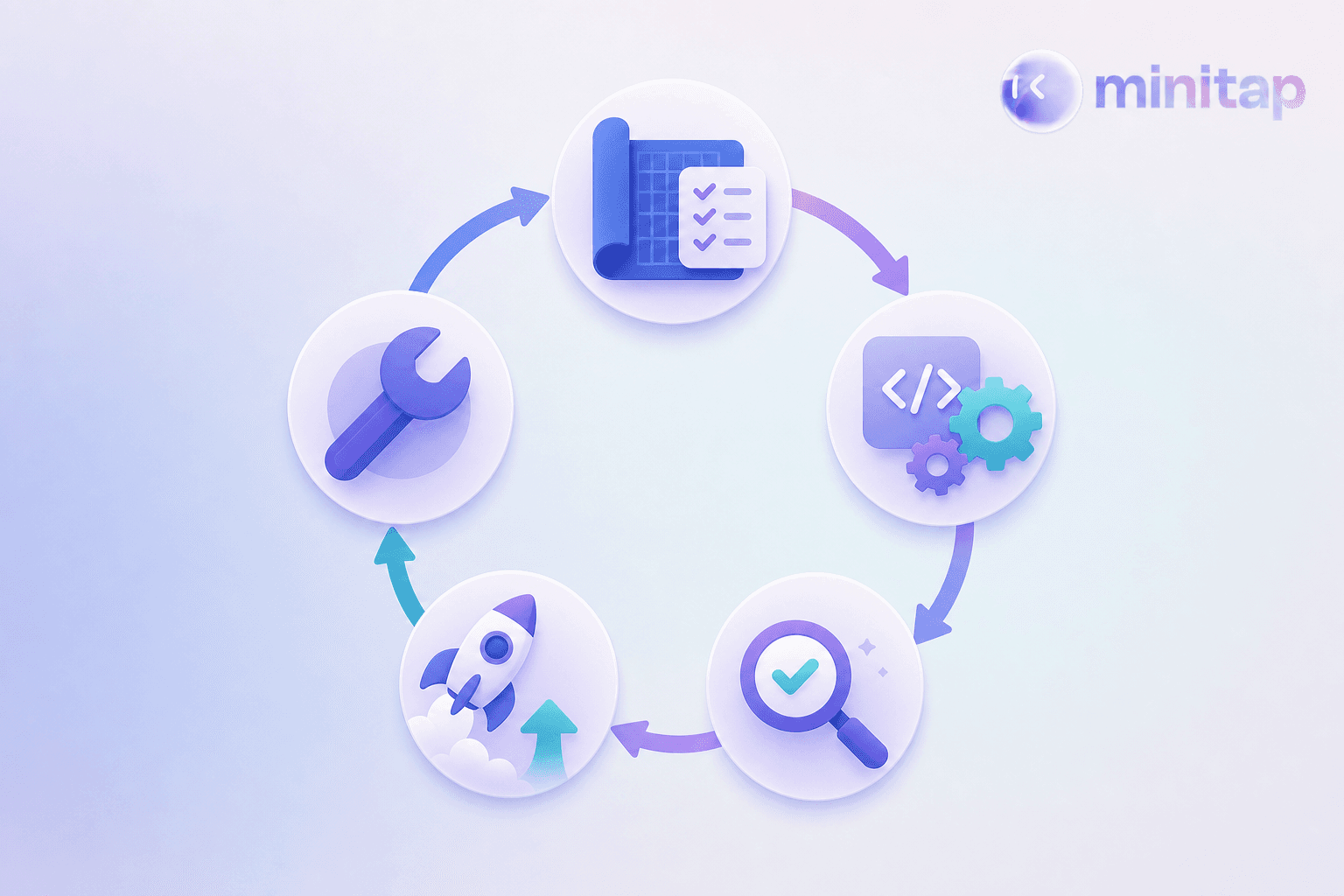
Every SDLC framework breaks down into the same functions, even when names or groupings shift between sources. Some combine planning and feasibility into one phase, others separate requirements from design, but the work stays the same.
Planning
Product managers and engineering leads scope the project, estimate resources, and assess feasibility, giving budget, timeline, and risk a first look.
Requirements Analysis
Business analysts and product owners document what the software needs to do. Engineering and QA should review here too, since ambiguity caught now costs nothing. Caught later, it costs a sprint.
Design
Architects and senior engineers translate requirements into system architecture, data models, and interface specs, the blueprint the build phase works from.
Development
Engineers write the code against that design. This phase consumes the most calendar time, and version control discipline matters most here.
Testing
QA validates the build against requirements: functional, regression, performance, and security checks. Defects caught here cost far less to fix than defects found after release.
Deployment
The build ships to staging, then production. Release managers and DevOps own rollout sequencing, feature flags, and rollback plans.
Maintenance
Bug fixes, patches, and updates keep the software running after launch, often outlasting every other phase combined.
Popular SDLC Models and When to Use Them
The phases above describe what work happens. A model describes how that work gets sequenced. Two teams running identical phases still ship on different timelines depending on the model they pick.
| Model | Sequence | Flexibility | Best fit |
|---|---|---|---|
| Waterfall | Linear, one phase completes before the next starts | Low | Fixed scope projects with stable requirements |
| Agile | Short iterations, continuous feedback | High | Products where requirements evolve alongside user feedback |
| Iterative | Repeated build test cycles, each adding functionality | Medium | Projects where full scope isn't clear upfront |
| Spiral | Iterative cycles wrapped around risk analysis | Medium | High risk, large scale projects needing constant risk checks |
| V-Model | Linear, with a testing phase mapped to every dev phase | Low | Compliance-driven environments needing strict verification |
| DevOps | Continuous integration, delivery, and monitoring | High | Teams shipping often and automating the pipeline |
The underlying tradeoff is predictability versus adaptability. Waterfall and V-Model buy documentation and traceability at the cost of slow course correction. Agile and DevOps buy speed but demand constant testing and requirements review instead of a one time check. The right model depends on how often requirements shift and how much risk a slow release cycle creates for the business.
How to Choose the Right SDLC Model for Your Team
Picking a model comes down to five questions, not a preference for one framework over another.
- Requirements stability: Locked requirements suit Waterfall or V-Model. Shifting requirements suit Agile.
- Project size: Large, multi-team builds benefit from Waterfall or Spiral checkpoints. Small projects move faster under Agile.
- Compliance needs: Medical, aviation, and financial systems need V-Model's traceability, where every requirement maps to a test.
- Team distribution: Agile needs tight communication. Distributed teams often lean toward Iterative or Spiral models.
- Release cadence: Frequent releases point toward DevOps. Quarterly releases can tolerate Waterfall's pace.
Compliance-driven industries favor Waterfall or V-Model for audit trails. Consumer software favors Agile or DevOps. Most teams adjust models as the product matures.
Where Testing and Quality Assurance Fit Into the SDLC
Testing is not a phase scheduled near the end. It runs alongside every other phase, from requirements review through maintenance, with different testing types owned by different roles:
- Unit testing: engineers validate individual functions during development
- Integration testing: QA and engineers confirm merged components work together
- System testing: QA validates the full build against requirements before release
- Regression testing: QA confirms new changes have not broken existing functionality, run every release
- User acceptance testing: product owners sign off before deployment
Shift left testing means writing test cases against requirements as they are documented, surfacing ambiguity before code exists. The reason this matters is cost. Software defect research has shown production bugs take more time and resources to fix than the same defect caught earlier in the cycle, with some analyses putting the cost multiplier at 10x or more depending on severity and time to discovery.
Embedding Security Into the SDLC
Security built into the SDLC runs alongside every phase instead of showing up as a checklist before launch. Design includes threat modeling. Development follows secure coding practices like input validation and least-privilege access. Before release, static analysis and runtime testing scan code and running builds for what manual review misses.
DevSecOps formalizes this: instead of a separate team auditing the build right before launch, checks get embedded into CI/CD across engineering, QA, and security from day one. Deepstrike's 2026 research shows organizations are embedding security earlier, though earlier checks only reduce risk when someone owns fixing what they find.
How Automation and AI Are Reshaping SDLC Testing
AI is changing what happens inside the testing phase. It's doing more than speeding up what teams already did. Traditional test automation ran the same scripted steps until someone updated them, so every UI change created a maintenance queue somewhere on the backlog. AI-driven tools now read an application's actual behavior and adjust test flows when a button moves or a screen gets restructured, cutting into the manual selector rewrites that used to eat a sprint. That shift also touches test case generation: instead of a QA engineer translating requirements into steps by hand, AI can parse tickets, specs, and existing code to draft coverage and flag ambiguity before a build reaches staging. The bigger change shows up in regression, where mobile QA agents connect to specs, tickets, and prior runs to decide what needs testing and execute it across real devices, instead of waiting on someone to author and maintain a fixed script for every path. None of this removes the phases described above. It changes who, or what, owns the work inside them.
Core Tools for Managing the SDLC
Every phase described so far needs tooling behind it, or it stays theoretical. Here is the practical map, organized by category.
- Issue and project tracking: Jira or Linear turn requirements and defects into trackable work items, giving planning a paper trail from ticket to release.
- Version control: Git, hosted through GitHub or GitLab, lets teams branch, review, and merge code without stepping on each other's work.
- CI/CD pipelines: Jenkins, GitLab CI, or CircleCI automate build, test, and deploy steps, cutting manual handoffs.
- Code quality: SonarQube scans for style, security, and complexity issues before a reviewer opens the pull request.
- Documentation: Confluence or Notion keep specs accessible to engineering and QA.
- Test management: TestRail or Zephyr track test cases against requirements for audit traceability.
Common SDLC Mistakes That Undermine Release Confidence
Even teams that follow a defined SDLC still run into the same failure patterns.
- Vague or shifting requirements: documented once, then reinterpreted mid sprint with no one flagging the drift from original scope.
- Testing as a final gate: QA gets the build days before release instead of test cases written alongside requirements, so defects surface when fixing them costs the most.
- Neglected maintenance: the phase with no launch date gets the least staffing, until patches queue up and technical debt slows every release after.
- Siloed communication: product, engineering, and QA working from different versions of the same requirement, each assuming the others caught the change.
The Standish Group's CHAOS 2020 research (2020 data), spanning tens of thousands of IT projects, found only about 31% were fully successful, 50% were challenged, and 19% failed outright. Every one of those projects likely had a named SDLC on paper. A framework only prevents failure if someone enforces its checkpoints, phase by phase, release by release.
Bringing Fast, Reliable Regression to the SDLC With Minitap
Testing and maintenance are the two SDLC phases most likely to stall a release, and regression is where that stall usually happens. At enterprise scale, a single platform's regression can consume days of QA time per release, with extra setup and testing work piling up on every pull request across multiple platforms, browsers, geographies, and feature flag combinations.
Minitap targets that exact phase. It connects to specs, tickets, code, and prior runs, builds and maintains its own tests, and executes across real devices, recommending next steps whenever a run stalls.
FAQ
What is the SDLC and how does Minitap fit into the testing and maintenance phases?
The SDLC is a structured framework of phases, planning through maintenance, that stays constant regardless of which methodology your team runs, whether that's Agile, Waterfall, or Scrum. Minitap operates inside the testing and maintenance phases specifically, the two most likely to stall a release: it connects to your specs, tickets, and code, builds and maintains its own regression tests, and executes them across real devices, so that part of the SDLC keeps moving no matter which model sits around it.
How can engineering teams stop manually maintaining regression tests?
Minitap removes manual test maintenance by connecting directly to your specs, tickets, and code, then generating and maintaining its own regression tests as the product changes, instead of your engineers rewriting scripts every time the UI shifts. When drift opens up between what the test suite covers and what the product actually does, Minitap reconciles that gap on its own and flags what changed, so the upkeep stops sitting on your team's backlog.
Can Minitap test both mobile and web user journeys in the same regression cycle?
Yes, Minitap tests both mobile and web user journeys, with mobile (iOS and Android) as its primary focus and web as a strong secondary platform, using the same vision-based, black-box approach across both. That means one regression run can validate a journey on every relevant surface without your team maintaining a separate script for each platform.
How does Minitap compare to traditional scripted test automation?
Traditional scripted automation executes predefined steps and breaks the moment the product changes underneath it, while Minitap understands the product from your existing specs, tickets, and code and decides what to test from that context instead of a fixed script. That difference shows up most in regression, where scripted suites accumulate maintenance debt release after release and Minitap instead reconciles its own coverage against what the product actually does.
How can we keep pace with frequent releases without scaling QA headcount?
Minitap adds regression capacity without scaling your QA team linearly, since it executes full regression campaigns across real devices on its own instead of requiring more people to cover more releases. That capacity comes from Minitap owning the repetitive execution and test maintenance that would otherwise consume QA time between every release, which is what lets release cadence increase without a proportional headcount increase.
Final Thoughts on Keeping the SDLC on Track
Whichever model your team runs, the framework only holds up if someone owns each handoff instead of assuming it happened. Regression testing is where that discipline gets tested most, since it's the phase that quietly stretches release timelines. Your engineers shouldn't have to spend days on checks that could run in an hour. Take a look at Minitap to see how it handles that regression load across your devices and platforms automatically.