
There's a version of this search that ends with you buying a tester community to satisfy Google's closed testing window, and a version that ends with you having real QA coverage. Both results come up when you search android app testing services, and they're not interchangeable. If your goal is catching bugs before users do, the criteria you care about are pretty specific, and one service owns the entire testing loop so your team never has to. Here's what to actually look for, and why Minitap is the answer at the end of it.
TLDR:
- Android holds around 71.8% of global mobile OS share, so a broken release hits the majority of your users at once
- The key buying decision is maintenance ownership: who fixes the tests when your UI changes, your team or the service?
- Every service in this comparison except Minitap leaves authorship, maintenance, or triage with your team or a vendor's staff
- Google Play closed testing (12 testers for 14 days) is a distribution requirement, separate from functional regression coverage
- Minitap reads your app from source, maps all test scenarios automatically, and runs the full regression suite on cloud iOS simulators and Android emulators in about one hour with zero maintenance overhead
What Are Android App Testing Services?
Android app testing services get searched for two different reasons, and mixing them up wastes a buyer's time. The first category is Google Play closed testing services: paid tester communities that help you hit Google's requirement of 12 testers running your app for 14 straight days before production access opens. That solves a compliance checkbox, not a quality problem.
The second category, and the focus for the rest of this piece, is continuous QA that checks functionality, regressions, UI flows, and runtime behavior every time the app changes. The stakes are real: Android holds around 70% of global mobile OS share, according to StatCounter's mobile OS market share data, so a broken release hits the majority of the mobile market at once. Google's own Android testing fundamentals documentation outlines why layered, continuous testing is central to shipping reliable apps.
How We Ranked Android App Testing Services
We built this list around the questions we would ask if we were the ones signing the contract, not a scorecard designed to make any one product look good.
- Loop ownership: does the service own authorship, execution, and maintenance end to end, or hand tests back to your engineers to fix?
- Android first depth: is Android a core testing surface, or a secondary target bolted onto a web first product? For a broader look at AI mobile app testing tools, the field extends beyond Android-only services.
- Maintenance model: agents that adapt to UI changes with zero maintenance, versus human authored flows that someone has to keep current.
- Integration depth: does it plug into CI/CD, GitHub PRs, and coding tools like Cursor and Claude Code, or sit outside the development loop?
- Failure output quality: session traces and fix prompts you can paste into a coding tool, versus a screenshot and a stack trace.
- Selector dependency: tools built on brittle selectors break every UI shift. Tools that read the running app do not. The QA automation mobile apps guide covers how selector-based approaches compare to agent-based execution.
- Cross platform reach: one spec covering iOS, Android, and web, or separate suites per platform.
Every service below is measured against these seven criteria, based on publicly available product information.
Best Overall Android App Testing Service: Minitap
Minitap is a fully autonomous QA agent that reads your app from source, maps every test scenario automatically, and runs the full regression suite on cloud Android emulators in about one hour with zero maintenance overhead. Where every other service on this list hands authorship, maintenance, or triage back to your team or a vendor's staff, Minitap's agent owns the entire testing loop: it connects to your codebase, builds the suite without any flow descriptions from your engineers, keeps tests in sync as the app evolves, and ships a session trace with a fix prompt when something breaks. One flow specification covers iOS, Android, and web simultaneously, so there are no parallel suites to maintain across platforms. When a failure surfaces, the output includes a video clipped to the exact moment of failure, logs, and a fix prompt ready to paste into Cursor or Claude Code.
What They Offer
- Autonomous test generation from source code with no flow descriptions or selectors required
- Full regression suite on cloud Android emulators in about one hour with zero flakiness
- Single specification covering iOS, Android, and web with no parallel suites
- Automatic test maintenance: Mini updates the suite post-merge (full auto) or proposes changes in the PR pre-merge (gated mode)
- Issues triage inbox with before-and-after diff, activity timeline, and one-click fix prompt for Cursor or Claude Code
- GitHub PR agent, Slack run trigger, and CI/CD integration so test results land inside the development loop
Good for: Engineering teams that ship software and want to eliminate test maintenance and reduce engineering time spent on QA. Especially valuable for high-cadence organizations releasing weekly or faster, teams slowed by brittle selector-based tests, teams using AI-assisted development tools that have accelerated implementation, and mobile-native teams where the absence of a DOM equivalent makes selector maintenance particularly costly. Also a strong fit for teams shipping iOS, Android, and web who want one agent covering all three surfaces from a single specification.
Limitation: Teams with specialized judgment-heavy needs (localization sign-off, payments compliance across global markets, or accessibility sign-off with real assistive devices) can define those flows as test scenarios. Minitap's agent maps and executes all flows autonomously, including judgment-heavy categories, with no human intervention required at any stage. Regression coverage and judgment-heavy sign-off are both fully owned by Minitap's loop.
Bottom line: Minitap is the only service here where zero test authoring, zero selector maintenance, and a full regression report in about one hour all coexist without any work landing on your engineers. If the goal is shipping Android apps without QA becoming the bottleneck, Minitap is where that problem ends.
QA.tech
QA.tech is an AI-powered testing agent that runs autonomous end-to-end checks against web and mobile apps. Teams connect their app, describe goals or journeys in natural language, and QA.tech's agent moves through the running application to verify flows, returning screenshots, recordings, and structured bug reports. The service targets teams that want faster feedback than manual QA cycles provide but are not ready to invest in script-based automation frameworks. Its primary design surface is web, with mobile coverage added as an extension of the same agent architecture.
What They Offer
- Natural language goal authoring: teams describe what the app should do and the agent executes against the live build
- Autonomous agent execution with screenshots and video recordings as primary failure evidence
- CI/CD integration so test runs can be triggered on each deployment
- Bug reports surfaced as structured findings with session context attached
Good for: Web-first teams that want autonomous execution without writing code and are comfortable authoring goal descriptions to define what gets tested.
Limitation: Coverage maps to the goals your team has explicitly written. Flows you have not described are not tested, so the suite is only as complete as the authoring effort behind it. When the product changes, goal descriptions need to be updated to keep coverage current, which puts ongoing maintenance back on your team. Mobile support is a secondary surface, not a native target.
Bottom line: QA.tech gives web teams a faster path to execution than scripted frameworks, but the authoring dependency means your team still owns what gets tested and must keep those descriptions current as the app evolves. For Android teams that need the full regression surface covered without writing or maintaining any test definitions, Minitap reads the app from source and maps every scenario automatically, with no authoring required at any stage.
Drizz
Drizz is an AI-powered testing service that runs automated checks against web and mobile applications. Teams point Drizz at a running build, describe the flows they want verified, and the service executes those journeys and returns pass/fail results with supporting evidence. The design target is teams that want faster feedback than manual QA cycles without the overhead of maintaining a script-based automation framework. Coverage maps directly to the journeys the team has described, so the scope of what gets tested is determined by the authoring effort the team puts in up front and keeps current as the product changes.
What They Offer
- Journey-based test authoring where teams describe flows and the service executes against the live build
- Automated execution with screenshots and session recordings as primary failure evidence
- CI/CD integration to trigger test runs on each deployment
- Bug reports with session context attached to each finding
Good for: Teams that want automated execution without scripting and are comfortable owning the test definitions that determine what gets covered.
Limitation: Coverage is bounded by what the team has explicitly described. Flows that have not been authored are not tested, and when the product changes, the journey descriptions need to be updated to keep coverage current, which puts ongoing maintenance back on the team. Mobile support is layered onto a web-first execution model, not built as a native target.
Bottom line: Drizz gives teams a faster execution path than manual QA, but the authoring dependency means your team still owns what gets tested and must keep those definitions current as the product evolves. For Android teams that need the full regression surface covered without writing or maintaining any test definitions, Minitap reads the app from source and maps every scenario automatically, with no authoring required at any stage.
MobileBoost
MobileBoost is a mobile-focused testing service that combines crowdsourced human testers with device coverage across a range of Android handsets and OS versions. Teams submit builds, define the scope of what needs to be verified, and MobileBoost's tester network runs the specified flows and returns bug reports with screenshots and reproduction steps. The model targets teams that want broader device coverage than internal hardware allows, without building out a dedicated QA function. Coverage is bounded by the test scope the team defines upfront, and each testing cycle is coordinated manually between the team and the service before execution begins.
What They Offer
- Crowdsourced human testers running specified flows across Android devices and OS versions
- Bug reports with screenshots and reproduction steps for each finding
- Flexible engagement model: teams scope each cycle and the service executes against that scope
- Device breadth across Android handsets and OS versions beyond what most internal hardware setups provide
Good for: Teams that need broader Android device coverage for a specific release and are comfortable scoping each test cycle manually, with the primary goal being device-surface breadth over continuous regression coverage.
Limitation: Coverage maps only to the flows the team has explicitly defined for each cycle, which means undescribed flows are not tested and maintenance of the test scope stays with the team as the app changes. Regression cycles depend on manual coordination and tester availability, not automated execution on each commit, so the feedback loop is longer than CI-integrated approaches. There is no autonomous test generation, no selector-free execution, and no fix prompt output.
Bottom line: MobileBoost gives teams a path to broader Android device coverage without internal hardware investment, but the manual scoping and coordination model means your team still owns what gets tested and when. For continuous regression coverage across Android with no authoring, no coordination overhead, and a full report in about one hour, Minitap reads the app from source and maps every scenario automatically.
TesterArmy
TesterArmy is a Y Combinator backed AI testing service built primarily for web apps, with iOS and Android support layered on as a secondary target. Teams describe test journeys in plain English, and TesterArmy runs browser checks, returning screenshots, recordings, and bug reports.
What They Offer
- Plain-English test journey authoring with browser-based execution
- Vercel preview deployment and GitHub Actions integrations
- OAuth and OTP handling via per-agent inboxes
- Free trial with no credit card required
Good for: Early-stage web-first startups that want quick setup and browser automation without deep mobile QA requirements.
Limitation: Teams author and maintain the plain-English test descriptions, creating overhead as flows change. It does not monitor runtime diagnostics, and mobile support sits secondary to its web-first architecture.
Bottom line: TesterArmy tests the flows your team has described in plain English: coverage stops where your authoring stops, and maintenance stays with your team as the product changes. Minitap autonomously maps and maintains all test scenarios from source code across iOS, Android, and web with no authoring required at any stage.
Testlio
Testlio pairs vetted human testers across 150+ countries with an AI-powered triage tool, covering functional, localization, payments, and accessibility testing. It holds ISO/IEC 27001:2022 certification with over a decade in the market.
What They Offer
- Human testers in 150+ countries and 100+ languages for localization and cultural QA
- Payments testing across 800+ payment methods with compliance validation
- Accessibility testing with assistive tools including screen readers
- Flexible staffing: dedicated teams, crowdsourced bursts, and nearshore options
Good for: Enterprises with global launch requirements needing market-specific localization, payments compliance, or accessibility testing with real assistive devices.
Limitation: Regression cycles depend on tester availability and scope coordination, and test creation requires scoping conversations instead of autonomous generation from source code.
Bottom line: Testlio's model requires tester availability scheduling, scope conversations, and manual coordination for each release cycle, and the testing loop stays with humans, not the agent. For engineering teams that need continuous regression coverage to keep pace with frequent releases (autonomous execution, a full session trace, video proof, and a fix prompt after every run, with no coordination overhead and no test suite to own), Minitap is the answer.
Android App Testing Services: Feature Comparison
Here is the matrix, built from publicly available product information for each service.
| Capability | Minitap | QA.tech | Drizz | MobileBoost | TesterArmy | Testlio |
|---|---|---|---|---|---|---|
| Zero test authoring required | Yes | No | No | No | No | No |
| Autonomous maintenance, no human validation step | Yes | No | No | No | No | No |
| iOS, Android, and web from one spec | Yes | No | No | No | No | No |
| Full regression run in about 1 hour | Yes | No | No | No | No | No |
| Runtime diagnostics (CPU, memory, logs) | Yes | No | No | No | No | No |
| Fix prompt for AI coding tools | Yes | No | No | No | No | No |
| Zero flakiness | Yes | No | No | No | No | No |
The pattern comes down to loop ownership. For context on how mobile automated testing works end to end, the complete guide covers execution models in depth. Google's own Android testing strategies documentation breaks down the layered approach (unit, feature, application, and release candidate tests) that defines what a complete test infrastructure looks like. Minitap reads the app from source, maps every scenario, runs against the live build, and ships a fix prompt when something breaks, without a human touching the test suite. The other five leave authorship, maintenance, or triage with your team or a vendor's staff.
Why Minitap is the Best Android App Testing Service
Every other service on this list answers the same question the same way: here are the flows you described, here is what passed, here is what failed. The test surface is bounded by what your team wrote, scoped, or coordinated in advance. Minitap answers a different question entirely. It reads your app from source, maps every testable scenario automatically, and runs the full regression suite on cloud Android emulators in about one hour, without a single test description, selector, or scope conversation from your team. The agent owns authorship, execution, and maintenance. When your UI changes, the suite adapts. When something breaks, you get a session trace, a video clipped to the exact moment of failure, and a fix prompt ready to paste into Cursor or Claude Code.
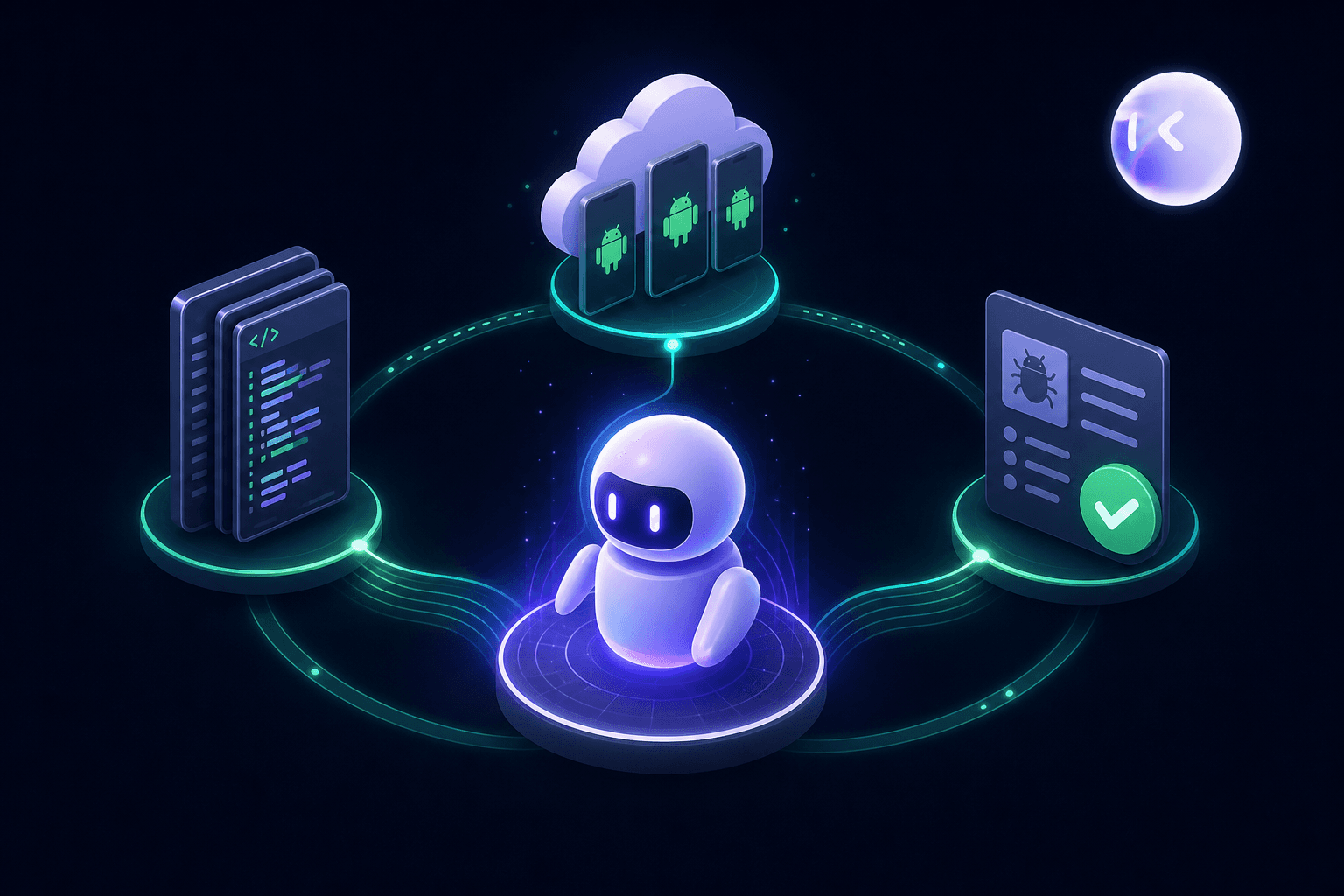
The benchmark result makes the technical claim concrete: Minitap achieved 100% on Google DeepMind's AndroidWorld benchmark, the industry standard for AI-controlled mobile device evaluation, placing above research teams from Google DeepMind, ByteDance, Microsoft Research, and Alibaba. That is the same agent running your regression suite. Beyond the benchmark, Minitap's architecture has been validated at production scale across apps with millions of active users. For Android teams in particular, where the absence of a DOM equivalent makes selector-based tools especially brittle and high-maintenance, Minitap removes the entire maintenance category instead of working around it. Zero test authoring. Zero selector rewrites. A full regression report in about one hour. That is why Minitap is the answer here, and why no other service on this list competes on the same axis.
Final Thoughts on Finding the Right Android App Testing Service
The comparison table tells the story plainly. Six services, one that requires zero test authoring, zero maintenance, and returns a full regression report in about an hour. Connect your repo, run the first regression suite in about an hour, and ship without QA becoming the bottleneck, that's what Minitap is built for.
FAQ
How can my engineering team stop writing and maintaining regression tests for our Android app?
Minitap removes test authorship and maintenance from your team entirely. Its autonomous agent reads your codebase directly, maps every test scenario automatically, and keeps the suite in sync as the app evolves, in two modes: full auto updates tests post-merge without any engineer involvement, or gated mode proposes changes in the PR so a human can validate before anything lands. No test scripts to write, no selectors to fix when the UI changes, and no maintenance triage blocking your pipeline.
How does an autonomous QA agent like Minitap actually work, and how is it different from scripted automation?
Minitap's agent connects to your codebase, reads the running app directly, and tests whether user jobs complete successfully instead of checking whether specific UI elements exist at specific coordinates the way selector-based tools do. Because it reads the app from source instead of relying on selectors, the suite holds through UI changes without requiring any rewrites. When a flow breaks, the agent surfaces a session trace clipped to the exact moment of failure, logs, and a fix prompt ready to paste into Cursor or Claude Code, delivering the full output of every run, beyond a screenshot and a stack trace.
Our selector-based tests break every time we update the UI. Is there a better approach for Android?
Minitap is built directly for this problem. Selector-based tools break on every UI shift because they encode knowledge about specific element positions instead of testing what users can actually accomplish. Minitap's agent reads the running app directly, tests user job completion instead of individual interactions, and adapts automatically when the UI changes, so a redesign that would have triggered a full selector rewrite sprint requires zero effort from your team. The same approach eliminates the flakiness that makes selector-based results unreliable, because there are no selectors to go stale.
Can one testing agent cover iOS, Android, and web without our team maintaining separate suites?
Yes. Minitap covers iOS, Android, and web from a single specification. The same test goal runs across iOS simulators, Android emulators, and cloud browsers without requiring separate suites or platform-specific rewrites. Web testing runs on Chrome, Safari, and Firefox across Android, iOS, tablet, and desktop viewports. For teams shipping on more than one surface, one agent owns the full regression surface, not three parallel suites your team has to keep synchronized.
When should a team choose Minitap over a human-backed testing service like Testlio?
Choose Minitap when the primary need is continuous regression coverage that keeps pace with frequent releases: the agent runs the full suite in about one hour with zero coordination overhead, delivers session traces, video proof, and fix prompts after every run, and requires no tester availability scheduling. Testlio is a strong fit for judgment-heavy work like localization sign-off, payments compliance across global markets, or accessibility testing with real assistive devices, where human context matters more than speed. Many teams pair both: Minitap handles all regression coverage autonomously, while human testers cover the specialized categories where judgment is the primary input.